
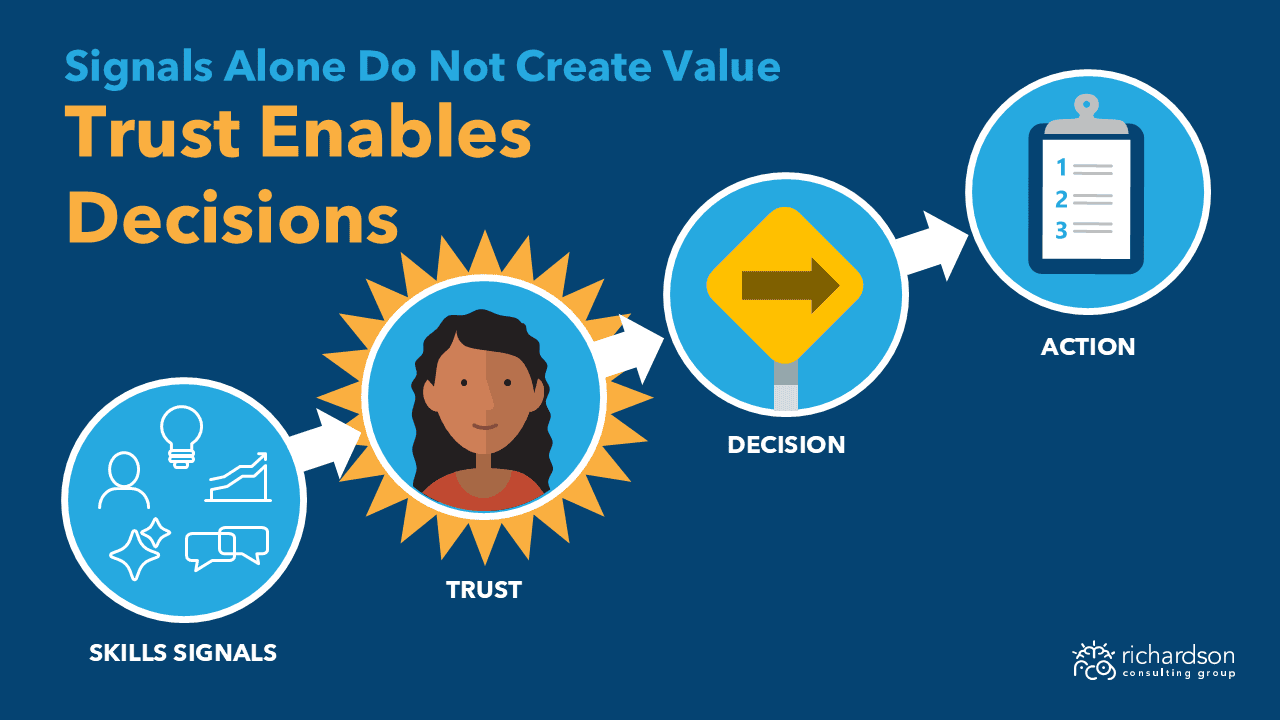
Many organizations assume the biggest barrier to AI-powered skills systems is data quality.
In practice, the bigger challenge is trust.
Leaders do not act on signals they cannot explain.
Managers do not trust recommendations they cannot defend.
Employees do not embrace systems they believe are making assumptions about them behind the scenes that they can’t validate or refute.
And organizations do not operationalize intelligence they cannot govern.
This is why many skills initiatives stall even when the technology works exactly as designed.
The challenge is not generating intelligence.
The challenge is building confidence in that intelligence.
As organizations increasingly invest in AI-powered skills platforms, talent marketplaces, workforce planning tools, and skills inference engines, a new question is emerging:
What makes a skills signal trustworthy enough to influence workforce decisions?
The answer is not simply more data or higher accuracy.
It is trust.
From the Field
One pattern I see repeatedly across enterprise skills initiatives:
The phrase “AI inferred this skill” often lowers confidence rather than increasing it.
The reaction is rarely:
“Great. Now we have more data.”
Instead, leaders immediately begin asking:
- How did the system determine that?
- What signals were used?
- How current is the information?
- How much confidence should we place in this conclusion?
- What happens if the inference is wrong?
- Can we explain this recommendation to employees?
The issue is not whether the inference is correct.
The issue is whether stakeholders trust it enough to act on it.
And that distinction matters.
Because workforce intelligence only creates value when it influences decisions.
The Accuracy Trap
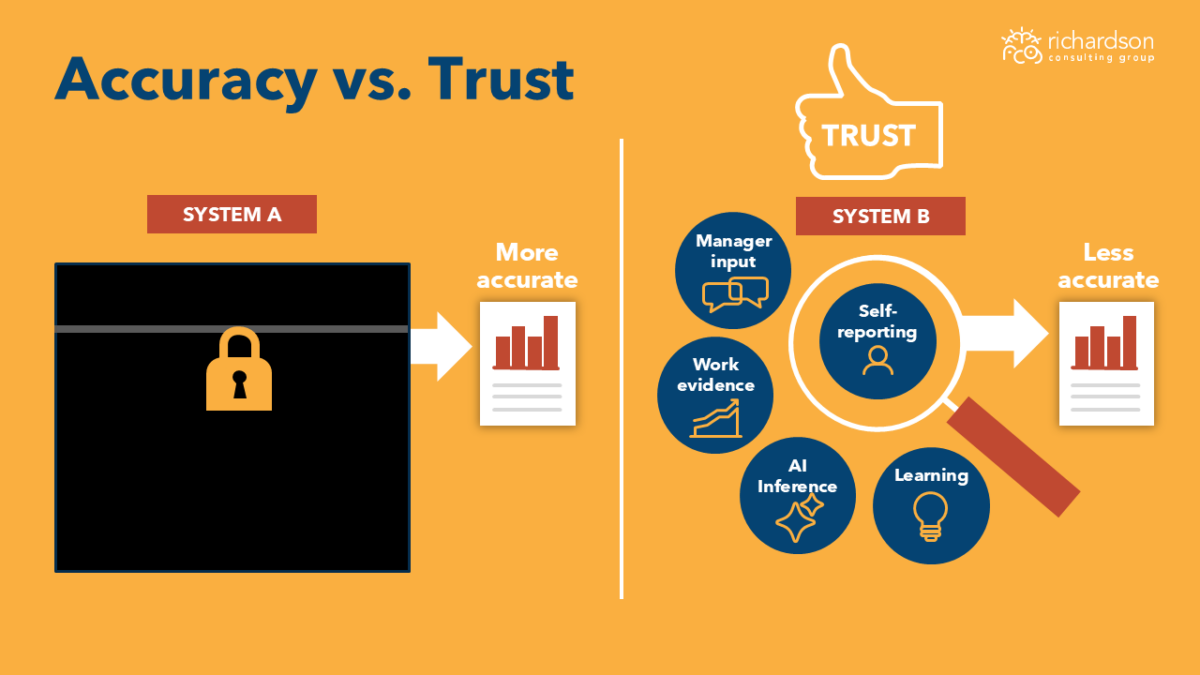
Many organizations pursue trust by pursuing accuracy.
The logic seems straightforward:
Better data → Better intelligence → Greater trust
In practice, people often trust:
- transparent systems with moderate accuracy
more than:
- opaque systems with high accuracy
Why?
Because they can understand how the conclusion was reached.
They can evaluate the evidence.
They can challenge assumptions.
They can defend the outcome.
In enterprise environments, explainability often matters as much as accuracy.
Sometimes more.
This is particularly true when skills intelligence begins influencing decisions related to:
- Hiring
- Internal mobility
- Workforce planning
- Succession
- Development investments
- AI readiness
The higher the impact of the decision, the more important trust becomes.
People Trust Conclusions They Can Interrogate
One of the most important principles in workforce intelligence is surprisingly simple:
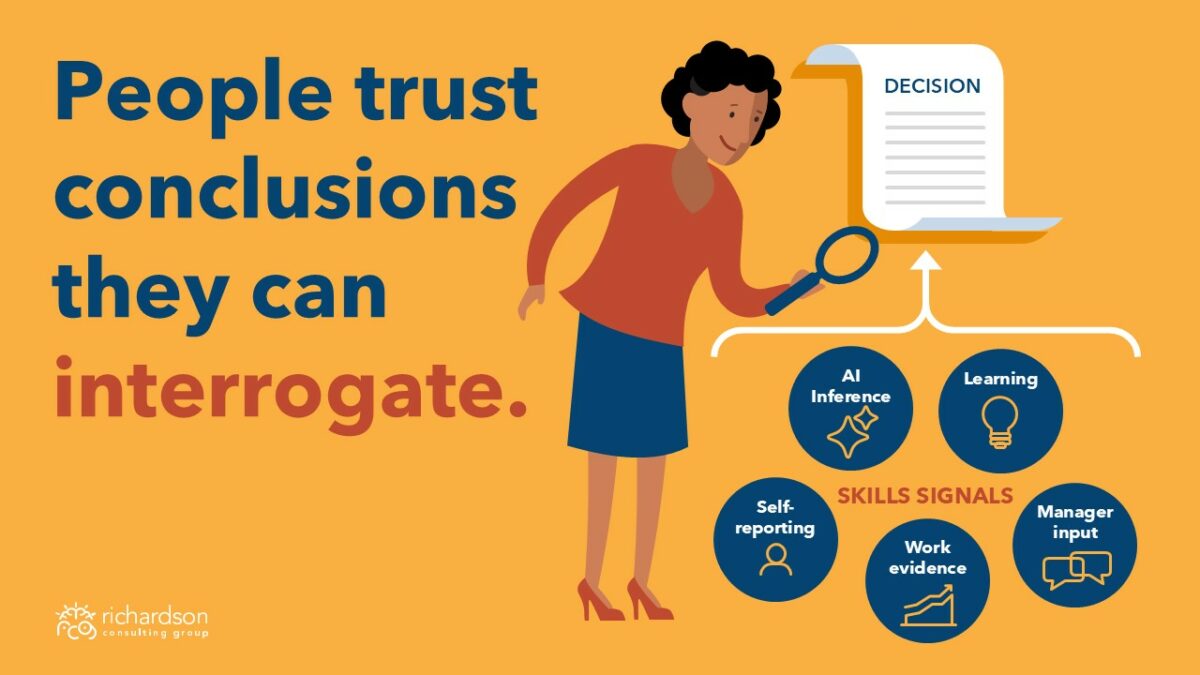
People trust conclusions they can interrogate.
When leaders review a recommendation, they want to understand:
- What signals were used?
- How recent are those signals?
- How much weight was assigned to each source?
- What evidence supports the recommendation?
- How confident is the system?
- Can someone audit the conclusion?
These questions are not signs of resistance.
They are signs of responsible governance.
Organizations that scale workforce intelligence successfully do not eliminate scrutiny.
They design for it.
Because trust is not built by asking people to believe the system.
Trust is built by giving people visibility into how the system works.
Why “Inferred Skills” Creates Tension
Many skills platforms rely heavily on inference.
The system analyzes available signals and estimates the likelihood that an individual possesses a particular skill.
The challenge is that “inference” often sounds like assumption.
For many stakeholders, the phrase:
“The AI inferred these skills.”
raises immediate concerns.
Was the inference based on:
- outdated data?
- incomplete information?
- irrelevant signals?
- flawed assumptions?
Could the recommendation be biased?
Could it be wrong?
Could it be impossible to explain?
These are reasonable and obvious questions.
And organizations ignore them at their peril.
Because the issue is not whether inference should be used.
Inference is important and useful as part of an overall skills data strategy.
The issue is whether inference is transparent enough to earn trust.
A low-trust signal looks like this:
“The system inferred these skills.”
A higher-trust signal looks very different:
“The system inferred these skills based on project history, learning activity, manager validation, and demonstrated work outcomes. Confidence level: 82%.”
The difference is not the intelligence.
The difference is the transparency.
Introducing Confidence Architecture
Most organizations invest heavily in:
- taxonomies
- skills graphs
- AI capabilities
- data integrations
- workforce analytics
Far fewer invest intentionally in what I call:
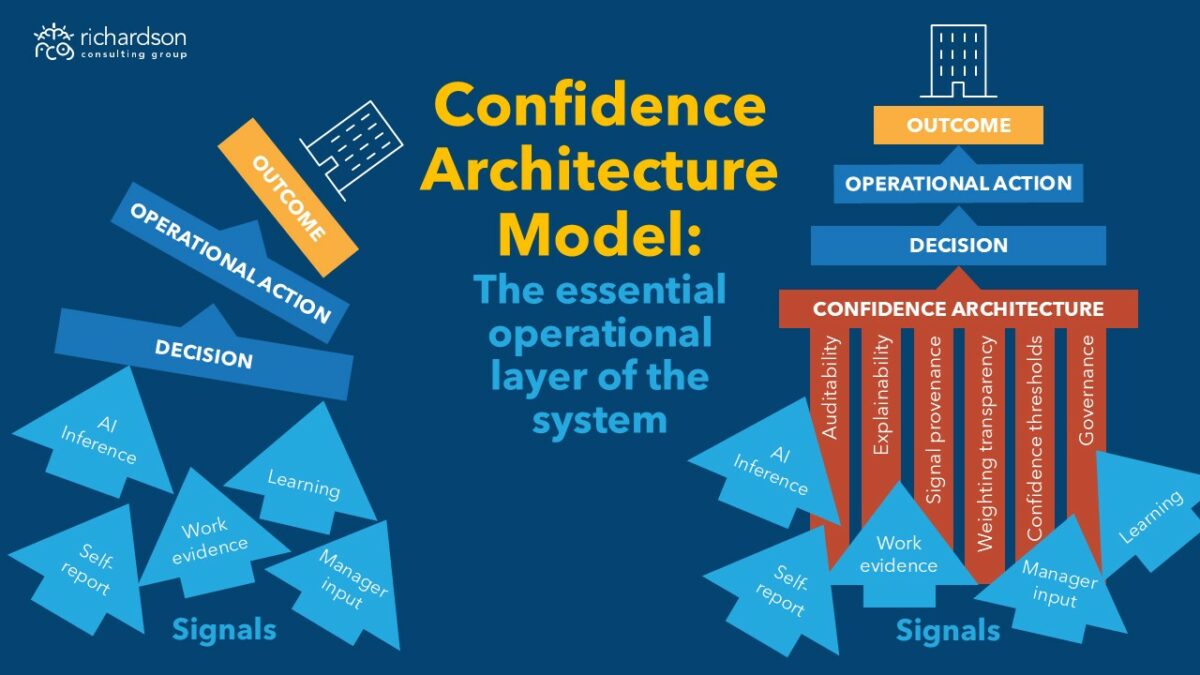
Confidence Architecture
Confidence Architecture is the collection of structures that allow workforce intelligence to become trusted, governable, and actionable.
It includes:
- signal provenance
- explainability
- auditability
- weighting transparency
- confidence scoring
- review processes
- escalation paths
- governance mechanisms
Confidence Architecture answers the question:
“Why should I trust this signal?”
Without it, organizations often create intelligence that nobody fully trusts.
And intelligence that nobody trusts rarely changes decisions.
Why Signal Triangulation Matters
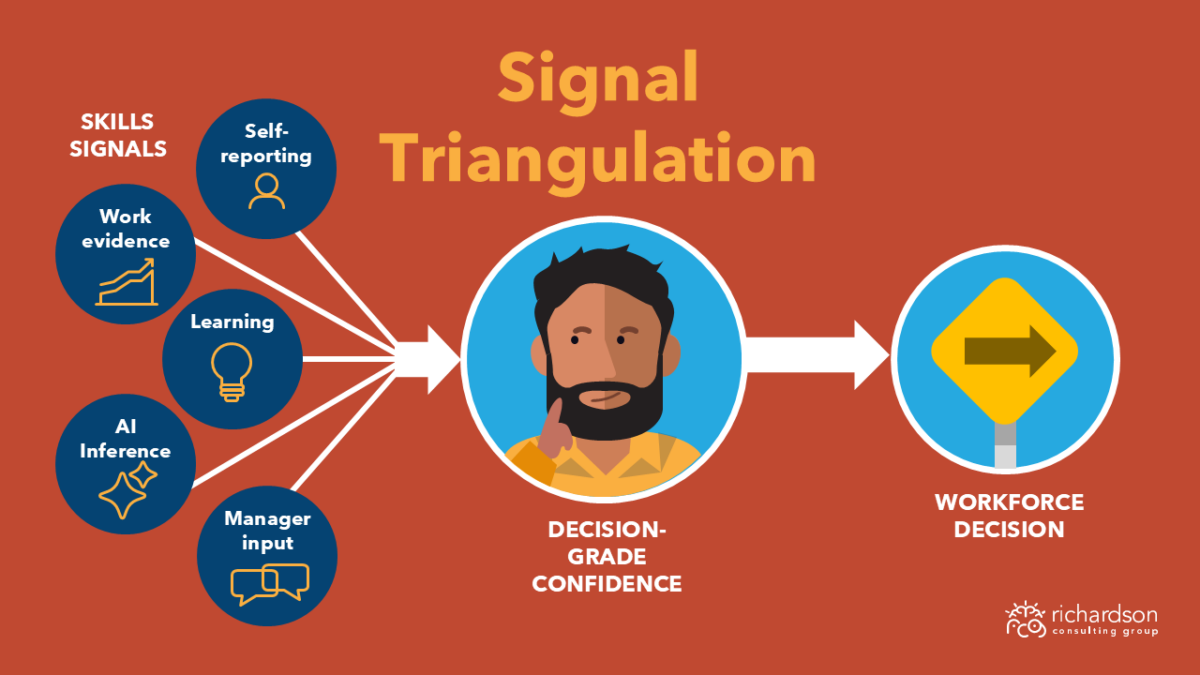
Many skills discussions become debates between competing signal sources.
Should organizations trust:
- self-assessments?
- manager assessments?
- AI inference?
- learning records?
The answer is all of them.
Because no signal is perfect.
Self-assessments introduce self-reporting bias.
Manager assessments introduce observational bias.
Inference introduces explainability concerns.
Learning records demonstrate activity, not necessarily capability.
The goal is not identifying the perfect signal.
The goal is combining imperfect signals intelligently.
This is where trust begins to scale.
When Signals Agree
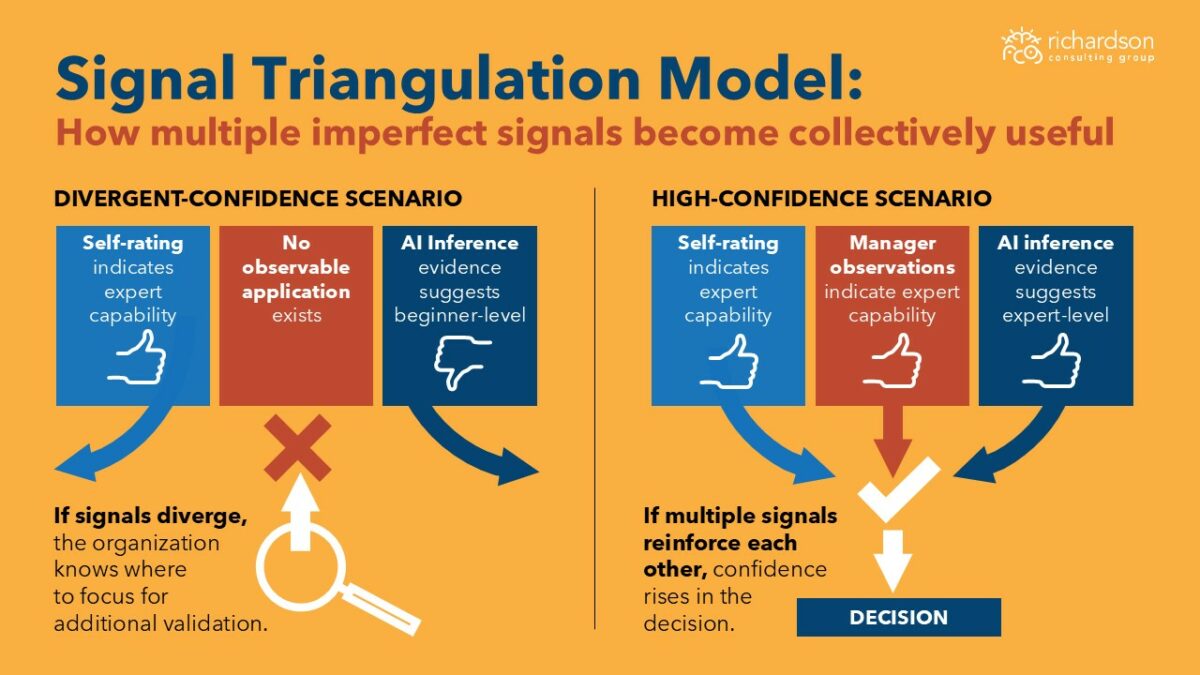
Imagine the following scenario:
- Self-rating indicates advanced capability.
- AI inference identifies strong supporting evidence.
- Relevant learning activity exists.
- Manager observations align.
- Work outcomes support the conclusion.
Confidence rises naturally.
Not because any one signal is perfect.
Because multiple signals reinforce one another.
This creates stronger evidence and stronger trust.
When Signals Diverge
Now imagine a different situation:
- Self-assessment indicates expert capability.
- AI inference suggests beginner-level proficiency.
- No demonstrated work evidence exists.
Many organizations view this as a problem.
In reality, it is valuable information.
Signal disagreement identifies uncertainty.
It highlights where additional validation should occur.
Organizations can:
- review source data
- gather additional evidence
- involve managers
- conduct targeted assessments
- refine confidence thresholds
Divergence is not failure.
It is a governance opportunity.
One of the most powerful capabilities of workforce intelligence systems is not confirming what we know.
It is revealing what we do not know confidently.
Decision-Grade Confidence
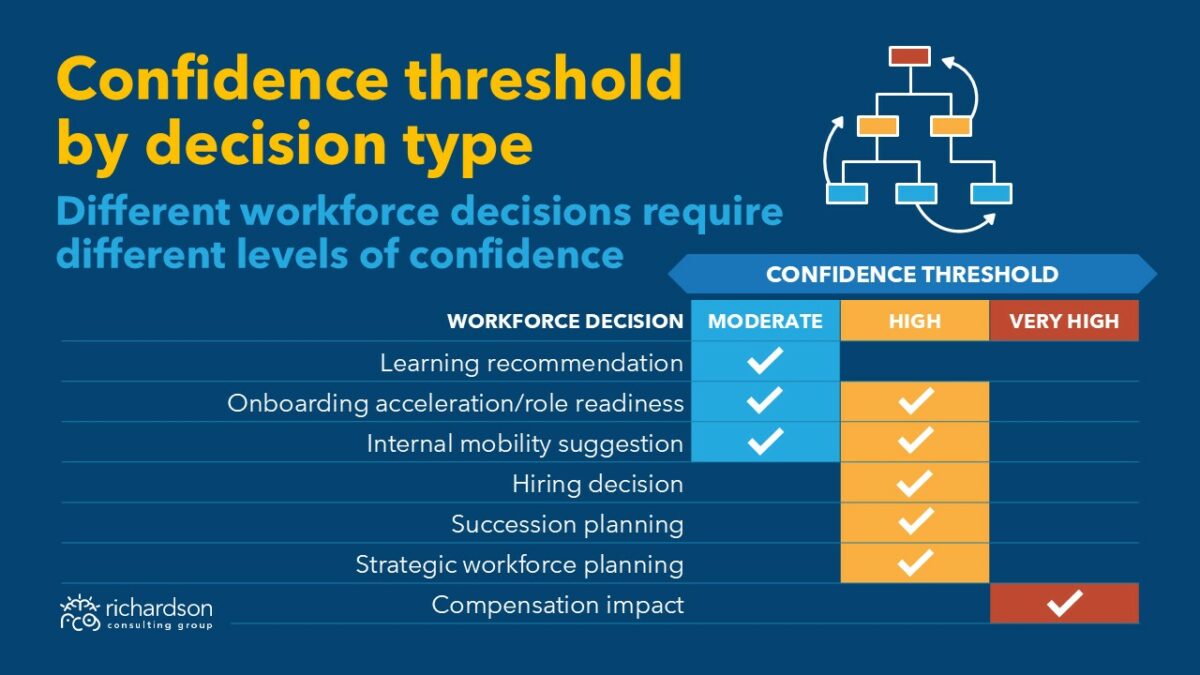
Not every workforce decision requires the same level of confidence.
A learning recommendation may require moderate confidence.
An internal mobility recommendation may require more.
A strategic workforce planning decision may require significantly more.
A succession decision may require greater scrutiny.
Organizations often make the mistake of pursuing one universal confidence standard.
A more practical approach is defining confidence thresholds based on the decision being enabled.
I call this:
Decision-Grade Confidence
The goal is not perfect certainty.
The goal is achieving sufficient confidence for the decision being made.
That distinction allows organizations to move faster while maintaining appropriate governance.
Trustworthy Workforce Intelligence
The future of workforce intelligence will not be determined by which organizations generate the most signals.
It will be determined by which organizations generate the most trust.
Trustworthy workforce intelligence is:
- transparent
- explainable
- auditable
- governable
- confidence-aware
It helps leaders understand both:
What the system believes
and
Why the system believes it.
That distinction matters.
Because leaders do not operationalize intelligence they cannot explain.
And organizations do not scale systems they cannot govern.
The next generation of skills intelligence will not be built on perfect data.
It will be built on trustworthy decisions.
Looking Ahead
In the first article in this series, I argued that many skills pilots fail because they validate data and technology before validating workforce decisions.
In the next article, we’ll explore another missing component:
The Decision Layer
The governance, ownership, confidence thresholds, and operating rhythms that connect skills intelligence to workforce action.
Because even trusted intelligence creates little value if organizations have not defined how decisions will be made.