
Most enterprise skills pilots fail for the same reason:
They validate data and technology before validating workforce decisions.
Organizations spend months piloting:
- skills taxonomies
- job architectures
- AI inference engines
- dashboards
- profile completion
- talent marketplaces
- ontology structures
- workforce analytics platforms
Yet many never operationalize skills at enterprise scale.
Why?
Because the real challenge is not generating skills intelligence.
The real challenge is building enough organizational trust, governance, and operational clarity for leaders to act with confidence.
That is the difference between a pilot that becomes an operating model and a pilot that becomes another abandoned dashboard.
Most Organizations Are Piloting the Wrong Things
When organizations launch a “skills pilot,” they often believe they are testing:
- the technology
- the data model
- the AI
- the skill model
- the user experience
But that is not what determines whether skills actually scale operationally.
What organizations are really piloting is something much more important:
A repeatable workforce decision cycle powered by skills signals.
That distinction matters.
Because value is not created when skills data exists.
Value is created when leaders can:
- trust the signals,
- make decisions faster and with greater confidence,
- and operationalize those decisions consistently over time.
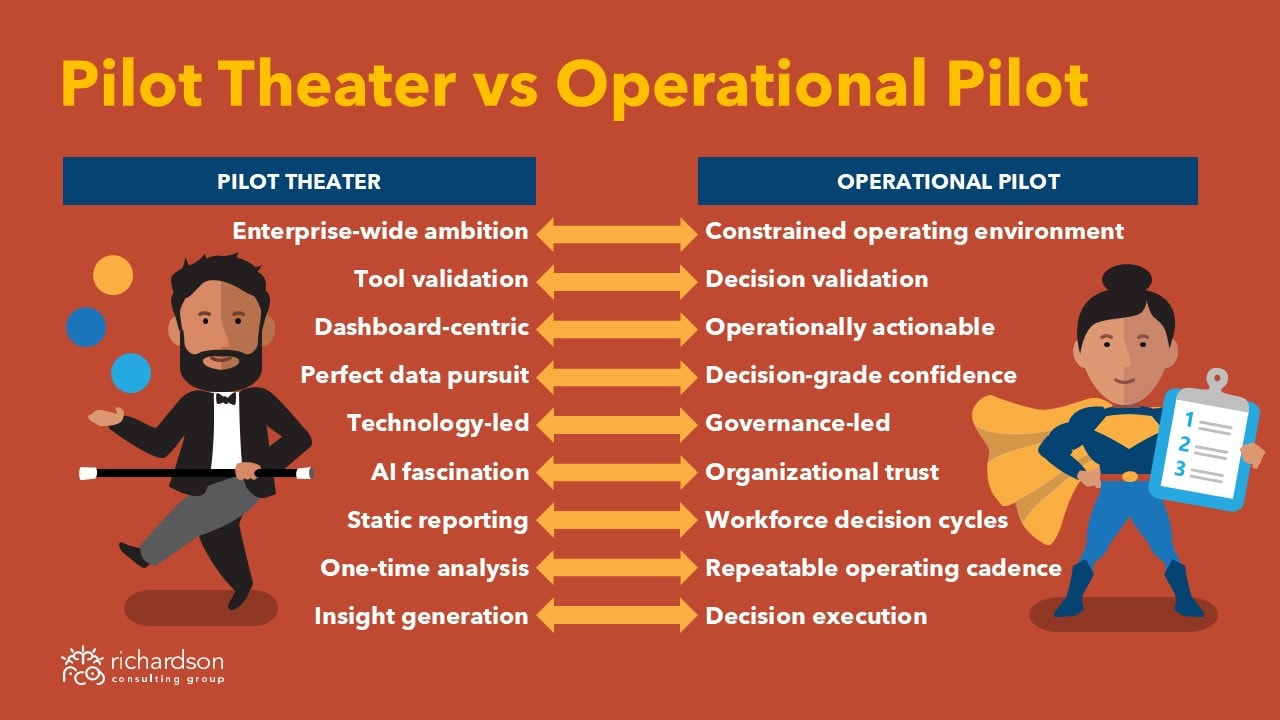
A dashboard is not a pilot.
A completed taxonomy is not a pilot.
An AI-generated skills graph is not a pilot.
A pilot exists to determine whether the organization can reliably use skills intelligence to improve workforce decisions.
The Problem With “Pilot Theater”
Many enterprise skills initiatives get stuck in what I call Pilot Theater.
Pilot Theater creates activity without producing operational capability.
The organization becomes consumed with:
- refining taxonomies,
- harmonizing data structures,
- debating platforms,
- improving profile completion,
- validating AI inference quality,
- or expanding scope before operational patterns exist.
The results are predictable:
- the pilot becomes larger,
- the architecture becomes more complex,
- governance becomes less clear,
- and nobody is entirely sure what operational changes or improvements result from the pilot.
The organization can see the signals.
But nobody knows what decisions those signals are intended to enable—or what actions should consistently follow.
This is why many skills pilots never move beyond “interesting experiment.”
They generate insight without generating operational behavior.
The “Perfect Data” Trap
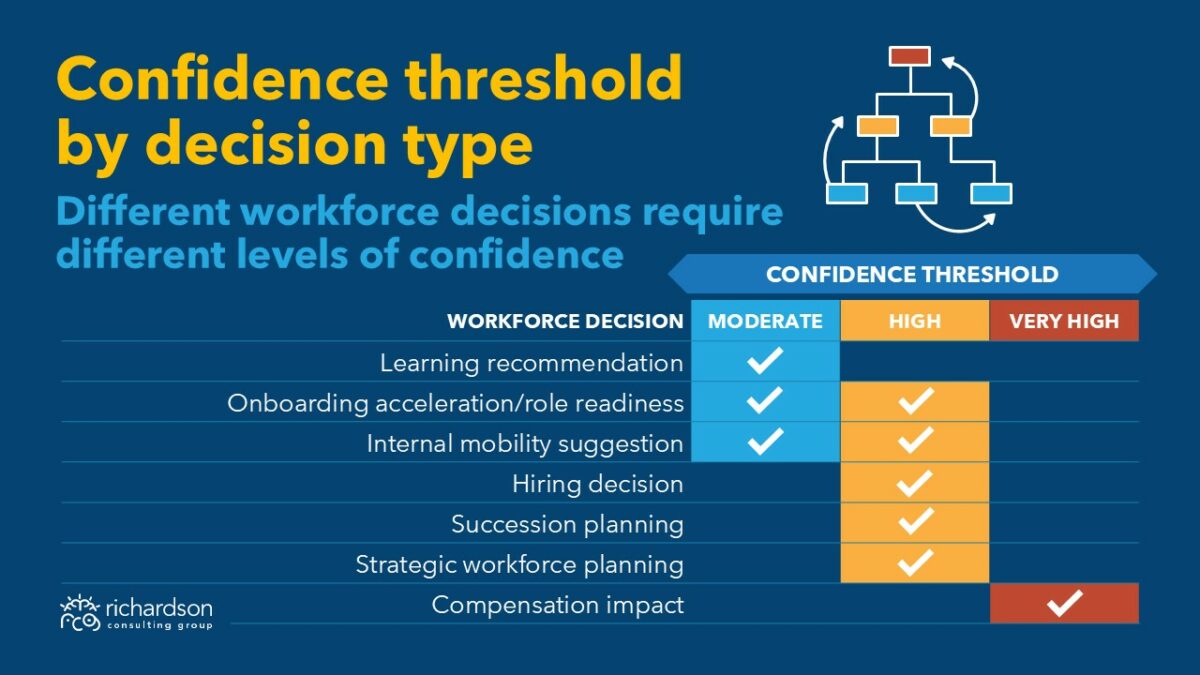
One of the most common failure patterns in enterprise skills work is waiting for perfect data before enabling decisions.
Organizations delay action because:
- profile completion is inconsistent,
- skills are self-reported,
- AI inference confidence is low,
- taxonomies are incomplete,
- systems are not fully harmonized,
- or leadership lacks confidence in the signals.
These concerns are legitimate.
But they also create paralysis.
Enterprise workforce systems never achieve perfect confidence.
The real question is not:
“Is the data perfect?”
The real question is:
“Is the data sufficient to make a confident decision?”
That is a fundamentally different operating philosophy.
Organizations that scale successfully do not wait for perfect signals.
They define decision-grade confidence:
- enough confidence to act responsibly,
- enough transparency to build trust,
- and enough governance to improve signal quality iteratively over time.
This shifts the organization from:
- static validation to
- operational learning.
Trust Is the True Scaling Constraint
Most organizations assume the biggest barrier to AI-powered skills systems is data quality.
In practice, the larger issue is trust.
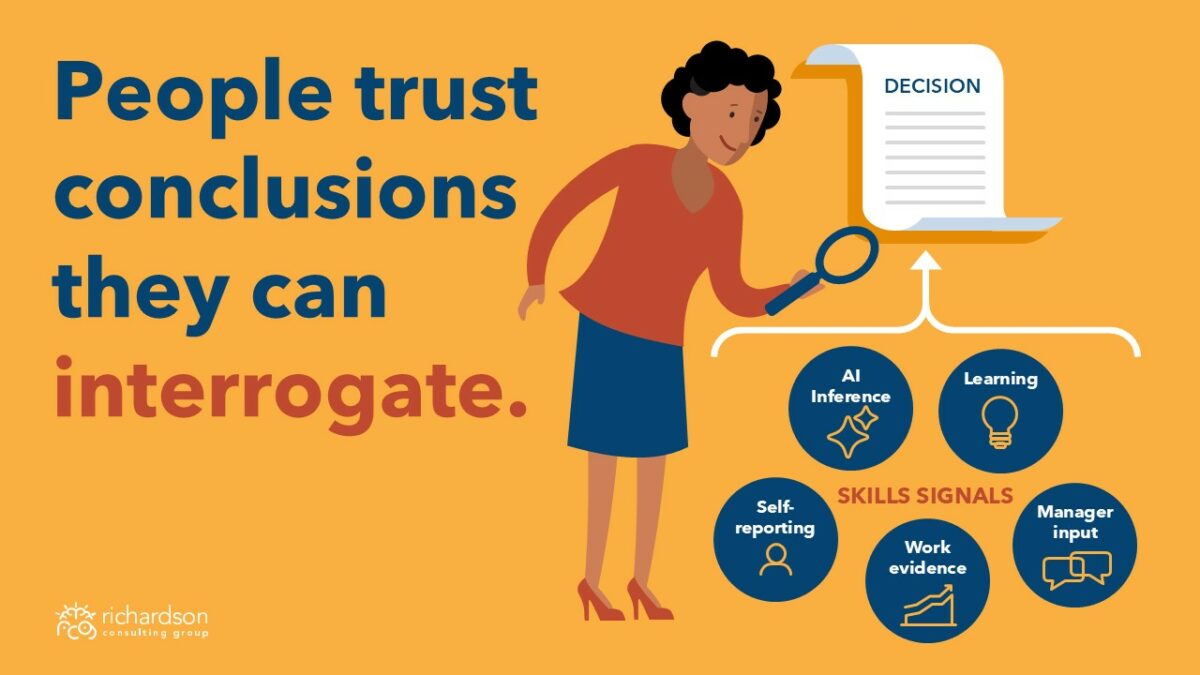
Leaders do not operationalize signals they cannot:
- explain,
- interrogate,
- defend,
- or confidently communicate to others.
This is where many “AI-powered” skills systems unintentionally create resistance.
A list of “inferred skills” often signals:
“AI made assumptions about people.”
And in many organizations, that immediately raises questions:
- Was the inference based on incomplete data?
- Was the source current?
- Was the weighting logic reasonable?
- Could the system hallucinate capability?
- What evidence supports the recommendation?
- Can anyone audit how the conclusion was reached?
The issue is not whether the inference is correct.
The issue is whether stakeholders trust the inference enough to act on it.
This is why explainability matters so much.
A low-trust signal looks like this:
“The AI inferred these skills.”
A higher-trust signal looks very different:
“Here are the signals used, how they were weighted, the confidence level assigned, and the validation sources available.”
That changes the interaction entirely.
People trust conclusions they can interrogate.
And organizations scale systems they can govern.
Confidence Architecture: The Missing Layer
Most organizations focus heavily on:
- generating signals,
- improving AI,
- expanding taxonomies,
- and integrating platforms.
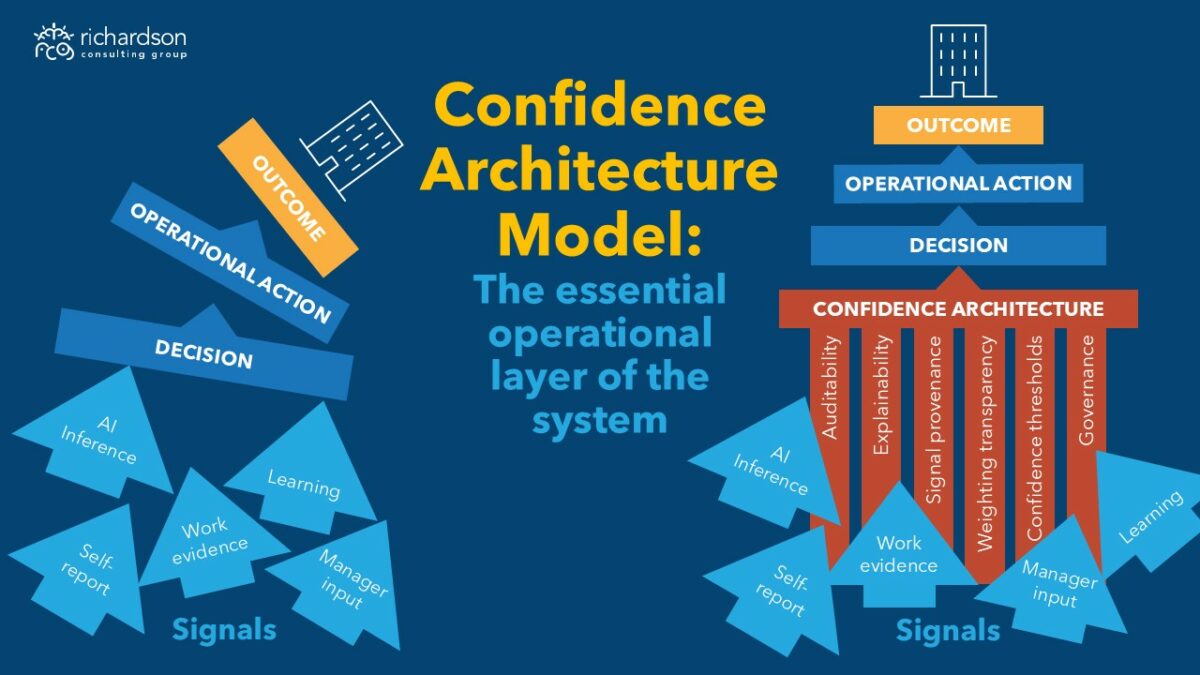
Far fewer focus intentionally on designing Confidence Architecture.
Confidence Architecture includes:
- explainability,
- auditability,
- signal provenance,
- weighting transparency,
- confidence scoring,
- escalation paths,
- and governance mechanisms for reviewing conflicting signals.
This layer is critical because enterprise workforce decisions are rarely based on a single “perfect” signal.
They rely on confidence built through triangulation.
Why Signal Triangulation Matters
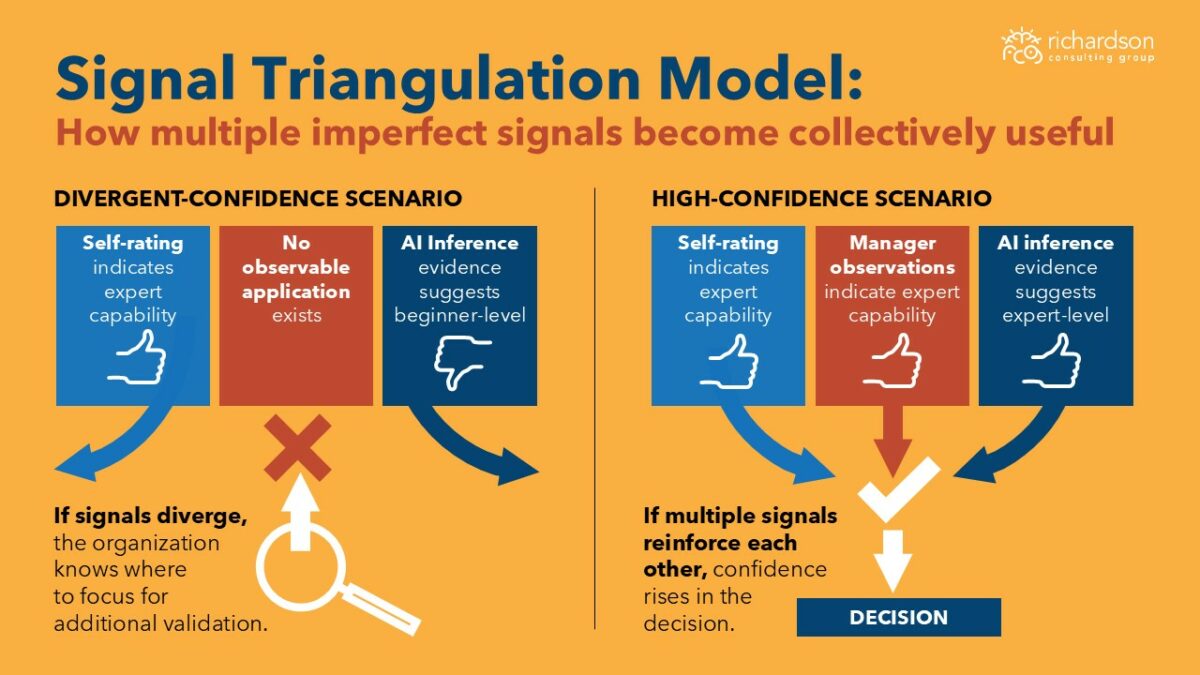
Many organizations treat self-assessment and AI inference as competing approaches.
That is the wrong framing.
Both have limitations:
- self-assessment introduces self-reporting bias and low rating hesitancy,
- inference introduces explainability and transparency concerns.
But together, they become more powerful.
The goal is not to eliminate imperfect signals.
The goal is to combine signals in ways that increase confidence responsibly over time.
For example:
High-confidence scenario
- self-rating indicates advanced capability,
- AI inference identifies consistent behavioral evidence,
- learning completion exists,
- and manager observations align.
Confidence becomes relatively strong because multiple signals reinforce one another.
Divergent-confidence scenario
- self-rating indicates expert capability,
- inference suggests beginner-level evidence,
- and no observable application exists.
Now the organization knows where to focus:
- review the signal sources,
- gather additional evidence,
- involve manager validation,
- or reassess confidence thresholds.
This is operationally valuable.
When signals agree, confidence rises.
When signals diverge, organizations know where to focus additional validation.
That is far more useful and practical than pretending any individual signal source is perfectly reliable.
What Effective Skills Pilots Actually Validate
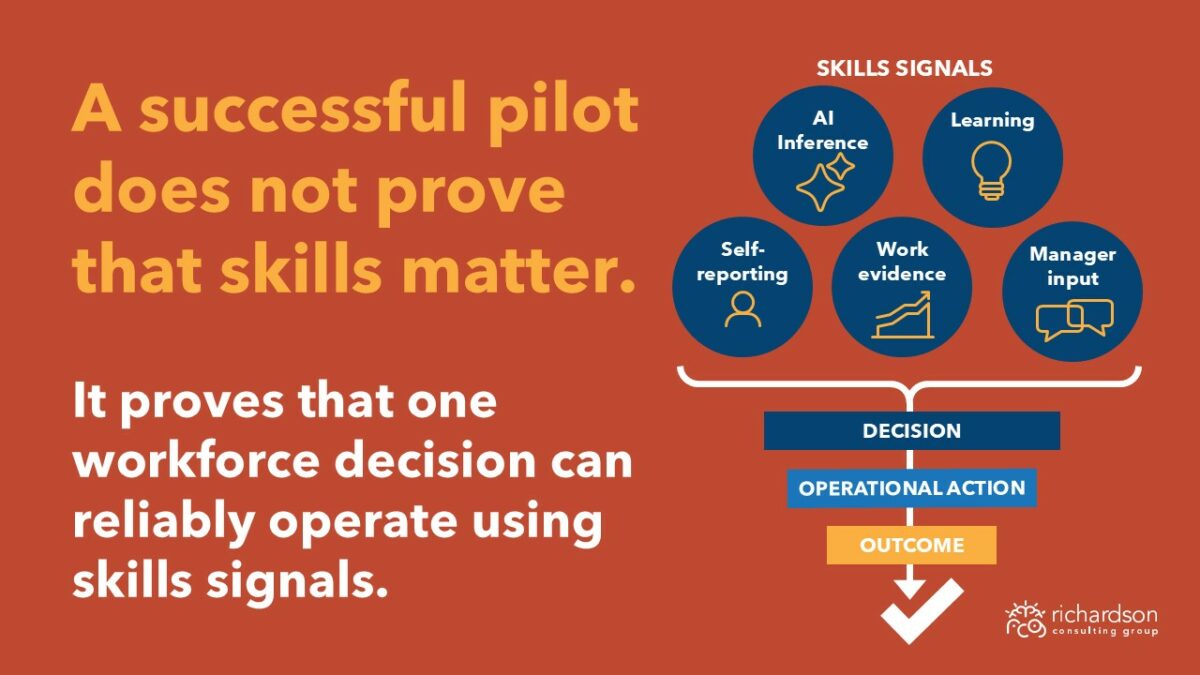
Effective skills pilots do not prove that skills “matter.”
They prove that one workforce decision can reliably operate using skills signals.
That is the real objective.
Strong pilots validate:
- decision quality,
- decision velocity,
- governance effectiveness,
- operational cadence,
- confidence thresholds,
- and organizational trust.
Weak pilots validate:
- dashboard functionality,
- taxonomy completeness,
- AI sophistication,
- profile completion,
- or platform features in isolation.
The difference is substantial.
The Operational Pilot Model
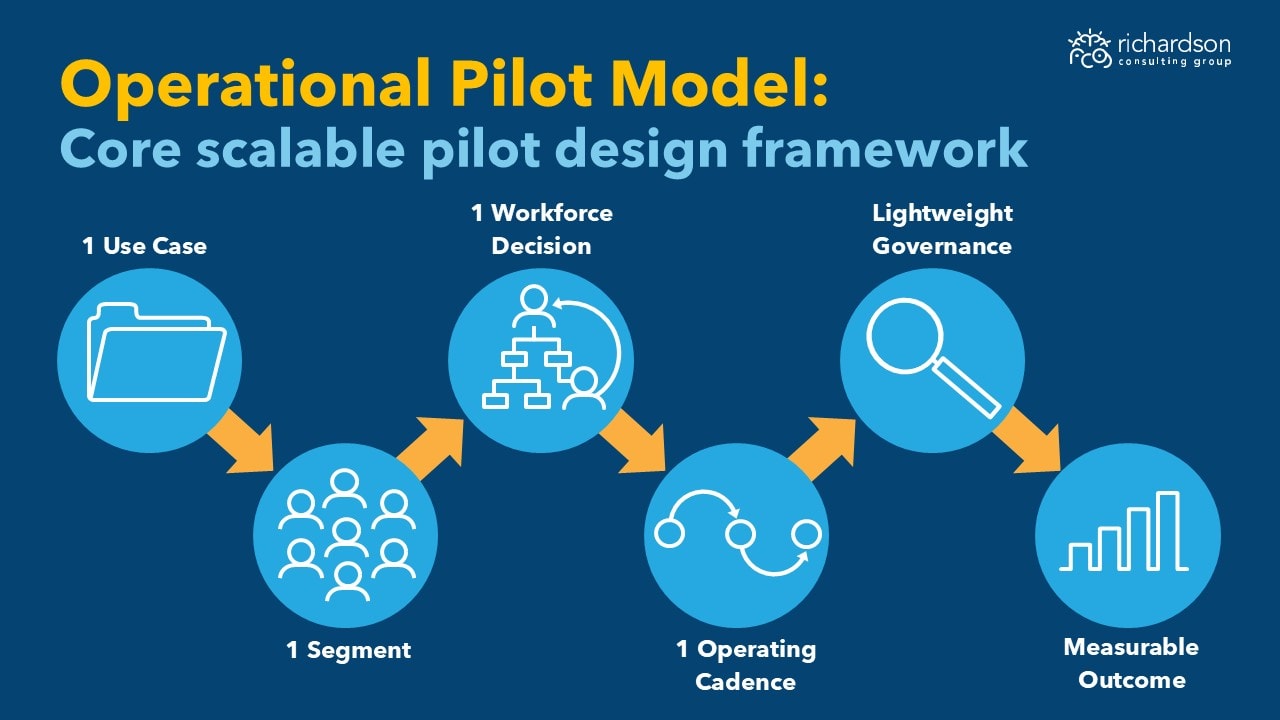
The most effective enterprise pilots are usually much smaller and more focused than organizations expect.
A scalable pilot typically includes:
1 Use Case
Not “skills transformation.”
One workforce decision.
Examples:
- build vs. buy workforce decisions,
- internal mobility readiness,
- workforce planning,
- succession risk identification.
1 Segment
A constrained environment.
Not enterprise-wide deployment.
Examples:
- a corporate function,
- a digital team,
- a business unit,
- a leadership population.
1 Decision
The specific decision being enabled must be explicit.
For example:
“Should we reskill internally or hire externally for emerging AI capability gaps?”
That is operationally actionable.
1 Operating Cadence
A recurring rhythm for:
- reviewing signals,
- interpreting confidence,
- making decisions,
- and adjusting governance.
Without cadence, pilots become one-time analyses instead of operating systems.
Lightweight Governance
Not massive committees.
Just enough structure to define:
- ownership,
- escalation,
- confidence thresholds,
- and accountability.
Measurable Outcomes
Success should be measured through:
- decision speed,
- decision quality,
- workforce visibility,
- confidence,
- and operational action.
Not simply data completeness.
What Scalable Pilots Actually Produce
The most valuable outcome of a pilot is not technology validation.
It is organizational capability.
Strong pilots produce:
- reusable governance patterns,
- operational trust,
- confidence models,
- scalable decision frameworks,
- and repeatable workforce operating rhythms.
They teach the organization:
- how to make decisions with imperfect signals,
- how to govern evolving intelligence,
- and how to operationalize workforce insight responsibly over time.
A successful pilot does not prove that skills matter.
It proves that a single workforce decision can reliably operate using skill signals.
That is the foundation for scalable workforce intelligence.