
During a recent Skills Roundtable, we asked HR, Talent, and Learning leaders a simple question:
What’s the biggest barrier to making skills stick in your organization?
The answers were revealing.
It wasn’t a lack of executive interest.
It wasn’t technology.
It wasn’t even employee resistance.
Instead, participants overwhelmingly pointed to two challenges:
- Managers lack the time, confidence, or capability to support skills development.
- Skills are not integrated into existing HR and talent processes.
In other words, the problem isn’t whether organizations believe skills matter.
The problem is that skills are competing against dozens of other priorities—and often losing.
Skills Have Won the Argument
One of the most interesting observations from the discussion was that we have largely moved beyond the question of whether skills matter.
Most organizations represented in the session are already investing in some combination of:
- Skills frameworks
- Skills data
- Talent marketplaces
- Learning ecosystems
- Workforce planning initiatives
- AI-enabled skills technologies
The challenge isn’t creating awareness.
The challenge is turning awareness into action.
As one participant observed, “Everyone thinks it’s important, but it’s not their priority.”
That sentiment echoed throughout the discussion.
Leaders support skills initiatives.
Managers support skills initiatives.
Employees generally support development.
Yet many organizations still struggle to create meaningful behavior change.
The Culture Gap
Participants repeatedly described a familiar pattern.
An organization invests in a skills framework or platform.
Employees are tasked to complete profiles.
Skills data is collected.
Dashboards are built.
Then momentum fades.
Why?
Because the behaviors required to make skills useful never become part of everyday work.
Leaders don’t make different decisions.
Managers don’t have different conversations.
Employees don’t see enough personal value to stay engaged.
The result is often what participants described as “another HR initiative.”
The technology may work perfectly.
The culture doesn’t.
Where Skills Culture Breaks Down
During the discussion, participants identified four recurring breakdown points.
Leaders Support Skills, but Don’t Lead Skills
Multiple participants noted that leaders often express support for skills initiatives but fail to allocate meaningful time and attention to them.
Skills work frequently becomes delegated to HR.
The unintended consequence is that employees and managers begin viewing skills as an HR program rather than a business priority.
Participants suggested that visible leadership involvement matters more than verbal endorsement.
If leaders are not modeling behaviors, asking questions about skills, or using skills information in decision-making, employees notice.
Managers Are Overwhelmed
The strongest theme of the discussion centered on managers.
Managers were not described as resistant.
They were described as exhausted.
Participants reported that managers want to support development but struggle to fit skills conversations into already overloaded schedules.
Several participants connected this challenge to broader transformation fatigue.
Skills are often competing with AI initiatives, process changes, restructuring efforts, productivity targets, and countless other organizational priorities.
As one participant put it, managers don’t necessarily lack commitment—they lack capacity.
Employees Don’t See What’s In It For Them
Another recurring theme was employee trust and relevance.
Participants noted that employees often experience skills initiatives as something being done to them rather than for them.
Questions frequently arise:
- How will this data be used?
- Will it affect my performance evaluation?
- Will it impact my compensation?
- How does this help my career?
- When am I supposed to do this work?
Without clear answers, participation often feels like compliance rather than opportunity.
Organizations that successfully activate skills culture appear to do a better job communicating both the benefits of participation and the consequences of non-participation.
HR Must Create Alignment and Tell a Better Story
Participants also highlighted challenges within HR itself.
Skills means different things to different functions.
Talent acquisition, learning, workforce planning, compensation, and performance management often approach skills from different perspectives.
The result can be fragmented initiatives, inconsistent language, and competing priorities.
Several leaders emphasized that HR’s role extends beyond process design.
HR must also tell a compelling story about why skills matter and how employees benefit.
Without that narrative, adoption suffers.
The Most Important Insight: Integration Beats Enthusiasm
One of the strongest conclusions from the discussion was that successful skills cultures don’t require more enthusiasm.
They require more integration.
Participants repeatedly emphasized that skills cannot become a separate workflow.
They must become part of existing workflows.
This means embedding skills into:
- One-on-one conversations
- Goal setting
- Performance discussions
- Talent reviews
- Career planning
- Internal mobility decisions
- Learning activities
When skills become integrated into activities people are already doing, adoption becomes more sustainable.
When skills require additional processes, additional meetings, or additional systems, engagement declines.
What Would Create Momentum Right Now?
When participants were asked which behavior would create the most momentum over the next 90 days, one answer stood out:
Managers discussing skills during one-on-one and development conversations.
This finding is important because it shifts the conversation away from technology and toward behavior.
Organizations do not need new platforms to strengthen their skills culture.
Many may simply need better conversations.
The discussion suggested that one of the highest-leverage actions organizations can take is helping managers connect skills to existing coaching, development, and performance conversations.
The Path Forward
The roundtable reinforced a lesson we’ve seen across many organizations.
Skills strategies rarely fail because of taxonomies.
They rarely fail because of platforms.
And they never fail because employees oppose development.
They fail because organizations underestimate the behavior change required to make skills useful.
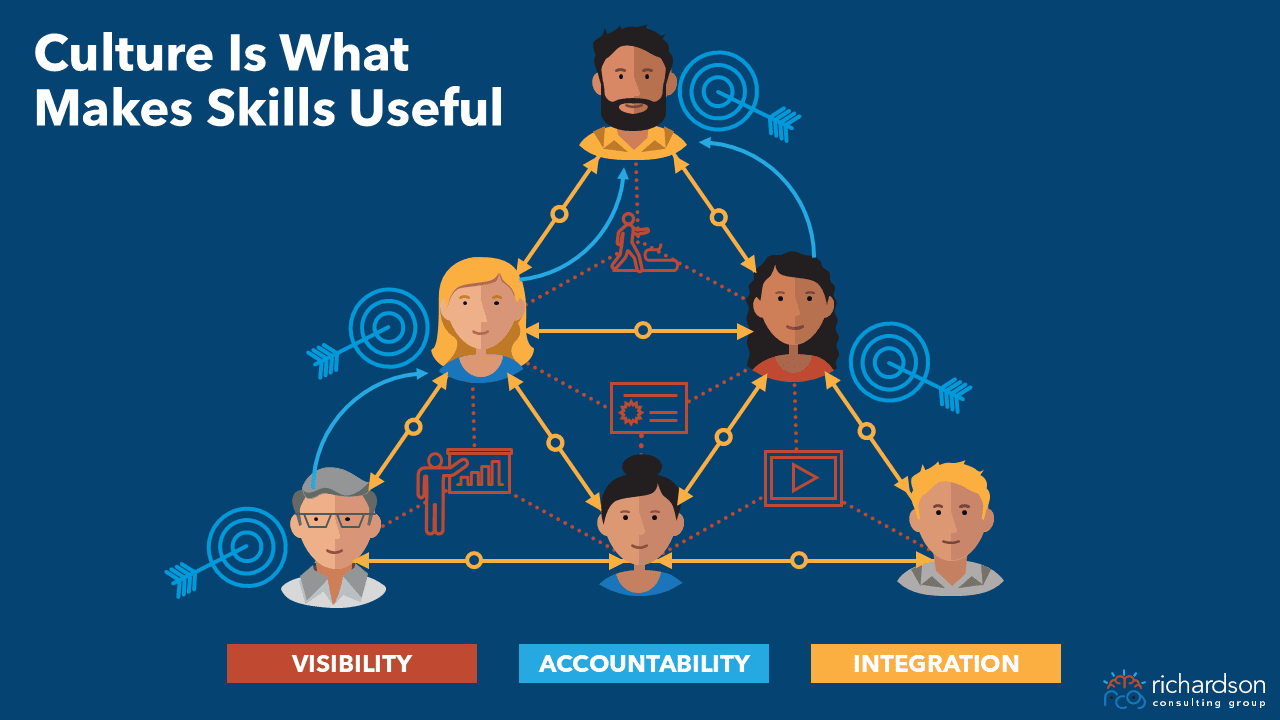
A skills culture emerges when:
- Leaders visibly prioritize skills.
- Managers incorporate skills into everyday conversations.
- Employees understand the personal value.
- HR aligns processes and tells a consistent story.
Most importantly, skills stop being treated as a separate initiative and start becoming part of how work gets done.
That’s when skills begin to stick.
Join the peer conversation on enterprise skills strategy.
The Enterprise Skills Advisory Circle is a curated forum for HR, Talent, L&D, and Workforce Planning leaders actively working through the practical realities of scaling skills strategy.
Participants receive early access to monthly Skills Roundtables, peer-level discussions, and occasional frameworks and tools focused on governance, data, technology, adoption, and workforce planning.