
Practical lessons from enterprise HR, Talent, and Learning leaders on improving skills data quality, adoption, and decision-making.
Organizations everywhere are investing in skills data.
But many are discovering the same hard truth:
Collecting skills data is relatively easy.
Getting leaders to trust it enough to use it is much harder.
That tension drove a recent Skills Roundtable hosted by Richardson Consulting Group, where HR, Talent, Learning, and workforce leaders discussed what actually makes skills data useful, actionable, and credible inside organizations.
The conversation covered:
- AI-inferred skills
- Self-assessment limitations
- frontline and technical workforce challenges
- governance and ownership
- taxonomy design
- skills validation
- workforce decision-making
One theme surfaced repeatedly:
Skills data only becomes valuable when it improves real workforce decisions.
Why Skills Data Matters More Than Ever
Organizations pursuing skills-based strategies are trying to solve increasingly practical business problems:
- Improving workforce agility
- Reducing dependence on external hiring
- Accelerating onboarding
- Increasing internal mobility
- Supporting workforce planning
- Identifying hidden expertise
- Improving staffing coverage for critical roles
As discussed during the session, skills-powered organizations increasingly rely on workforce insights—not just organizational hierarchy—to deploy talent more effectively.
But that creates a critical requirement:
The underlying data has to be trustworthy enough to support decisions.
The Four Characteristics of Trusted Skills Data
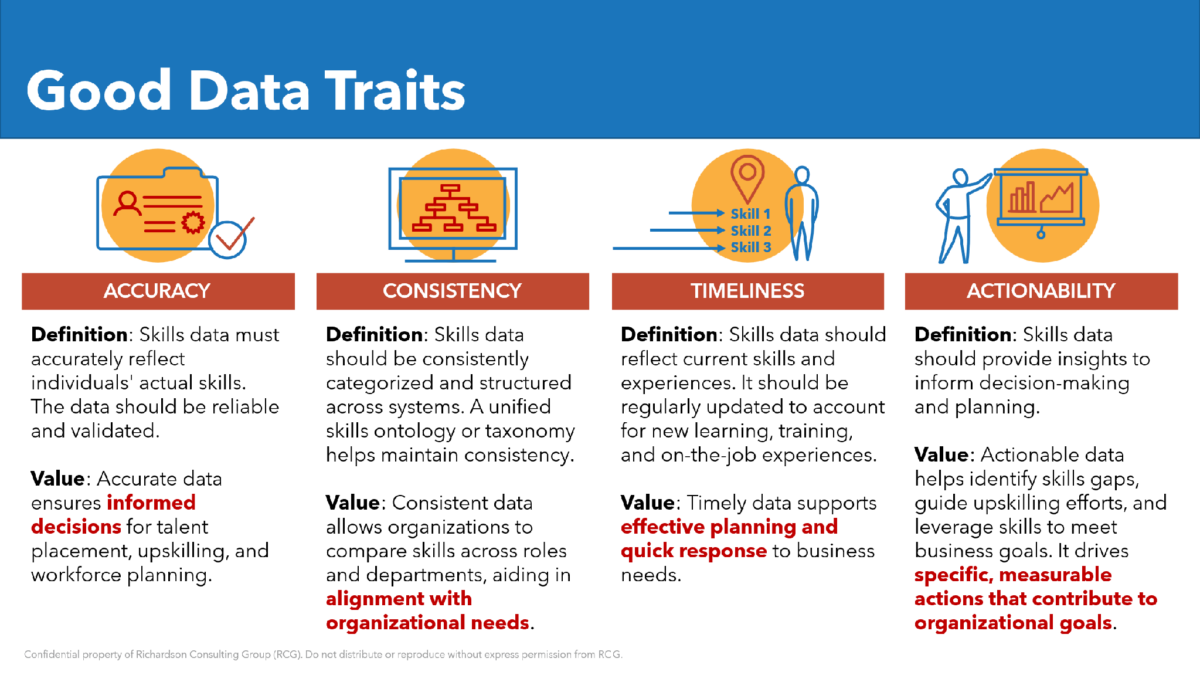
Participants consistently returned to four traits that determine whether skills data becomes usable at scale:
- Accuracy
If the underlying skills data does not reflect reality, confidence erodes quickly.
Organizations described common problems, including:
- outdated profiles
- fragmented systems
- inconsistent proficiency scales
- inflated self-assessments
- disconnected taxonomies
As Brian Richardson noted during the discussion, poor data quality directly undermines workforce planning, mobility, learning, and staffing decisions.
- Consistency
Many organizations now manage skills data across:
- HR systems
- LMS platforms
- talent marketplaces
- workforce planning tools
- external talent intelligence platforms
The challenge:
The same “skill” often means different things across functions and systems.
Several participants emphasized the importance of establishing:
- common language
- aligned definitions
- manageable skill architectures
- standardized proficiency models
Without consistency, organizations struggle to scale beyond isolated pilots.
- Timeliness
Skills data decays faster than many organizations expect.
Employees:
- learn new capabilities
- shift responsibilities
- move roles
- gain certifications
- develop expertise informally
One-time or annual self-assessments quickly lose relevance.
This is one reason organizations are increasingly exploring:
- AI inference
- continuous signals
- integrated learning data
- role-based skill mapping
- Actionability
This was arguably the strongest theme of the session.
Participants repeatedly emphasized:
Skills data should not be collected for its own sake.
The most successful organizations begin with workforce decisions first:
- What decisions are we trying to improve?
- What signals are good enough to support those decisions?
- What level of confidence do leaders actually need?
The strongest use cases discussed included:
- staffing coverage
- internal mobility
- workforce planning
- development targeting
- capability gap analysis
AI-Inferred Skills: Trust Depends on Transparency
AI-generated skill inference was one of the most discussed topics of the session.
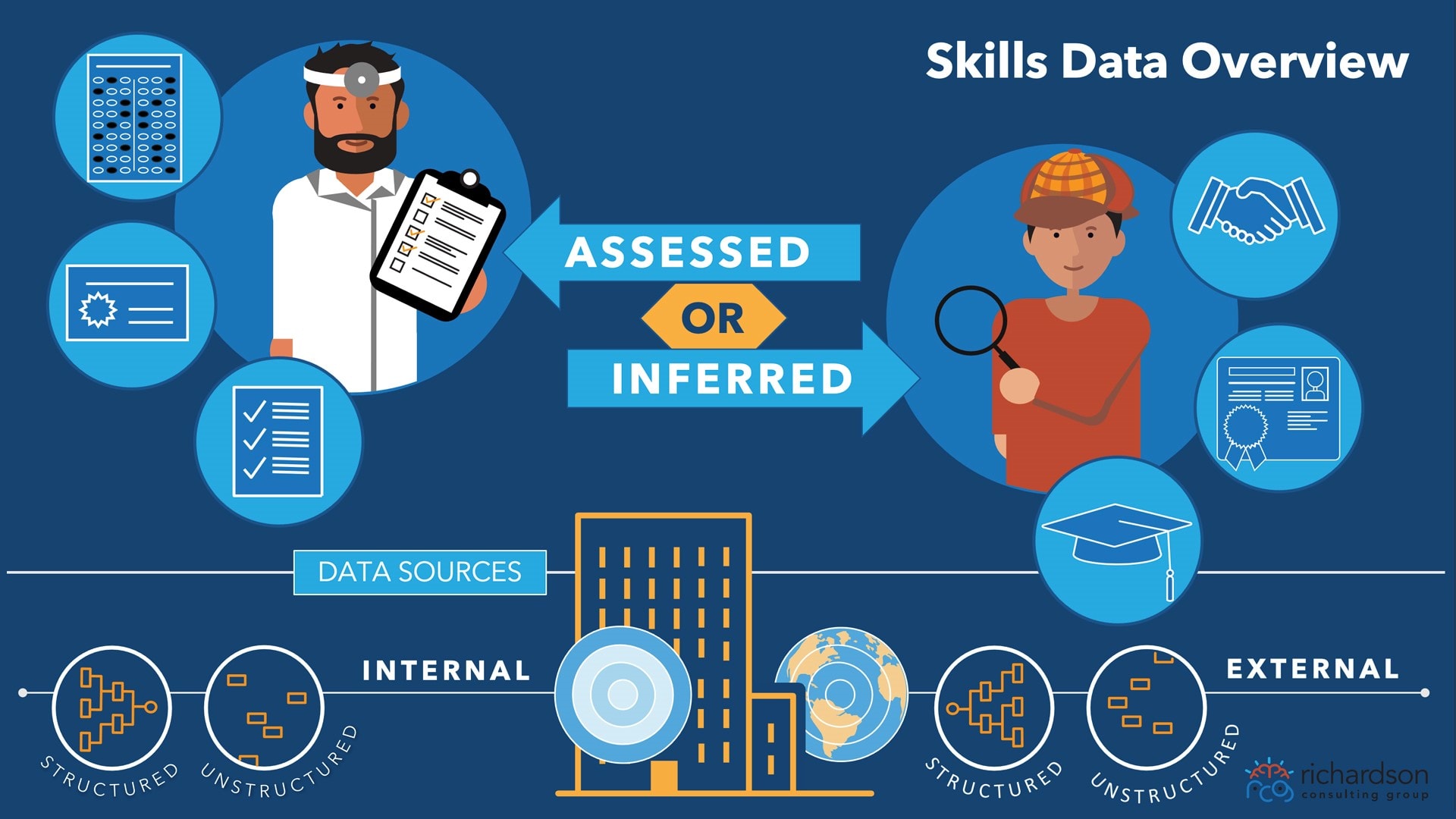
Several organizations are now using platforms that infer skills based on:
- current role
- prior positions
- job architecture
- salary grade
- learning history
- certifications
- workforce data
- external market signals
But participants were clear:
Leaders do not need AI to be perfect.
They need it to be explainable.
One participant summarized it this way:
“Leaders don’t have time to become data scientists. They just need to understand where the insight came from and whether they can trust it.”
The organizations seeing the strongest adoption are exposing:
- source signals
- confidence scores
- inference logic
- validation pathways
This allows leaders to apply human judgment instead of blindly trusting—or rejecting—the system.
Why Frontline and Technical Environments Are Especially Challenging
One of the richest parts of the conversation focused on frontline and technical workforces.
Several leaders described environments where:
- staffing coverage is mission-critical
- certifications matter
- operational trust matters more than systems
- skills are often tracked manually in spreadsheets
A recurring insight:
Frontline managers care less about “skills strategy” and more about:
“Who can reliably do the work today?”
That creates unique requirements for skills systems:
- operational credibility
- validated proficiency
- rapid staffing visibility
- trusted certifications
- practical use cases
Participants also discussed resistance from technical and frontline employees who fear skills data could eventually be used punitively.
This surfaced an important lesson:
Skills systems framed primarily around performance management often generate resistance.
Skills systems framed around development and operational support generate far stronger adoption.
Competency Models and Taxonomies: Simpler Wins
Another major discussion area focused on competency and skills architectures.
Organizations shared a range of approaches:
- Mercer libraries
- Korn Ferry models
- custom architectures
- blended taxonomies
- LMS-based skill frameworks
But the strongest advice was surprisingly consistent:
Keep the model simpler than you think.
Several participants reinforced:
- limiting skills per role
- focusing on the few skills that truly drive performance
- involving business leaders directly
- adapting vendor libraries instead of accepting them blindly
One participant described how leader involvement in customizing competency models significantly increased ownership and adoption.
Another important point:
Vendor libraries are starting points—not operating models.
Organizations still need to define:
- what skills mean internally
- how proficiency works
- how data will be used
- what decisions matter most
The Bigger Pattern: Most “Data Problems” Are Governance Problems
Toward the end of the session, the conversation shifted toward a broader realization:
Many technology and data challenges are actually symptoms of unclear workforce decision-making.
Organizations often struggle because they have not fully defined:
- ownership
- governance
- decision rights
- systems of record
- validation responsibilities
- use-case priorities
This mirrors a broader pattern emerging across enterprise skills transformations:
The bottleneck is rarely the platform itself.
The bottleneck is organizational alignment.
What Organizations Are Doing Differently
Across the session, several practices consistently emerged among organizations making meaningful progress:
They start with business use cases
Not abstract transformation language.
They combine multiple signals
Instead of relying entirely on self-assessment.
They involve leaders early
Especially in taxonomy and validation design.
They define “good enough” data
Rather than chasing perfection.
They treat skills as a workforce operating system
Not merely an HR initiative.
Final Takeaway
The organizations making the most progress with skills are not necessarily the ones with the most sophisticated technology.
They are the ones creating:
- clearer workforce decisions
- stronger governance
- more trusted signals
- better alignment between business needs and skills insights
Because ultimately:
Skills data only matters when leaders trust it enough to act on it.
Explore the Skills Decision Brief™
Many organizations reach a point where they have:
- skills platforms
- workforce data
- pilot programs
- growing executive interest
…but still struggle with:
- governance clarity
- data confidence
- architecture alignment
- decision readiness
That’s exactly why we created the Skills Decision Brief™.
The engagement helps organizations:
- assess current-state skills maturity
- clarify governance and ownership
- evaluate skills data readiness
- prioritize next-stage investments
- align leadership before scaling complexity
If your organization is navigating these questions, we’d be happy to compare notes.
⇒ Contact Richardson Consulting Group to learn more.