
Most organizations do not lack skills activity.
They have skills taxonomies, job architectures, AI inference engines, talent marketplaces, learning pathways, dashboards, workforce analytics tools, and skills profiles.
Many are also investing in skills intelligence.
They want better visibility into:
- what skills exist,
- where gaps are emerging,
- which roles are changing,
- who may be ready for new opportunities,
- where talent supply is misaligned with demand,
- and where the organization should build, buy, borrow, or redeploy capability.
That work matters.
But skills intelligence alone does not change anything.
A skills signal does not make a decision.
A dashboard does not resolve a tradeoff.
A talent marketplace does not determine whether an employee is ready.
An AI inference engine does not decide whether the organization should reskill, hire, redeploy, or redesign work.
People and organizations make those decisions.
And that is where many skills transformation efforts stall.
The organization may have more intelligence than ever before.
But it has not defined how that intelligence should change workforce decisions.
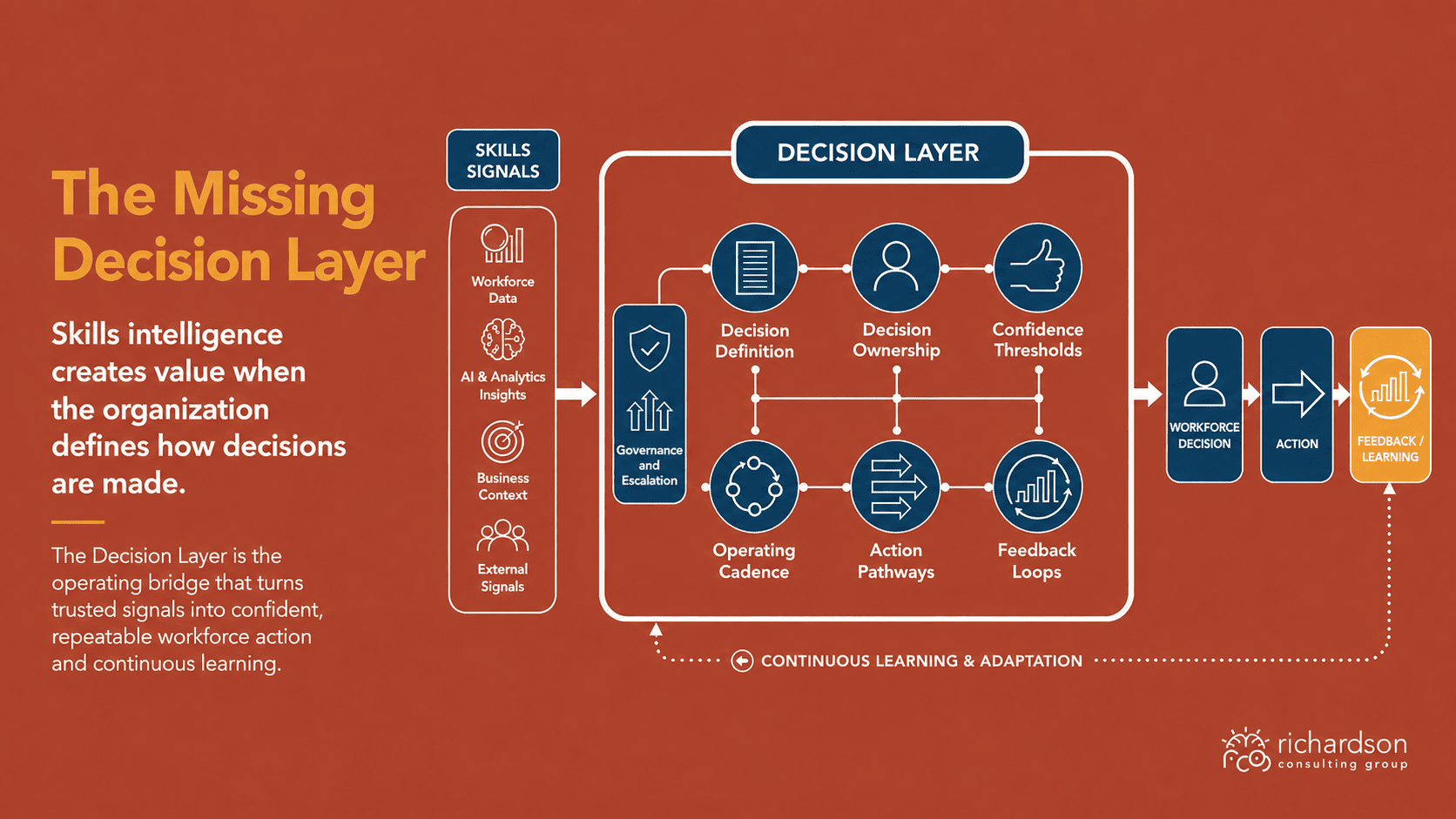
That missing connection is what I call the Decision Layer.
The Decision Layer is the operating structure that connects skills signals to workforce action.
It defines:
- what decisions skills intelligence is meant to improve,
- who owns those decisions,
- what evidence is sufficient to act,
- how uncertainty is governed,
- what cadence the decision operates within,
- and what actions should follow.
Without this layer, even trusted skills intelligence can remain operationally inert.
The organization can see the signal.
But nobody knows what decision should change because of it.
That is the difference between a skills system that informs the business and a skills system that changes how the business operates.
From the Field
One pattern I continue to see across enterprise skills initiatives:
Organizations can often describe the use case.
They can describe the technology.
They can describe the data sources.
They can describe the desired employee or leader experience.
But when the conversation turns to the actual workforce decision, things become less clear.
For example:
- Who decides whether a skill gap should be addressed through reskilling or hiring?
- Who decides whether an employee is “ready enough” for an internal opportunity?
- Who decides whether a role should continue to be filled, redesigned, or phased out?
- Who decides what level of skill confidence is sufficient for talent review, workforce planning, or succession?
- Who decides what happens when the skills signal conflicts with manager judgment?
Very often, the answer is some version of:
“It depends.”
Or:
“That would probably be shared across several groups.”
Shared ownership is not always a problem.
But shared ownership without clear decision rights becomes diffused accountability.
Talent has a view.
Learning has a view.
HR Technology has a view.
Workforce Planning has a view.
Talent Acquisition has a view.
The other business functions have a view.
But nobody owns the full decision cycle.
That is the Decision Layer problem.
And it is one of the biggest reasons skills initiatives struggle to move from insight to action.
Skills Intelligence Is Not the Same as Workforce Decision-Making
Skills intelligence helps organizations see the workforce more clearly.
That is valuable.
But visibility is not the same as decision-making.
A skills dashboard may show that a business unit has a growing AI capability gap.
A learning platform may show that employees are completing relevant development.
A talent marketplace may show that some employees appear adjacent to emerging roles.
An inference engine may estimate that certain employees have skills that are not formally captured in job profiles.
Each signal may be useful.
But none of those signals answers the operational question:
What should we do now?
Should the organization:
- hire externally?
- reskill internally?
- redeploy adjacent talent?
- redesign the work?
- change hiring requirements?
- stop backfilling declining roles?
- build a targeted learning pathway?
- create stretch assignments?
- adjust workforce planning assumptions?
Those are decisions.
And decisions require more than information.
They require ownership, authority, governance, judgment, and action.
This is why skills transformation cannot be treated as a data exercise alone.
At enterprise scale, skills become valuable when they are embedded into repeatable workforce decisions.
The Hidden Failure Pattern: Signals Without Decision Rights
Many organizations assume that once the right skills signals are available, better decisions will naturally follow.
That assumption is wrong.
Better signals can improve decisions.
But only when the organization has defined who is responsible for interpreting and acting on those signals.
Without decision rights, skills intelligence produces ambiguity.
For example:
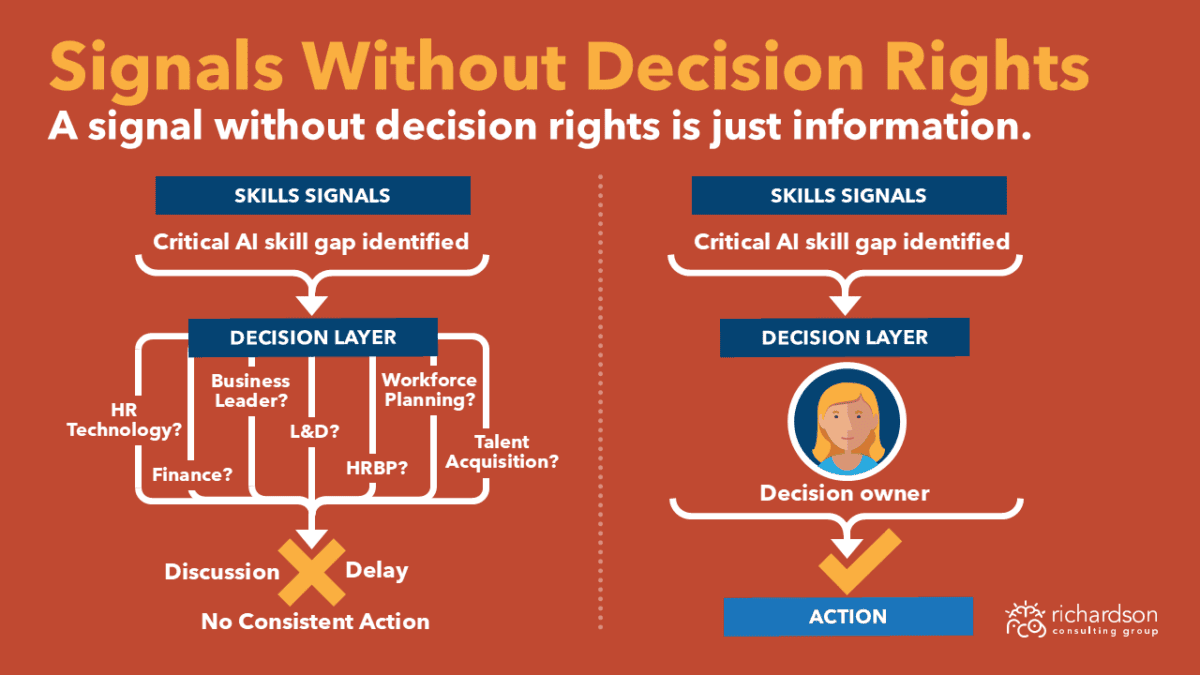
A workforce planning team identifies a critical future skill gap.
But who owns the response?
Is it the business leader?
Talent Acquisition?
Learning and Development?
HR Business Partners?
Finance?
Strategic Workforce Planning?
The answer may involve all of them.
But unless the decision rights are clear, the signal creates discussion instead of action.
The same pattern shows up in mobility.
A skills platform identifies employees who appear ready for adjacent roles.
But who decides whether those employees should be surfaced to hiring managers?
Who validates readiness?
Who manages employee expectations?
Who ensures the recommendation does not create fairness concerns?
Who is accountable if the match is poor?
Again, the issue is not whether the skills signal is useful.
The issue is whether the organization has defined the decision system around it.
A signal without decision rights is just information.
A signal with decision rights becomes operational intelligence.
The Decision Layer
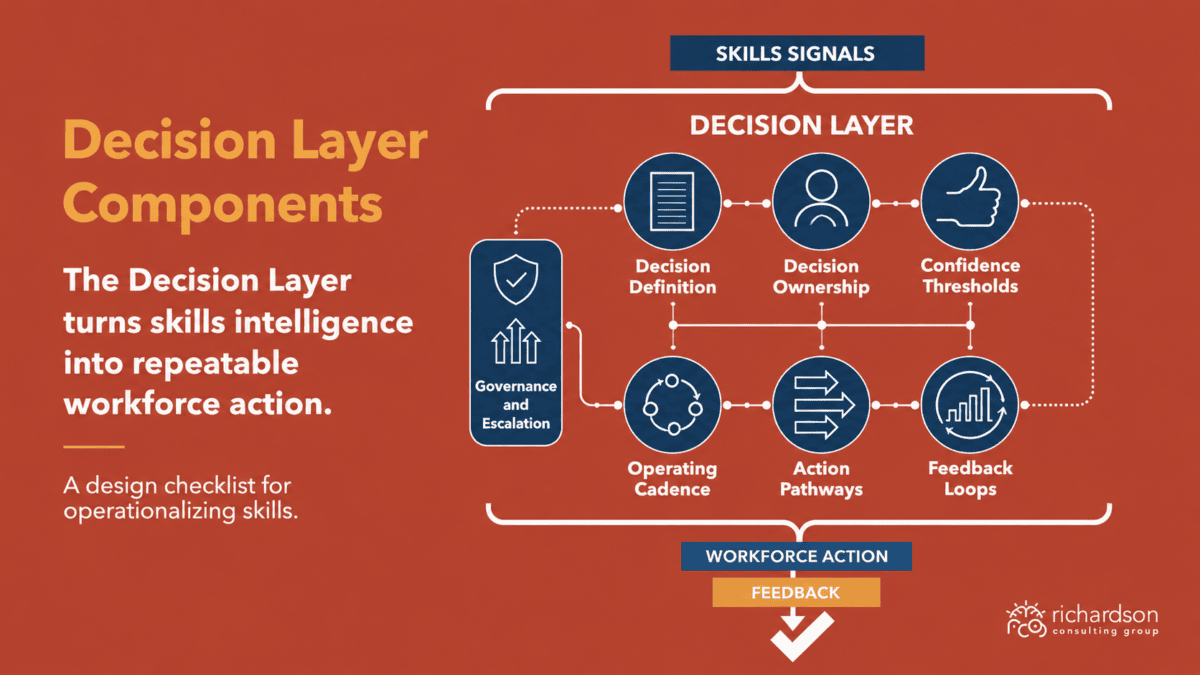
The Decision Layer is the connective tissue between skills intelligence and workforce action.
It sits between:
Skills Signals
and
Operational Decisions
Or more simply:
Signals → Decision Layer → Action
The Decision Layer answers seven practical questions:
- What decision are we enabling?
- Who owns the decision?
- What signals inform the decision?
- What confidence threshold is sufficient?
- How are exceptions or conflicts resolved?
- What operating cadence governs the decision?
- What action follows?
- What feedback loops inform and improve decisions over time?
These questions may sound basic.
But most enterprise skills initiatives do not answer them with enough precision.
They define the platform.
They define the taxonomy.
They define the employee experience.
They define the data sources.
But they do not define the decision.
And when the decision is unclear, everything else becomes harder to operationalize.
Governance becomes abstract.
Technology requirements become inflated.
Data quality debates become endless.
Stakeholders talk past each other.
Pilots become larger than necessary.
And the organization struggles to prove value.
The Decision Layer creates focus.
It forces the organization to ask:
What workforce decision are we trying to improve?
That question changes the work.
Component 1: Decision Definition
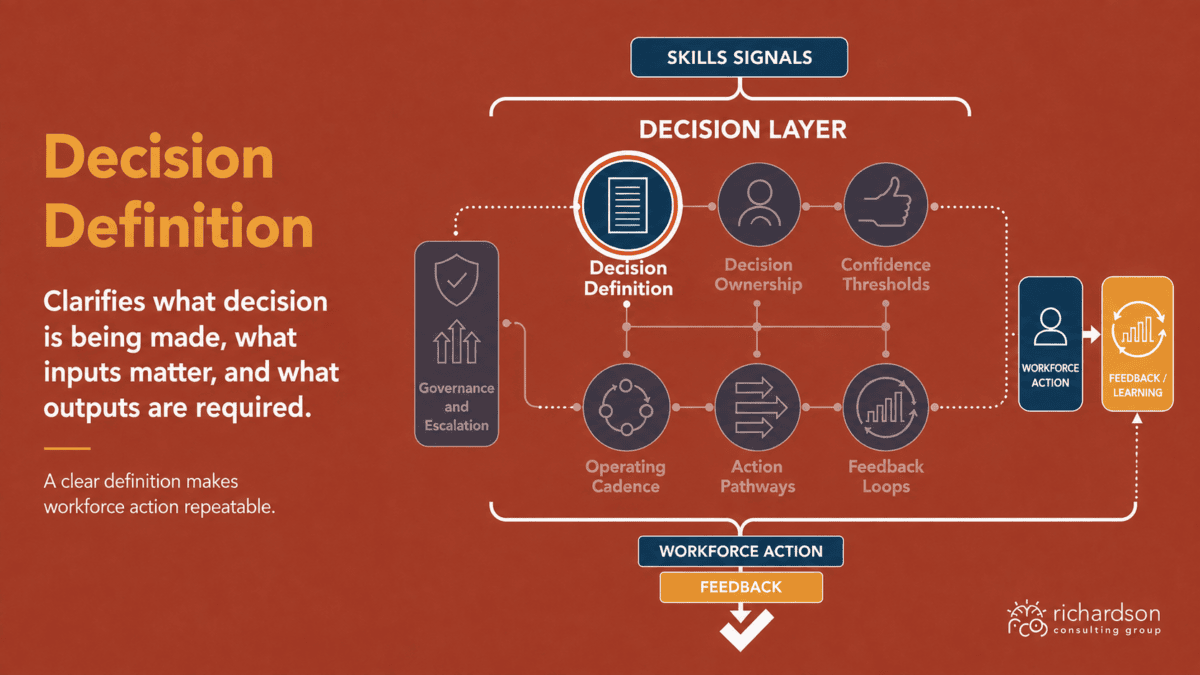
The first element of the Decision Layer is decision definition.
This may be the most important step.
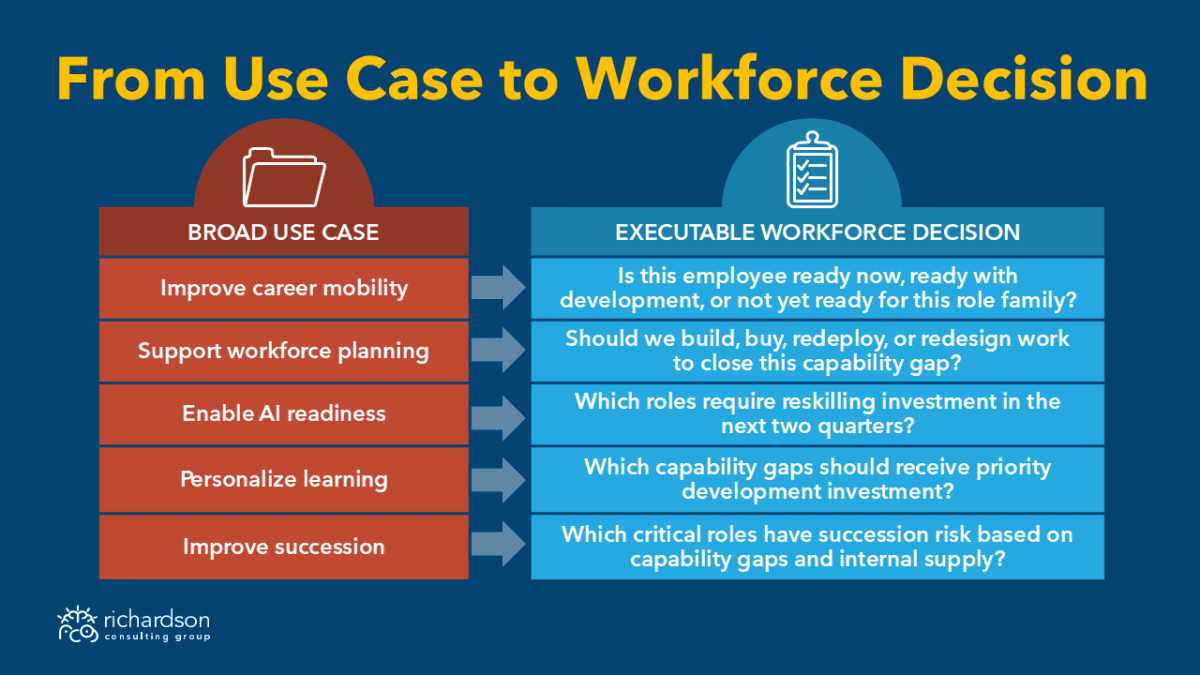
Many skills initiatives begin with broad use cases:
- improve career mobility
- support workforce planning
- enable AI readiness
- modernize talent management
- personalize learning
- strengthen succession
- improve internal hiring
These are useful strategic themes.
But they are not yet decisions.
A decision must be specific enough that people can act.
For example:
“Improve career mobility” is not a decision.
“Is this employee ready now, ready with targeted development, or not yet ready for this role family?” is a decision.
“Support workforce planning” is not a decision.
“Should we build, buy, redeploy, or redesign work to close this capability gap?” is a decision.
“Enable AI readiness” is not a decision.
“Which priority roles require reskilling investment in the next two quarters based on future skill demand and current internal supply?” is a decision.
The more precisely the decision is defined, the easier it becomes to define:
- required signals,
- confidence thresholds,
- ownership,
- governance,
- cadence,
- and success measures.
A vague use case creates vague governance.
A precise decision creates operational clarity.
Component 2: Decision Ownership
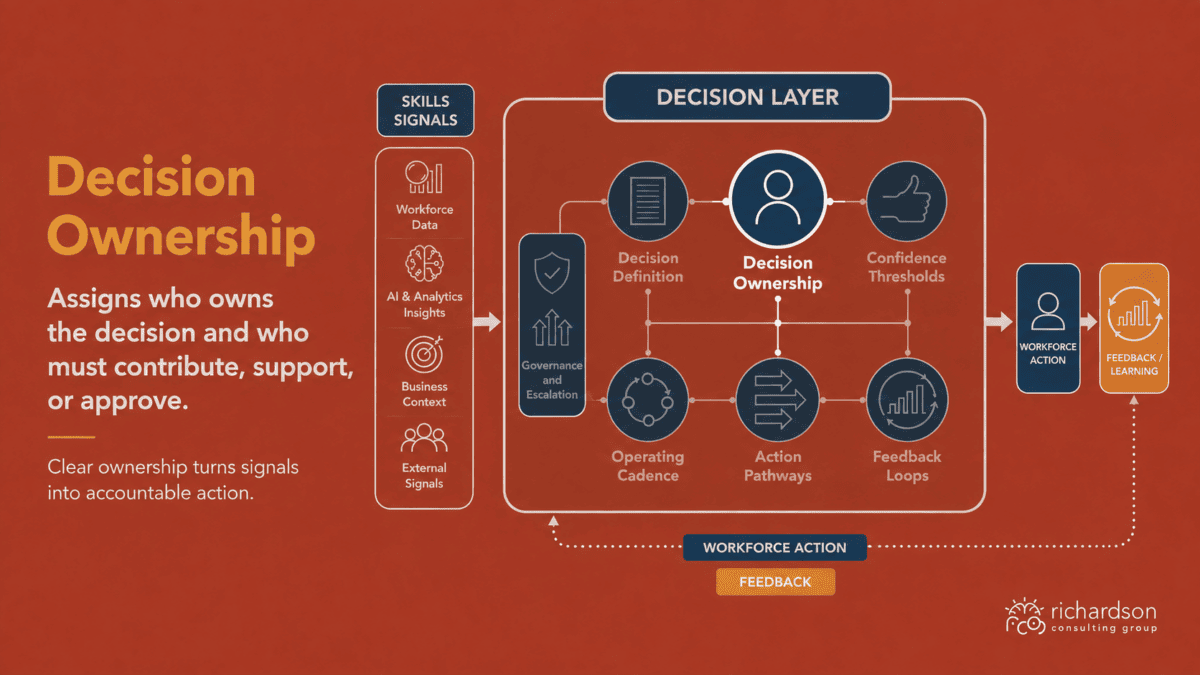
Once the decision is defined, the next question is ownership.
Who has the authority to act?
This is where many skills initiatives become difficult.
Skills decisions often cut across organizational boundaries.
A build-versus-buy decision may involve:
- business leaders,
- HR Business Partners,
- Strategic Workforce Planning,
- Talent Acquisition,
- Learning and Development,
- Finance,
- and HR Technology.
A mobility readiness decision may involve:
- the employee,
- the manager,
- Talent,
- Recruiting,
- Learning,
- and the receiving business function.
A succession decision may involve:
- leaders,
- HR Business Partners,
- Talent Management,
- assessment partners,
- and executive governance forums.
This cross-functional nature is unavoidable.
But cross-functional involvement is not the same as shared accountability.
A strong Decision Layer clarifies:
- who owns the decision,
- who provides input,
- who governs the process,
- who can challenge the signal,
- who approves exceptions,
- and who is accountable for action.
This does not require a massive governance structure.
In fact, heavy governance often slows the work down.
What is needed is decision clarity.
The organization should know who decides, who advises, who validates, and who acts.
Without that clarity, the skills system creates more conversations than decisions.
Component 3: Confidence Thresholds
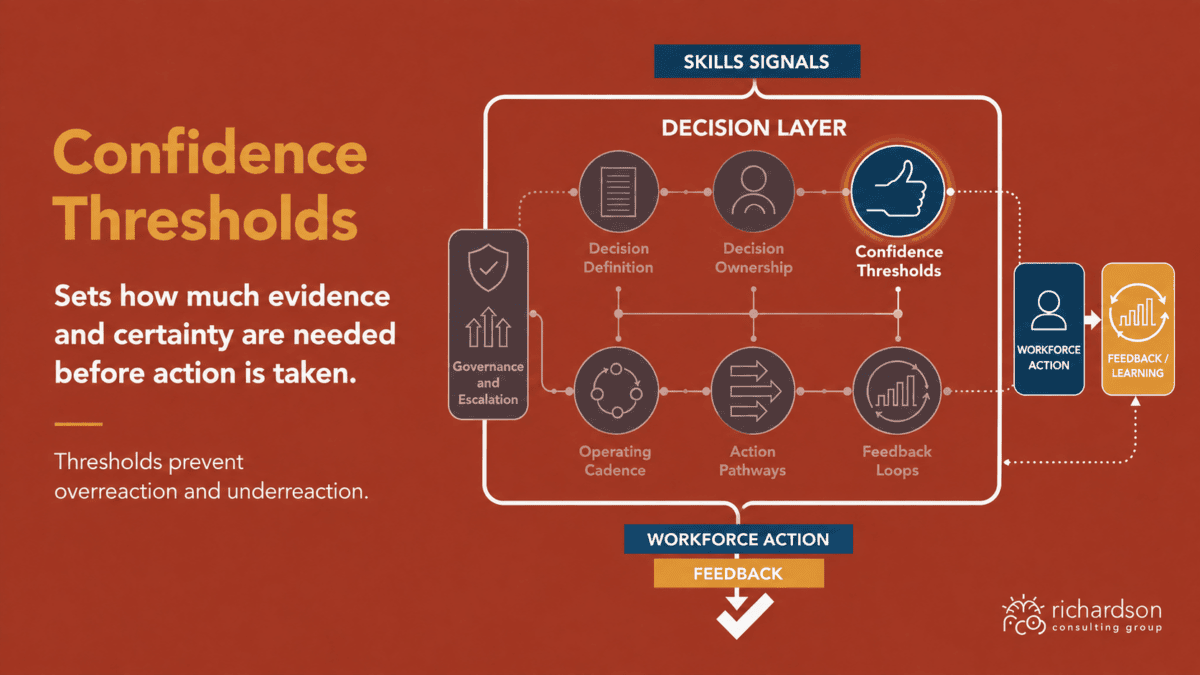
The third element of the Decision Layer is confidence thresholds.
This connects directly to the concept of decision-grade confidence.
Not every workforce decision requires the same level of confidence.
A learning recommendation can operate with moderate confidence.
If the recommendation is imperfect, the risk is relatively low.
An internal mobility recommendation requires more confidence because it affects employee opportunity, manager trust, and hiring outcomes.
A hiring decision requires even more confidence.
A succession decision requires greater scrutiny.
A compensation-related decision requires very high confidence because the consequences are materially different.
The Decision Layer defines what level of confidence is sufficient for each decision.
That includes clarity on:
- which signals are required,
- which signals are optional,
- which signals carry more weight,
- what level of evidence is enough to act,
- what requires human review,
- and what decisions should not yet be automated or heavily influenced by skills signals.
This is important because organizations often treat confidence as a general data-quality issue.
But confidence is decision-specific.
The question is not:
“Do we trust the skills data?”
The better question is:
“Do we trust this skills signal enough for this decision?”
That distinction allows organizations to move faster without pretending all signals are equally reliable or all decisions carry the same risk.
Component 4: Governance and Escalation
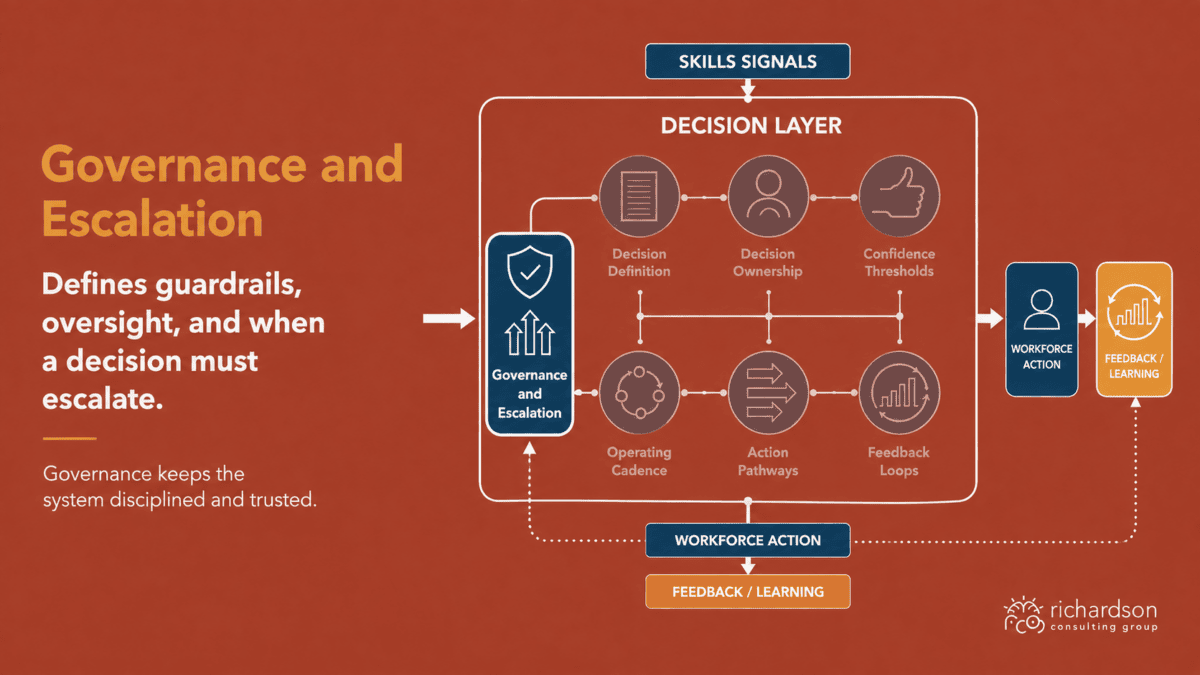
The fourth element of the Decision Layer is governance.
Governance is often misunderstood.
In many organizations, governance sounds like bureaucracy.
It sounds like committees, approvals, controls, and delays.
But effective governance is not about slowing decisions down.
It is about making decisions more consistent, explainable, and trustworthy.
In skills transformation, governance should answer questions such as:
- Who reviews conflicting signals?
- Who determines whether a skill should be added, changed, merged, or retired?
- Who decides whether an inferred skill is reliable enough for a given use case?
- Who resolves disputes between self-assessment, manager input, and system inference?
- Who approves changes to confidence thresholds?
- Who monitors unintended consequences?
- Who ensures skills are applied consistently across talent processes?
These questions become more important as skills intelligence begins influencing higher-stakes workforce decisions.
Without governance, inconsistency spreads quickly.
One business unit may use inferred skills aggressively for mobility.
Another may ignore them entirely.
One leader may treat skills data as directional.
Another may treat it as definitive.
One function may build its own skills structure.
Another may use the enterprise model.
The result is fragmentation.
Governance does not eliminate local judgment.
It creates guardrails for responsible action.
The goal is not control for its own sake.
The goal is decision velocity with trust.
Component 5: Operating Cadence
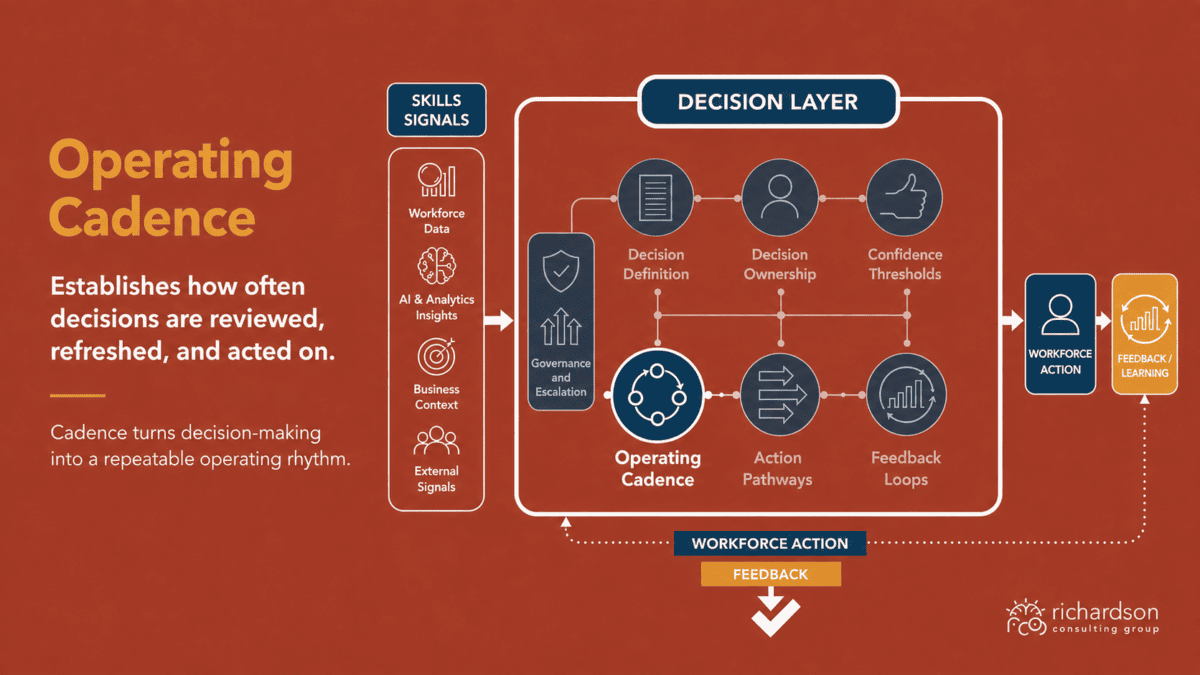
A decision is not operational until it has a cadence.
This is one of the most overlooked elements of skills transformation.
Many organizations create dashboards or reporting views and assume that leaders will use them when needed.
But workforce decisions do not scale through passive availability.
They scale through operating rhythms.
For example:
- monthly workforce planning reviews,
- quarterly talent reviews,
- business-unit capability planning sessions,
- hiring intake reviews,
- internal mobility reviews,
- succession planning cycles,
- learning investment prioritization forums,
- AI readiness governance meetings.
The cadence matters because it determines when skills signals are interpreted, discussed, challenged, and acted upon.
Without cadence, skills intelligence becomes a reference tool.
With cadence, it becomes part of how the business runs.
This is especially important for pilots.
A pilot should not be a one-time analysis.
It should be a repeatable decision cycle.
The question is not simply:
“Did the dashboard produce insight?”
The question is:
“Did the organization use the insight in a recurring decision rhythm?”
That is a much better test of scalability.
Component 6: Action Pathways
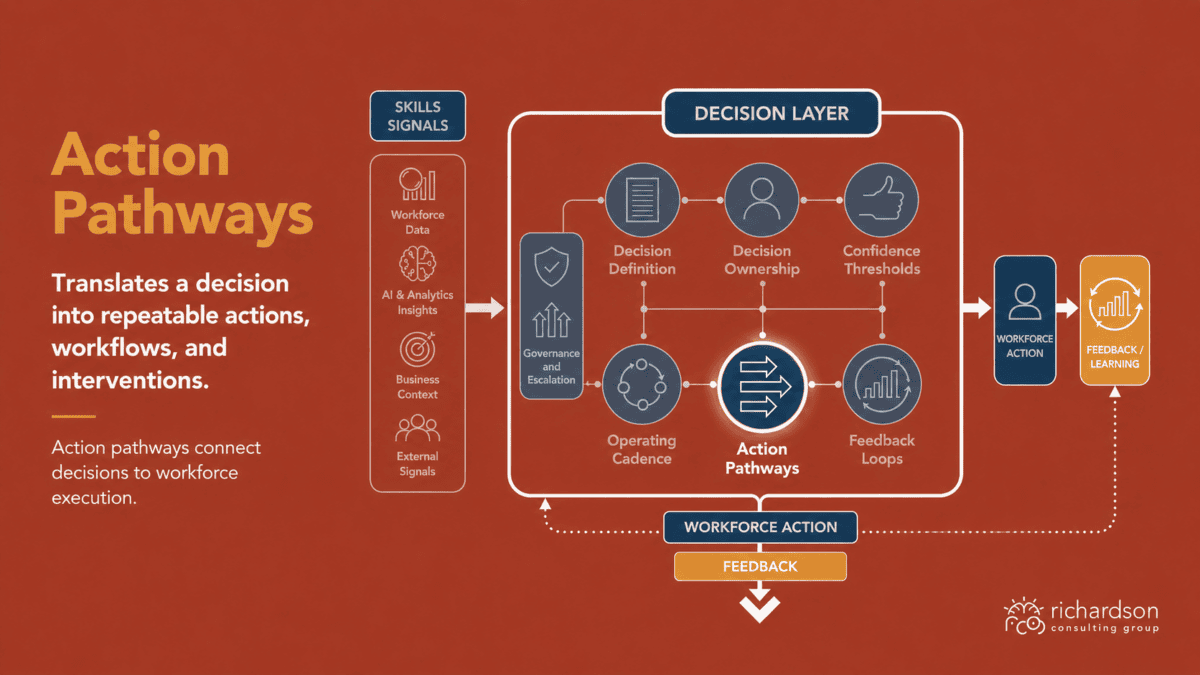
The Decision Layer must also define what happens after the decision.
This is where many skills initiatives lose momentum.
A signal identifies a gap.
A recommendation identifies a possible match.
A dashboard identifies a trend.
But the action pathway is unclear.
For example:
If the organization identifies a critical AI capability gap, what happens next?
Does the team:
- create a hiring plan?
- launch a reskilling pathway?
- redesign work?
- shift work to adjacent roles?
- change job requirements?
- invest in external partnerships?
- prioritize a specific business segment?
If an employee is identified as ready for an adjacent role, what happens next?
Does the employee:
- receive a recommendation?
- discuss it with a manager?
- get routed to a recruiter?
- receive targeted development?
- join a talent pool?
- get matched to a project?
- enter a formal mobility process?
If a role is identified as declining, what happens next?
Does the business:
- stop hiring for that role?
- redesign the role?
- redeploy incumbents?
- revise workforce plans?
- adjust learning investments?
- change succession assumptions?
Signals only create value when they lead somewhere.
The Decision Layer defines the pathway from insight to action.
Without that pathway, the organization creates awareness without behavior change.
Component 7: Feedback Loops
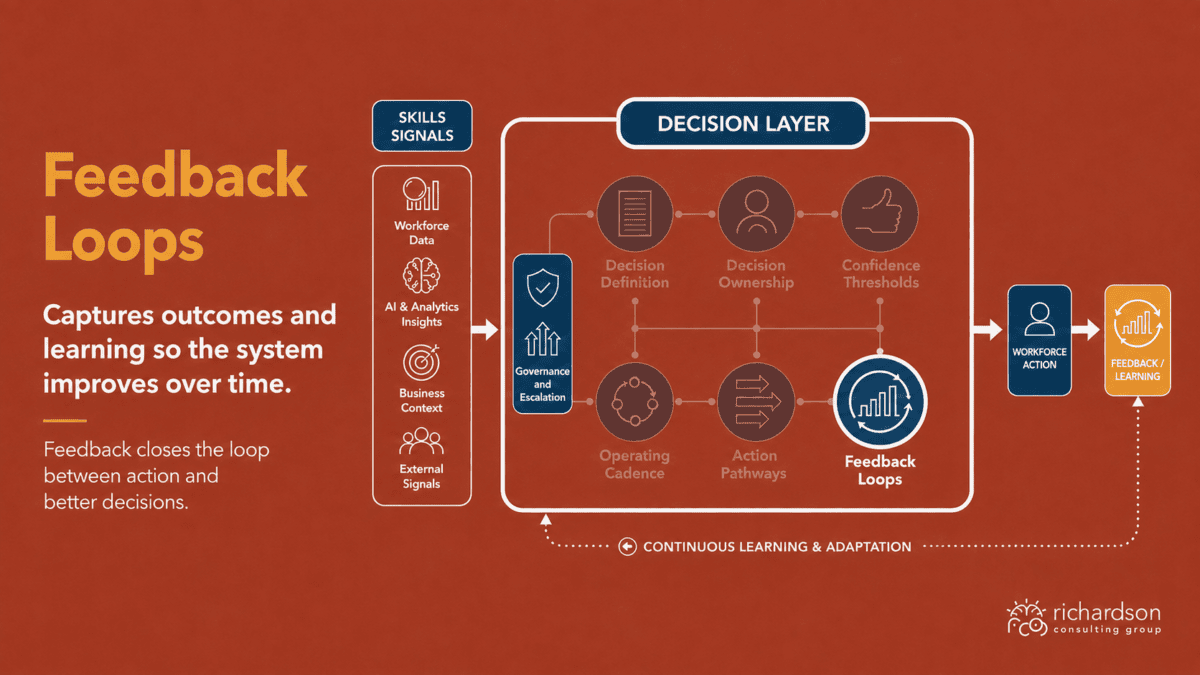
The final element of the Decision Layer is feedback.
Every decision cycle should teach the organization something.
Did the skills signal improve the decision?
Was the confidence threshold appropriate?
Did leaders trust the recommendation?
Did the action produce the intended outcome?
Did the signal miss important context?
Were there unintended consequences?
Should the model, threshold, governance process, or cadence change?
This feedback loop is critical because skills intelligence will always be imperfect.
Signals will evolve.
Roles will change.
Business priorities will shift.
AI models will improve.
Data sources will expand.
Employee behavior will adapt.
The organization should not expect to design the perfect decision model once.
It should design a decision system that learns.
That is the real advantage of a well-designed Decision Layer.
It turns each decision cycle into an opportunity to improve the system.
Example 1: AI Skills and Build-versus-Buy Decisions
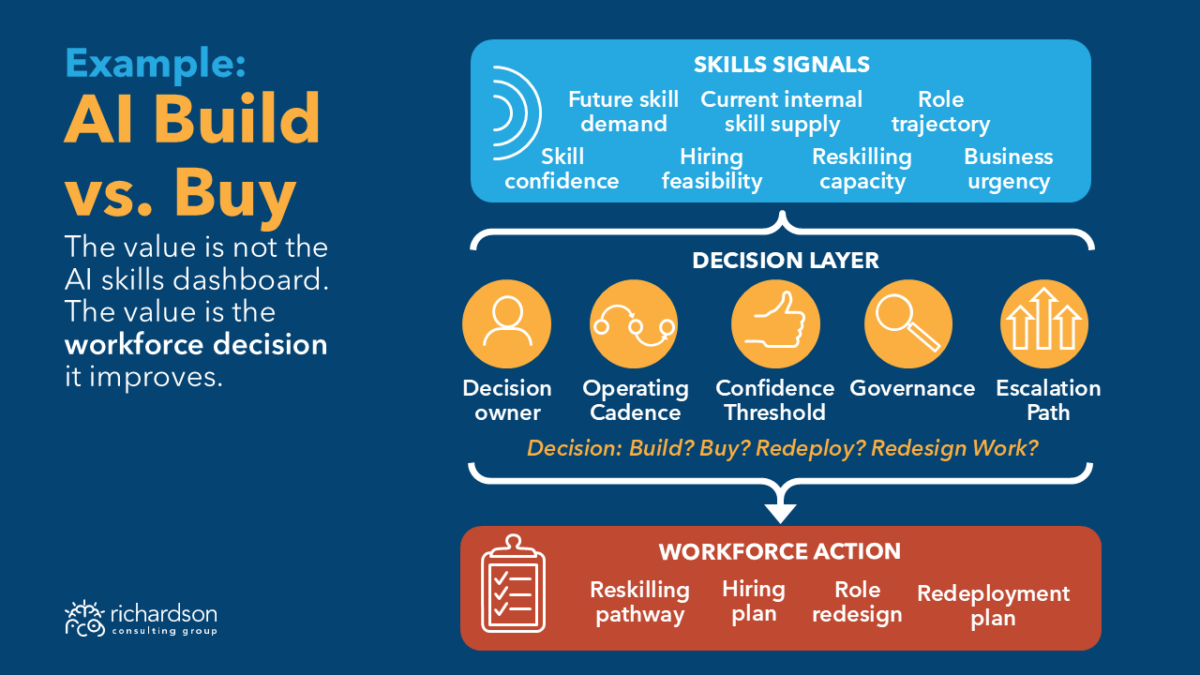
Consider a common enterprise use case:
Expose AI skill gaps to inform build-versus-buy workforce decisions.
This is a strong use case because it connects skills intelligence to a real business question.
The organization wants to understand:
- what AI-related skills are needed,
- where those skills exist internally,
- where gaps are emerging,
- which roles are changing,
- and whether the organization should reskill, hire, redeploy, or redesign work.
But the use case only becomes operational when the Decision Layer is clear.
The decision might be:
Should we build, buy, redeploy, or redesign work to close priority AI capability gaps in this business segment?
That decision requires multiple signals:
- future skill demand,
- current internal skill supply,
- proficiency confidence,
- role trajectory,
- external labor market availability,
- learning capacity,
- hiring feasibility,
- business priority,
- and timeline urgency.
But the signals alone are not enough.
The organization also needs to define:
- who owns the build-versus-buy decision,
- which leaders must be involved,
- what level of skill confidence is sufficient,
- when Talent Acquisition is engaged,
- when Learning and Development is engaged,
- when work redesign is considered,
- how tradeoffs are evaluated,
- and how decisions are reviewed over time.
Without the Decision Layer, the organization may produce a useful AI skills dashboard.
With the Decision Layer, the organization creates a repeatable workforce planning process.
That is the difference.
The value is not the insight.
The value is the decision the insight improves.
Example 2: Career Readiness and Internal Mobility
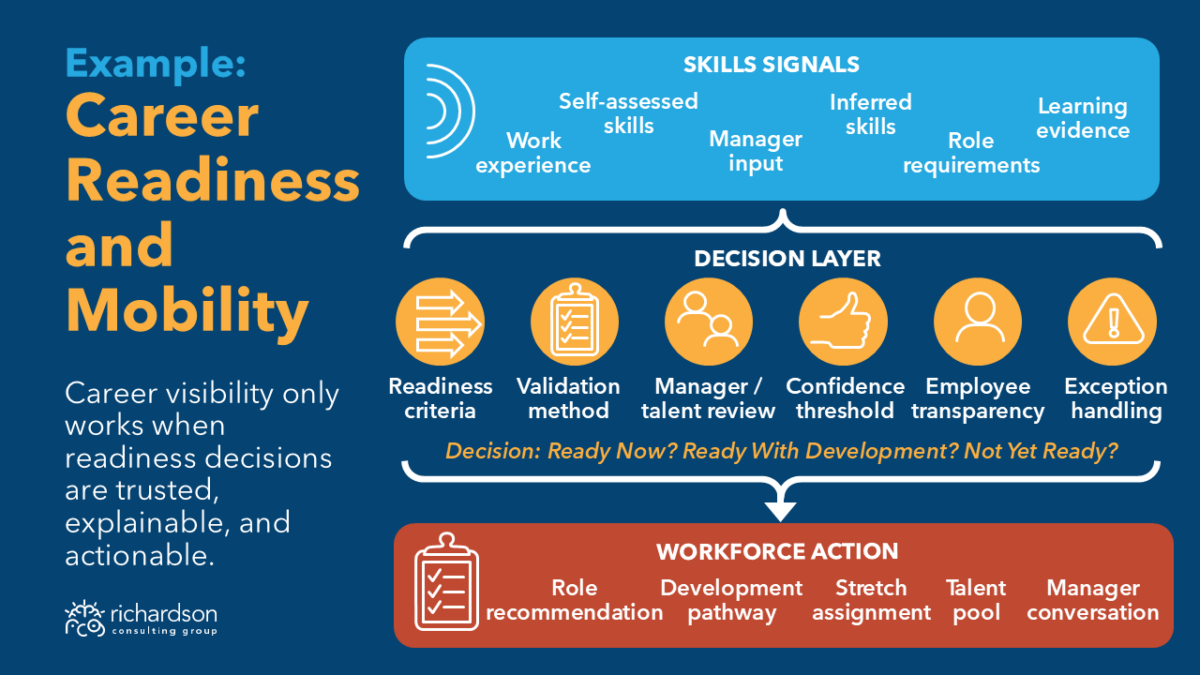
Make career readiness visible for internal mobility and growth.
This use case is compelling because it makes skills tangible to employees.
It can help people understand:
- what roles may be within reach,
- what skills they already have,
- what gaps they need to close,
- what learning or experience would help,
- and what career paths may be possible.
But the skills signal is not enough.
The organization must define the decision.
For example:
Is this employee ready now, ready with targeted development, or not yet ready for this role or opportunity?
That decision may rely on:
- self-reported skills,
- inferred skills,
- learning records,
- work experience,
- manager input,
- performance context,
- assessments,
- and role requirements.
But it also requires governance.
Who validates readiness?
How much confidence is enough to recommend a role?
What happens if the employee believes they are ready but the manager disagrees?
What if the system recommends an opportunity but the hiring manager does not trust the signal?
What if employees begin optimizing their profiles to appear more qualified?
What level of transparency should employees receive?
These are Decision Layer questions.
Without them, career readiness tools can create confusion, mistrust, or unmet expectations.
With them, the organization can create a more transparent, explainable, and actionable mobility experience.
The goal is not simply to show employees more options.
The goal is to make readiness more visible, development more targeted, and mobility decisions more consistent.
Why Technology Cannot Substitute for the Decision Layer
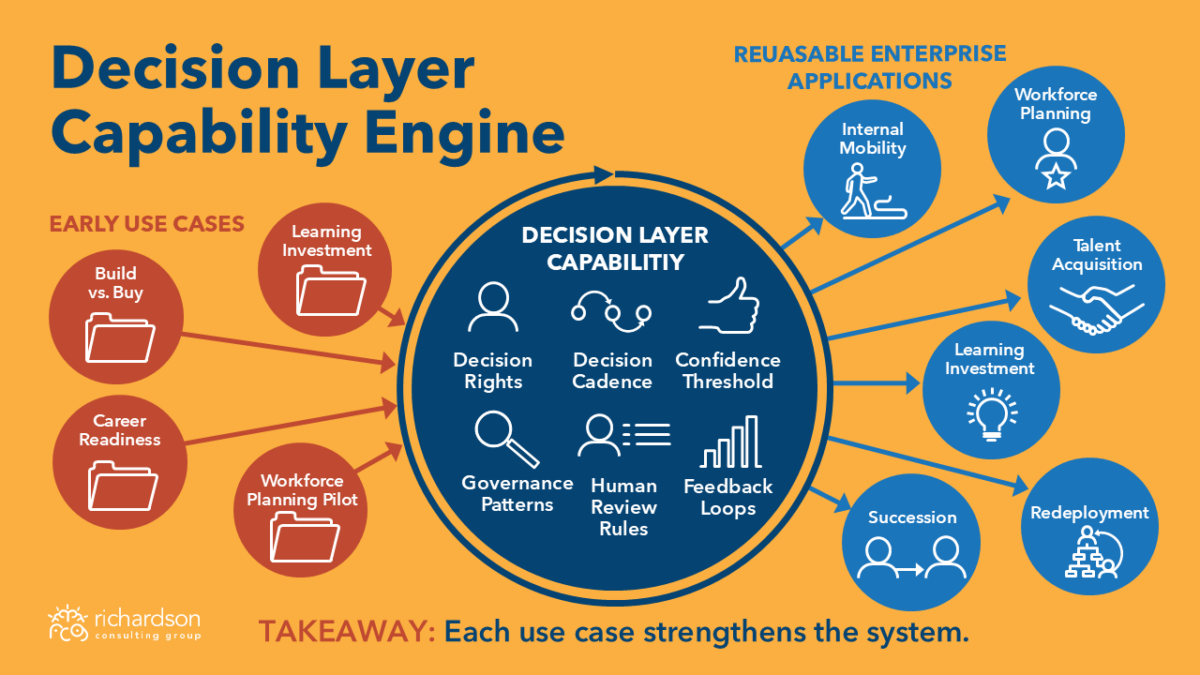
Many organizations hope the technology will solve these issues.
It will not.
Technology can support the Decision Layer.
It can enable workflows, surface recommendations, store profiles, infer skills, visualize gaps, and automate parts of the experience.
But technology cannot define the organization’s decision rights.
It cannot determine how much confidence is appropriate for a succession decision.
It cannot decide how Talent, Learning, HR Technology, Workforce Planning, Talent Acquisition, Compensation, and business leaders should share accountability.
It cannot resolve political tradeoffs between hiring externally and reskilling internally.
It cannot determine when local autonomy should give way to enterprise consistency.
It cannot decide what level of risk the organization is willing to accept.
Those are operating model questions.
When organizations skip the Decision Layer, vendor defaults often become accidental governance.
The platform workflow becomes the process.
The recommendation logic becomes the decision model.
The data structure becomes the operating philosophy.
That may work in narrow cases.
But it doesn’t scale across the enterprise.
The better approach is to define the Decision Layer first, then configure technology to support it.
Strategy should guide technology.
Technology should not quietly define strategy.
The Decision Layer Converts Trust Into Action
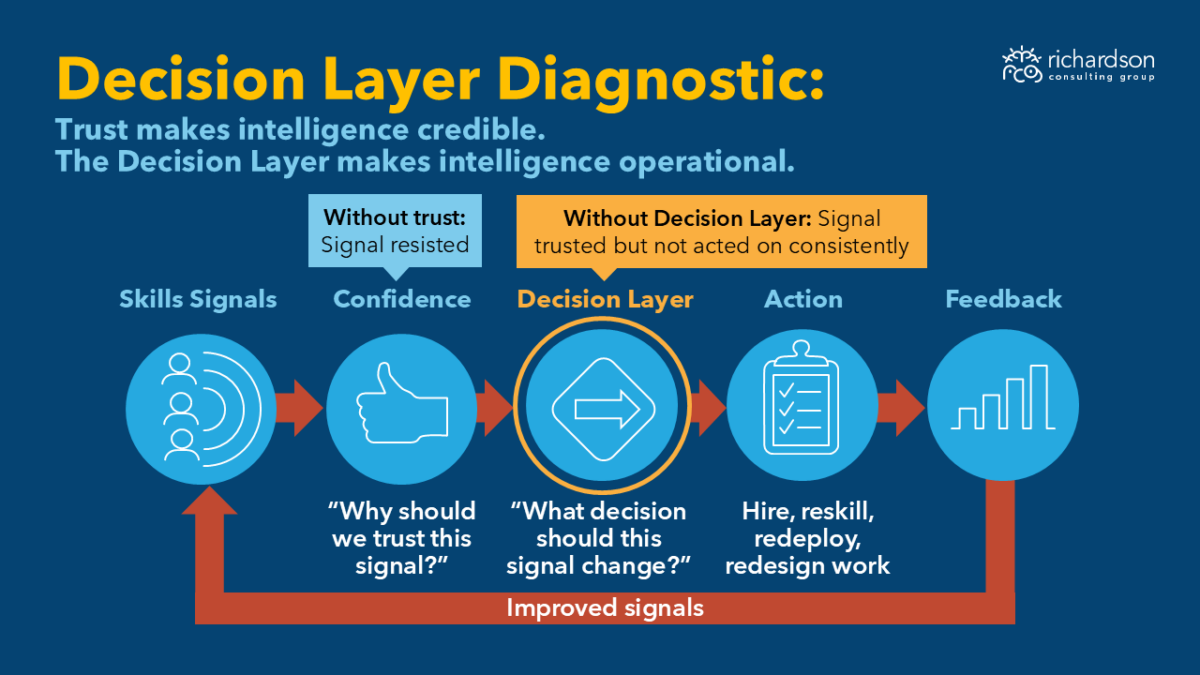
Article 2 in this series focused on trust.
That matters because leaders do not operationalize intelligence they cannot explain.
But trust alone is not sufficient.
A leader may trust the signal and still not know what to do with it.
A manager may believe the recommendation and still lack authority to act.
An HR team may understand the skills gap and still lack a decision forum where the issue can be resolved.
That is why the Decision Layer matters.
Confidence Architecture helps answer:
Why should we trust this signal?
The Decision Layer answers:
What decision should this signal change?
Both are necessary.
Trust makes intelligence credible.
The Decision Layer makes intelligence operational.
Without trust, people resist the signal.
Without the Decision Layer, people may trust the signal but fail to act on it consistently.
This is one of the most important distinctions in enterprise skills work.
The path to scale is not simply:
More data → Better insights → Better decisions
The more realistic path is:
Skills signals → Confidence → Decision Layer → Action → Feedback → Improved signals
That is how workforce intelligence becomes an operating system.
What Effective Skills Pilots Should Validate
This has major implications for skills pilots.
A pilot should not simply validate whether a platform works.
It should not simply validate whether a dashboard can be built.
It should not simply validate whether skills can be inferred.
It should validate whether a workforce decision can operate using skills signals.
From a Decision Layer perspective, an effective pilot tests whether:
- the decision is specific enough,
- the right decision owner is involved,
- the required signals are available,
- the confidence threshold is appropriate,
- stakeholders trust the evidence,
- governance can resolve uncertainty,
- the operating cadence works,
- actions actually follow,
- and the decision improves over time.
This is a very different kind of pilot.
It is not just a technology pilot.
It is an operating model pilot.
For example, a weak pilot might ask:
Can we identify AI skill gaps?
A stronger pilot asks:
Can business leaders, HR, Talent Acquisition, Learning, and Workforce Planning use AI skill gap signals every month to make faster, more consistent build-versus-buy decisions for one priority workforce segment?
That is more specific.
It is also more scalable.
Because if the organization can operate one decision cycle well, it can scale that pattern to other use cases.
Metrics That Matter
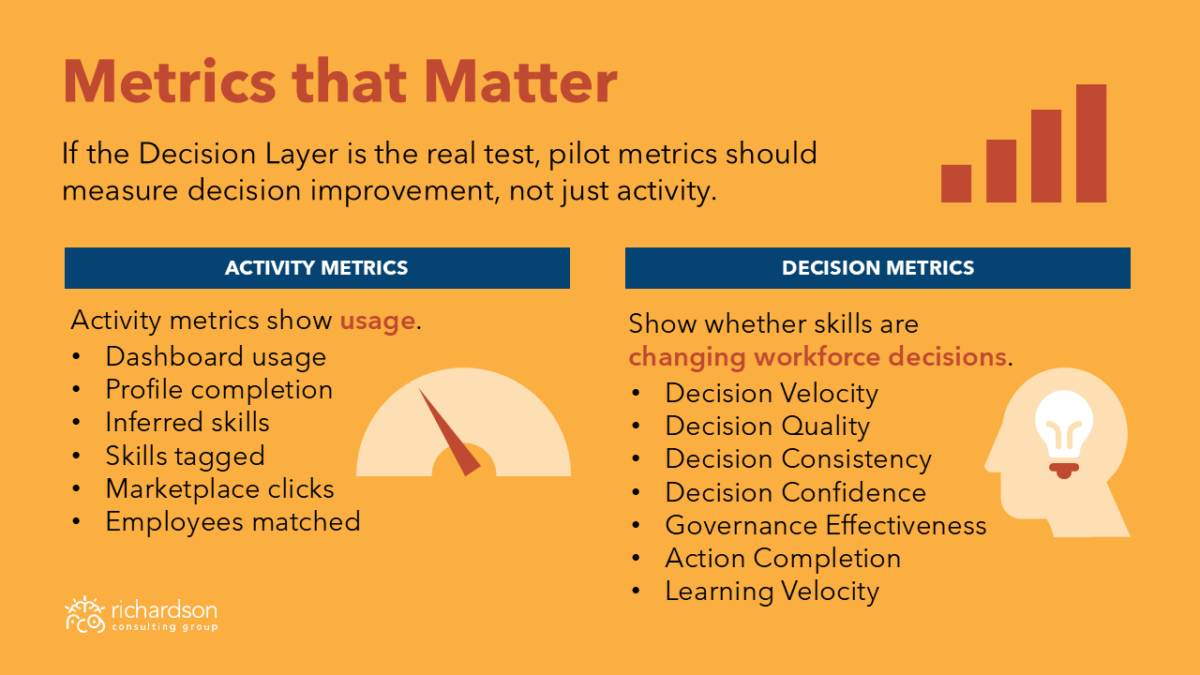
If the Decision Layer is the real test, then pilot metrics should change.
Many organizations measure:
Those metrics may be useful to gauge activity and adoption.
But they do not prove that skills are changing workforce decisions.
More meaningful metrics include:
Decision Velocity
Did the organization make the decision faster?
Decision Quality
Did the decision improve based on better evidence?
Decision Consistency
Are similar decisions being made in similar ways across teams?
Decision Confidence
Do stakeholders trust the signal enough to act?
Governance Effectiveness
Were conflicts, exceptions, and uncertainty resolved appropriately?
Action Completion
Did the decision lead to actual workforce action?
Learning Velocity
Did the organization improve the decision model after each cycle?
These metrics reveal whether the skills system is becoming operational.
They also help leaders see value before the enterprise architecture is perfect.
That matters because waiting for the entire system to be complete usually slows progress.
A strong Decision Layer allows the organization to learn while executing.
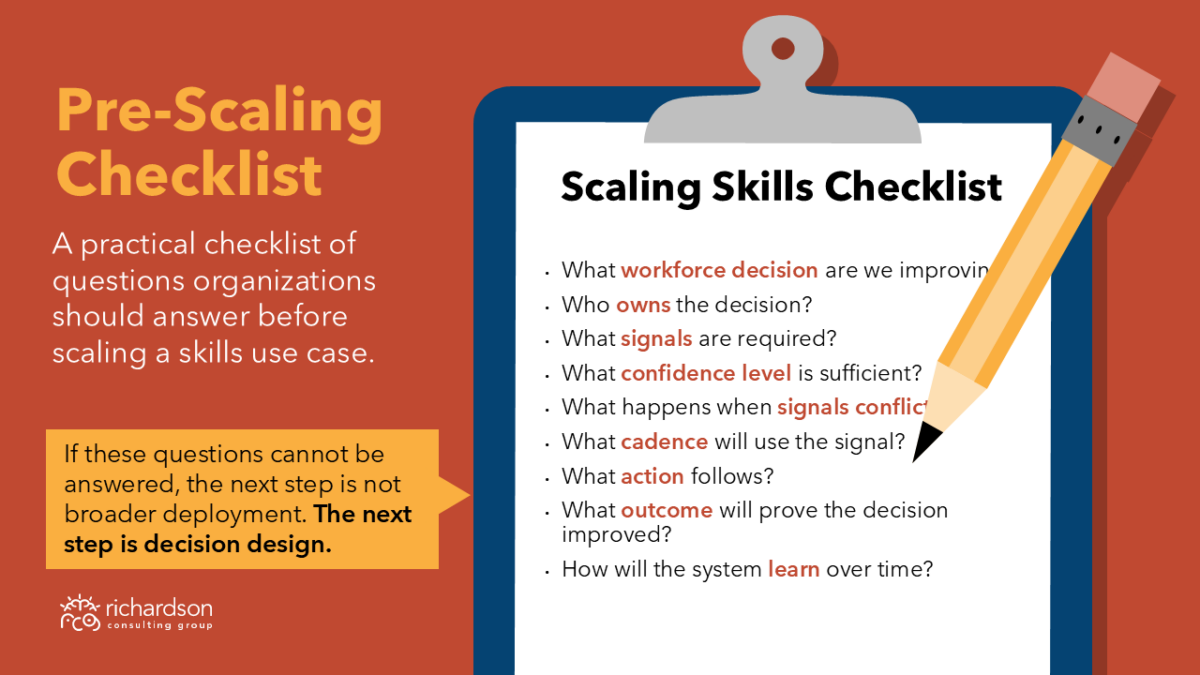
Decision Layer Diagnostic
Organizations can assess the maturity of their Decision Layer by asking a simple set of questions.
- What specific workforce decision are we trying to improve?
- Who owns that decision?
- Who provides input, validation, or governance?
- What skills signals are required?
- What level of confidence is sufficient to act?
- What happens when signals conflict?
- What decision forum or cadence will use the signal?
- What actions should follow the decision?
- What outcomes will indicate the decision improved?
- How will we learn from each cycle?
- What should be standardized across the enterprise?
- What should remain flexible for local business context?
If these questions cannot be answered clearly, the organization is probably not ready to scale the use case.
That does not mean the work should stop.
It means the next step is not more technology configuration or broader deployment.
The next step is decision design.
What Scalable Decision Layers Produce
A strong Decision Layer does more than support one use case.
It creates reusable organizational capability.
Over time, it produces:
- clearer decision rights,
- stronger governance patterns,
- more consistent use of skills signals,
- better confidence thresholds,
- more actionable workforce insights,
- stronger cross-functional alignment,
- faster decision cycles,
- and better feedback loops.
This is how skills transformation moves from fragmented activity to enterprise operating system.
The organization learns:
- which decisions can be supported with directional signals,
- which decisions require validated skills,
- which decisions need human review,
- which decisions should remain advisory,
- and which decisions require higher confidence before action.
That learning becomes reusable.
A build-versus-buy decision pattern can inform workforce planning.
A readiness decision pattern can inform mobility.
A confidence threshold model can inform succession.
A governance model can inform talent acquisition, learning investments, and strategic workforce planning.
This is the compounding value of the Decision Layer.
Each use case strengthens the system.
The Real Work of Skills Transformation
The real work of skills transformation is not simply defining skills.
It is not simply deploying platforms.
It is not simply generating intelligence.
It is redesigning how the organization makes workforce decisions.
That is why skills work is often harder than it appears.
On the surface, it looks like a data, taxonomy, or technology initiative.
Underneath, it is an operating model initiative.
It touches:
- decision rights,
- governance,
- accountability,
- business ownership,
- talent processes,
- technology boundaries,
- employee trust,
- and leadership behavior.
That is also why it matters.
When designed well, skills intelligence can help organizations make better decisions about:
- where to invest,
- where to hire,
- where to reskill,
- where to redeploy,
- where to redesign work,
- and how to help employees grow.
But that value does not come from skills data alone.
It comes from the decision systems built around it.
Closing
The future of skills transformation will not be determined by which organizations have the largest taxonomy, the most complete skills profiles, or the most sophisticated AI inference engine.
Those capabilities matter.
But they are not enough.
The organizations that scale skills most effectively will be the ones that define how skills intelligence changes workforce decisions.
They will know:
- what decisions matter,
- who owns them,
- what signals inform them,
- what confidence is sufficient,
- how uncertainty is governed,
- what actions follow,
- and how the system improves over time.
That is the Decision Layer.
And without it, skills intelligence remains just that:
intelligence.
Interesting.
Potentially useful.
But not yet operational.
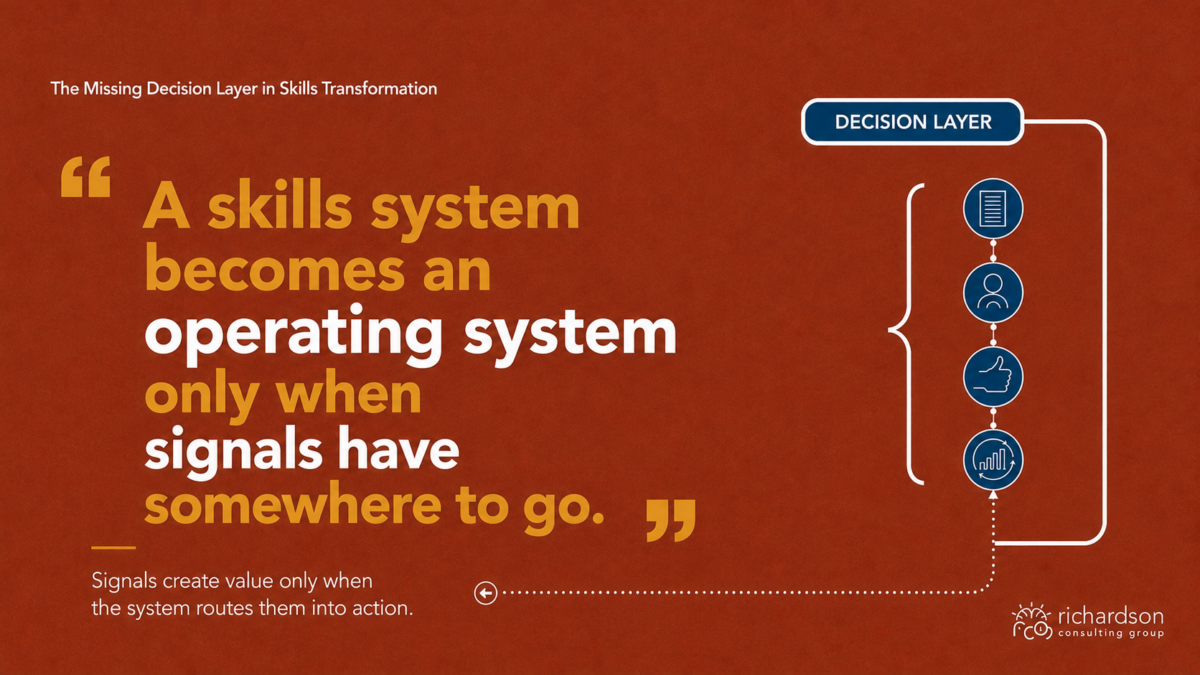
A skills system becomes an operating system only when signals have somewhere to go.
The Decision Layer is where they go.
Looking Ahead
In this article, we explored the Decision Layer: the governance, ownership, confidence thresholds, operating cadence, and action pathways that connect skills intelligence to workforce action.
In the next article, we will bring the pieces together and explore how to design a skills pilot that scales.
That means moving from broad ambition to a focused operating model:
- one use case,
- one segment,
- one workforce decision,
- one operating cadence,
- lightweight governance,
- decision-grade confidence,
- and measurable outcomes.
Because the goal of a pilot is not to prove that skills matter.
The goal is to prove that one workforce decision can reliably operate using skills signals.
That is how skills transformation becomes scalable workforce intelligence.