
How to Design a Skills Pilot That Actually Scales
Why the best pilots start smaller, move faster, and validate workforce decisions before enterprise transformation
Most enterprise skills pilots are too broad.
They try to prove too much, too soon, across too many populations, with too many stakeholders, using data that is not yet trusted enough to drive meaningful decisions.
The ambition is logical.
Organizations want skills to improve:
- workforce planning,
- internal mobility,
- learning personalization,
- succession,
- hiring,
- redeployment,
- AI readiness,
- career growth,
- and strategic capability building.
They want skills to become a common language across the enterprise.
They want technology to connect fragmented talent processes.
They want better visibility into workforce capability.
They want to make smarter decisions about where to build, buy, borrow, redeploy, or redesign work.
Those are the right ambitions.
But they are the wrong starting point.
Because the purpose of a skills pilot is not to prove the full enterprise vision.
The purpose of a skills pilot is to prove that one workforce decision can reliably operate using skills signals.
The distinction matters.
A pilot is not the first version of the whole system.
It is a controlled environment for learning how the system should work.
The best pilots do not try to validate every use case.
They validate the operating pattern.
They answer practical questions:
- Can leaders trust the skills signals enough to act?
- Is the decision clearly defined?
- Is ownership clear?
- Is the confidence threshold appropriate?
- Does governance resolve ambiguity?
- Does the operating cadence work?
- Do actions actually follow?
- Does the organization learn from each decision cycle?
When the answer is yes, the organization has something scalable.
Not a dashboard.
Not a taxonomy.
Not a proof of technology.
A repeatable workforce decision cycle.
That is the foundation for enterprise skills transformation.
From the Field
One pattern I continue to see across enterprise skills initiatives:
Organizations often make pilots too large because they are trying to reduce risk.
They expand the scope.
They include more populations.
They add more use cases.
They involve more stakeholders.
They wait for more complete data.
They debate more technology requirements.
They attempt to anticipate every future scaling need before proving the first operating pattern.
The intention is responsible.
The effect is usually the opposite.
The pilot becomes harder to govern, slower to execute, and less useful as a test of operational capability.
The organization ends up learning less, not more.
A smaller pilot is not a less strategic pilot.
A smaller pilot is often a more disciplined one.
The question is not:
“How do we prove skills can apply everywhere?”
The better question is:
“Where can we prove that skills intelligence improves one important workforce decision?”
That is the shift that separates scalable pilots from pilot theater.
Why Most Pilots Are Overdesigned
Many skills pilots become overengineered because organizations confuse enterprise relevance with enterprise scope.
They assume a pilot must be broad enough to represent the full organization.
So they try to include:
- multiple business units,
- multiple job families,
- multiple skill domains,
- multiple technologies,
- multiple stakeholder groups,
- and multiple talent processes.
This creates complexity before the organization has learned how the operating model should work.
The pilot becomes a miniature transformation program.
But a pilot should not be a compressed version of the full transformation.
It should be a focused experiment that reveals how transformation can scale.
That means constraining the pilot with intent.
A good pilot narrows the environment so the organization can observe the decision cycle.
When the scope is too broad, every issue becomes harder to diagnose.
If adoption is weak, is the issue:
- trust?
- data quality?
- manager behavior?
- technology workflow?
- unclear ownership?
- poor communication?
- weak governance?
- low business relevance?
- insufficient skill confidence?
- lack of action pathways?
When everything is in scope, everything becomes a possible explanation.
A focused pilot reduces noise.
It helps the organization identify what is working, what is not, and what must be redesigned before scaling.
The Real Purpose of a Skills Pilot
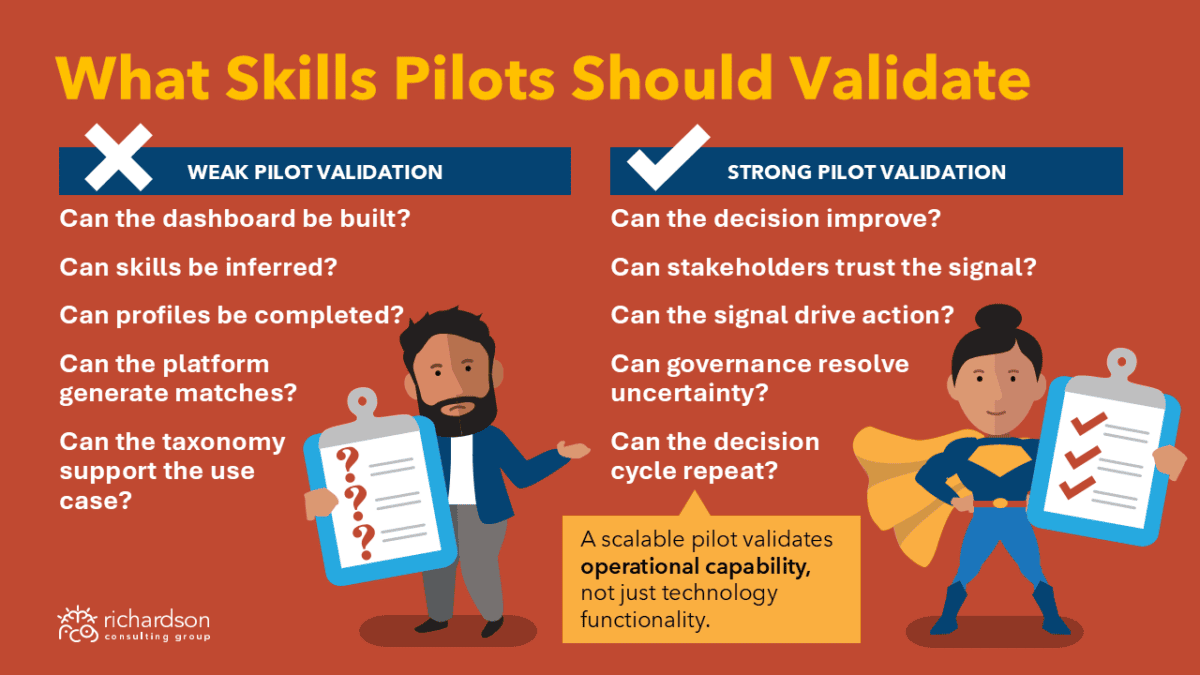
A skills pilot should validate operational capability.
That means it should test whether the organization can use skills intelligence to make a better workforce decision.
Not whether the technology can generate a dashboard.
Not whether employees can complete profiles.
Not whether AI can infer skills.
Not whether the taxonomy looks complete.
Those things may be useful inputs.
But they are not the point.
The real point is decision enablement.
A strong pilot validates whether the organization can:
- define a specific workforce decision,
- identify the required skills signals,
- establish confidence thresholds,
- build stakeholder trust,
- govern uncertainty,
- operate a recurring cadence,
- take action,
- measure outcomes,
- and improve the decision model over time.
That is a much more meaningful test.
It also creates more useful learning.
A technology pilot may tell you whether a tool works.
An operational pilot tells you whether the organization works differently because of the tool.
That is what matters.
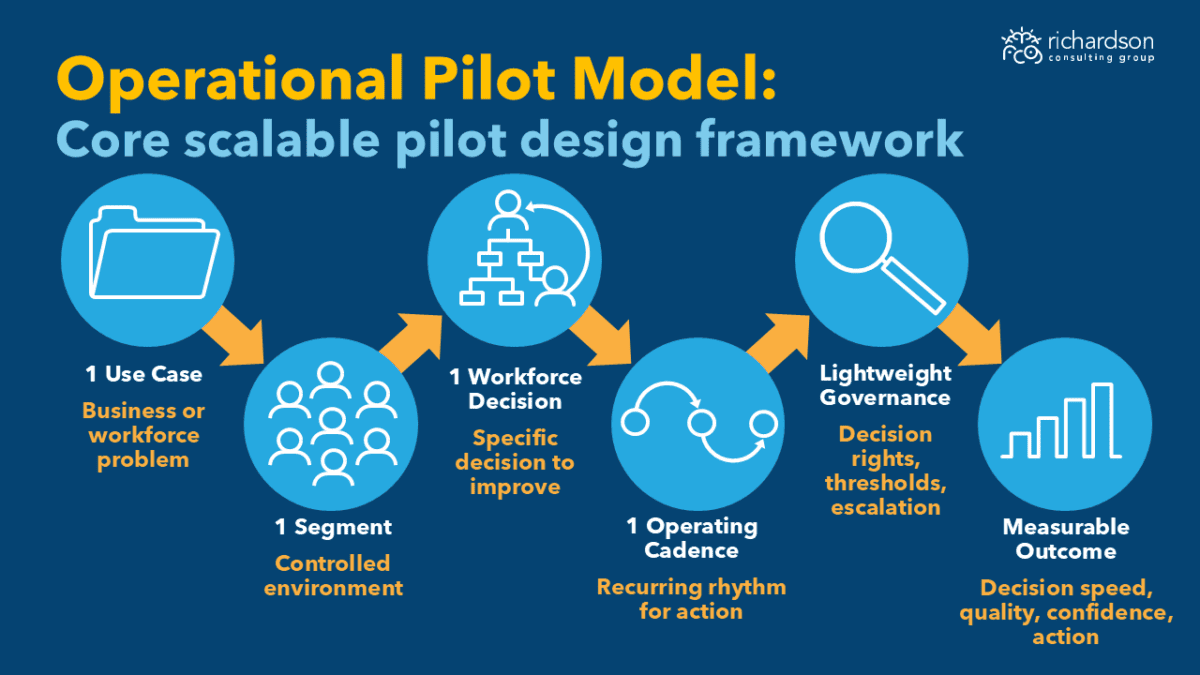
The Operational Pilot Model
A scalable skills pilot typically includes six elements:
1 Use Case
1 Segment
1 Workforce Decision
1 Operating Cadence
Lightweight Governance
Measurable Outcomes
This model is intentionally simple.
The simplicity is the point.
It forces the organization to make the pilot operational rather than conceptual.
It also prevents the pilot from becoming an enterprise transformation effort before the core decision cycle has been proven.
1 Use Case
The first design choice is the use case.
But the use case must be specific enough to matter.
“Skills transformation” is not a use case.
“Improve workforce agility” is not a use case.
“Enable career growth” is not a use case.
Those are strategic aspirations.
A pilot use case should connect directly to a business or workforce problem.
For example:
- expose AI skill gaps to inform build-versus-buy decisions,
- make career readiness visible for internal mobility,
- identify reskilling opportunities for roles in transition,
- improve succession visibility for critical roles,
- prioritize learning investments based on capability gaps,
- support redeployment from declining roles into growth roles.
The use case should have a clear reason to exist.
It should answer:
Why does this decision matter now?
A good pilot use case usually has:
- executive relevance,
- visible business value,
- available signals,
- a constrained population,
- an owner with decision authority,
- and a credible path to action.
If the use case is interesting but nobody owns the decision, it is not a strong pilot candidate.
If the use case is strategically important but the required signals are completely unavailable, it may be premature.
If the use case produces insight but no action pathway, it will likely stall.
The best use cases sit at the intersection of business relevance, decision readiness, and operational feasibility.
1 Segment
The second design choice is the segment.
Many organizations want to start enterprise-wide.
That is usually a mistake.
Enterprise-wide pilots introduce too much variation too early.
Different business units may have different processes, cultures, systems, data quality, leadership behaviors, and talent priorities.
That variation makes the pilot harder to interpret.
A segment creates a controlled operating environment.
The segment might be:
- one business unit,
- one function,
- one job family,
- one region,
- one leadership level,
- one critical workforce population,
- one role family undergoing disruption,
- or one group with urgent AI capability needs.
The segment should be narrow enough to govern, but important enough to matter.
A segment that is too small may not generate meaningful learning.
A segment that is too large may create complexity before the decision cycle is mature.
The right segment allows the organization to test the model with enough realism to learn and enough constraint to adapt quickly.
The question is not:
“Which population represents the entire enterprise?”
The better question is:
“Where can we learn the most about how this decision should work?”
1 Workforce Decision
This is the heart of the pilot.
The pilot must define the specific workforce decision being enabled.
Without a decision, the pilot becomes a reporting exercise.
Examples of weak framing:
- “Understand skills gaps.”
- “Improve mobility.”
- “Support AI readiness.”
- “Personalize learning.”
- “Improve workforce planning.”
Examples of stronger decision framing:
- “Should we reskill internally or hire externally for priority AI capability gaps in this workforce segment?”
- “Is this employee ready now, ready with development, or not yet ready for this adjacent role family?”
- “Which roles should we stop backfilling because work demand is declining or changing?”
- “Which employees should be prioritized for reskilling pathways based on skill adjacency and business need?”
- “Which critical roles have succession risk based on capability gaps and internal supply?”
A decision creates discipline.
It clarifies:
- what data matters,
- which stakeholders matter,
- what confidence is required,
- what governance is needed,
- what cadence should exist,
- and what action should follow.
Without a decision, every signal feels potentially relevant.
With a decision, the organization can separate what is useful from what is noise.
That is why the decision must be explicit.
The pilot is not testing whether skills are useful in general.
It is testing whether skills are useful for this decision.
1 Operating Cadence
A pilot should not be a one-time analysis.
It should operate through a recurring cadence.
This is one of the most important design choices.
A dashboard can be reviewed once.
A report can be consumed once.
A data analysis can be discussed once.
But an operating model requires rhythm.
The cadence might be:
- weekly during an intensive pilot,
- biweekly for mobility or readiness review,
- monthly for workforce planning,
- quarterly for talent review,
- aligned to hiring intake,
- aligned to learning investment planning,
- or aligned to business planning cycles.
The cadence should match the decision.
For example:
A build-versus-buy decision for AI capability gaps may fit into a monthly workforce planning review.
A career readiness decision may fit into a recurring talent mobility review.
A succession decision may fit into quarterly or semiannual talent review cycles.
A learning investment decision may fit into quarterly capability planning.
The cadence matters because it defines when signals become decisions.
Without cadence, skills intelligence remains passively available.
With cadence, it becomes operational.
The organization knows:
- when the signal will be reviewed,
- who will interpret it,
- what decision will be made,
- how uncertainty will be handled,
- and what actions will follow.
That is the beginning of an operating system.
Lightweight Governance
Governance does not need to be heavy.
In fact, heavy governance can kill momentum.
But no governance creates inconsistency, mistrust, and confusion.
A pilot needs just enough governance to make responsible decisions.
Lightweight governance should define:
- decision ownership,
- stakeholder roles,
- confidence thresholds,
- escalation paths,
- exception handling,
- signal review,
- and feedback loops.
It should answer practical questions:
- Who owns the decision?
- Who provides input?
- Who validates the signal?
- Who resolves conflicting evidence?
- Who approves exceptions?
- Who monitors unintended consequences?
- Who adjusts thresholds over time?
The goal is not bureaucracy.
The goal is decision velocity with accountability.
A common mistake is treating governance as something to design after the pilot.
That is backwards.
The pilot is where governance is tested.
The organization should learn:
- what decisions require review,
- where stakeholders disagree,
- which signals create trust,
- where confidence thresholds are too high or too low,
- and what guardrails are necessary for scale.
A scalable pilot does not avoid governance.
It designs governance lightly enough to move and clearly enough to learn.
Measurable Outcomes
The final element is measurable outcomes.
Most skills pilots measure the wrong things.
They measure activity instead of operational impact.
Common pilot metrics include:
- number of profiles completed,
- number of skills tagged,
- number of inferred skills generated,
- dashboard usage,
- number of learning recommendations,
- number of marketplace visits,
- number of role matches.
These metrics may be useful, but they are insufficient.
They do not prove the organization made better workforce decisions.
A stronger pilot measures decision outcomes.
For example:
Decision Velocity
Did the decision happen faster?
Decision Quality
Was the decision better informed?
Decision Confidence
Did stakeholders trust the evidence enough to act?
Decision Consistency
Were similar decisions made in similar ways?
Action Completion
Did decisions lead to actual workforce action?
Governance Effectiveness
Were conflicts, exceptions, and uncertainty resolved?
Learning Velocity
Did the organization improve the model after each cycle?
These metrics reveal whether skills intelligence is becoming operational.
They also help prevent pilot theater.
If the pilot cannot show how decisions changed, it probably did not validate the right thing.
Choosing the Right Pilot
Not every use case is a good starting point.
Some use cases are strategically important but too complex for an initial pilot.
Others are feasible but not important enough to create executive momentum.
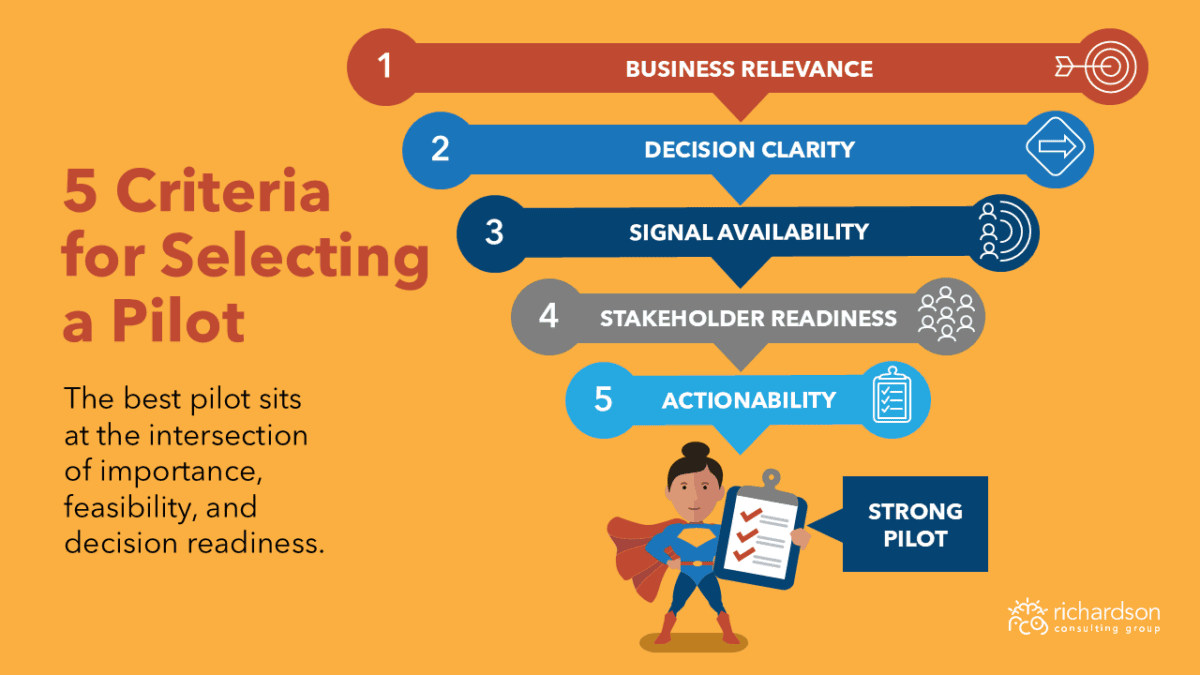
A strong pilot usually meets five criteria.
- Business Relevance
The use case should matter to the business now. - Decision Clarity
The workforce decision should be specific enough to operationalize. - Signal Availability
The organization should have enough data to act responsibly, even if imperfectly. - Stakeholder Readiness
The right people should be willing to participate in the decision cycle. - Actionability
The decision should lead to real action, not just insight.
The best pilots are not necessarily the easiest.
They are the ones where the organization can learn something strategically useful and operationally transferable.
A pilot that is too easy may not teach much.
A pilot that is too complex may never move.
The right pilot creates meaningful learning without requiring enterprise perfection.
Example: AI Skills Build-versus-Buy Pilot
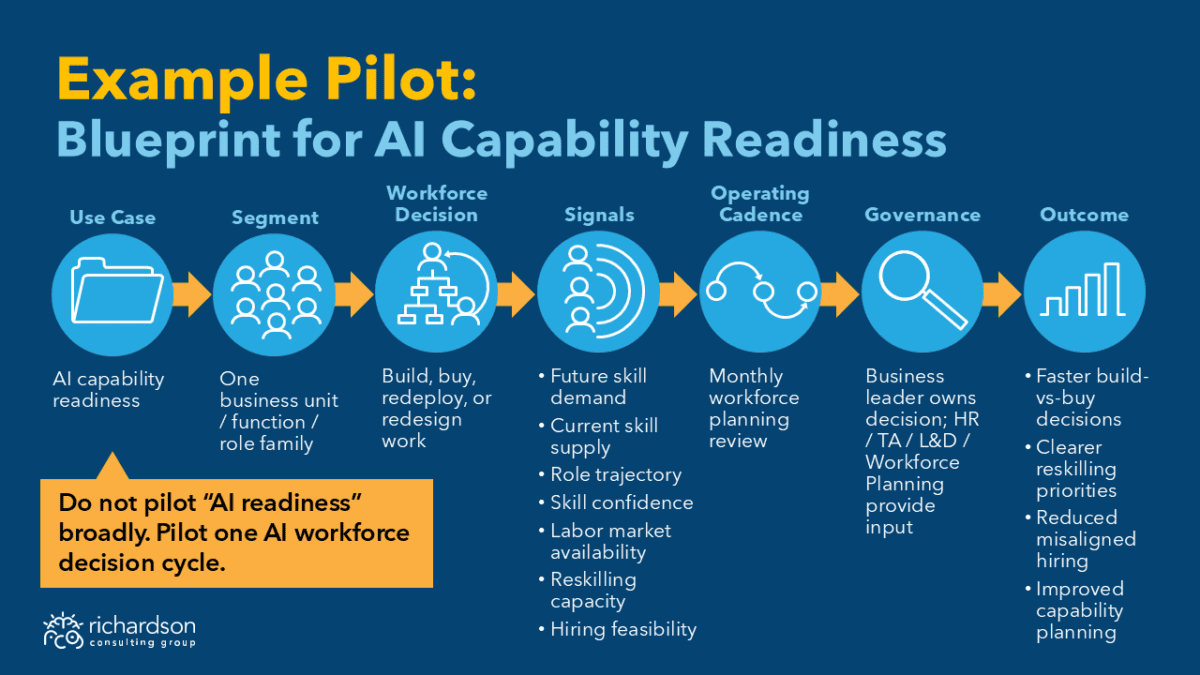
Consider a pilot focused on AI skills.
The broad use case might be:
Expose AI skill gaps to inform workforce planning.
That is useful but still too broad.
A more operational pilot might be:
For one business segment, use AI skills supply and demand signals to determine whether priority capability gaps should be addressed through reskilling, hiring, redeployment, or work redesign.
Now the pilot has shape.
Use Case
AI capability readiness.
Segment
One business unit, function, or role family.
Decision
Build, buy, redeploy, or redesign work for priority AI capability gaps.
Signals
- future skill demand,
- current skill supply,
- role trajectory,
- inferred skills,
- validated learning,
- manager input,
- external labor market data,
- hiring feasibility,
- reskilling capacity,
- business urgency.
Cadence
Monthly workforce planning review.
Governance
Business leader owns the decision. Workforce Planning, Talent Acquisition, Learning, HR Business Partners, and HR Technology provide input and support signal interpretation.
Outcomes
- faster build-versus-buy decisions,
- clearer reskilling priorities,
- reduced hiring for declining or misaligned roles,
- improved workforce visibility,
- better alignment between business strategy and talent action.
This pilot does not attempt to solve enterprise AI readiness all at once.
It proves a decision cycle.
If the decision cycle works, the organization can extend the pattern.
Example: Career Readiness Mobility Pilot
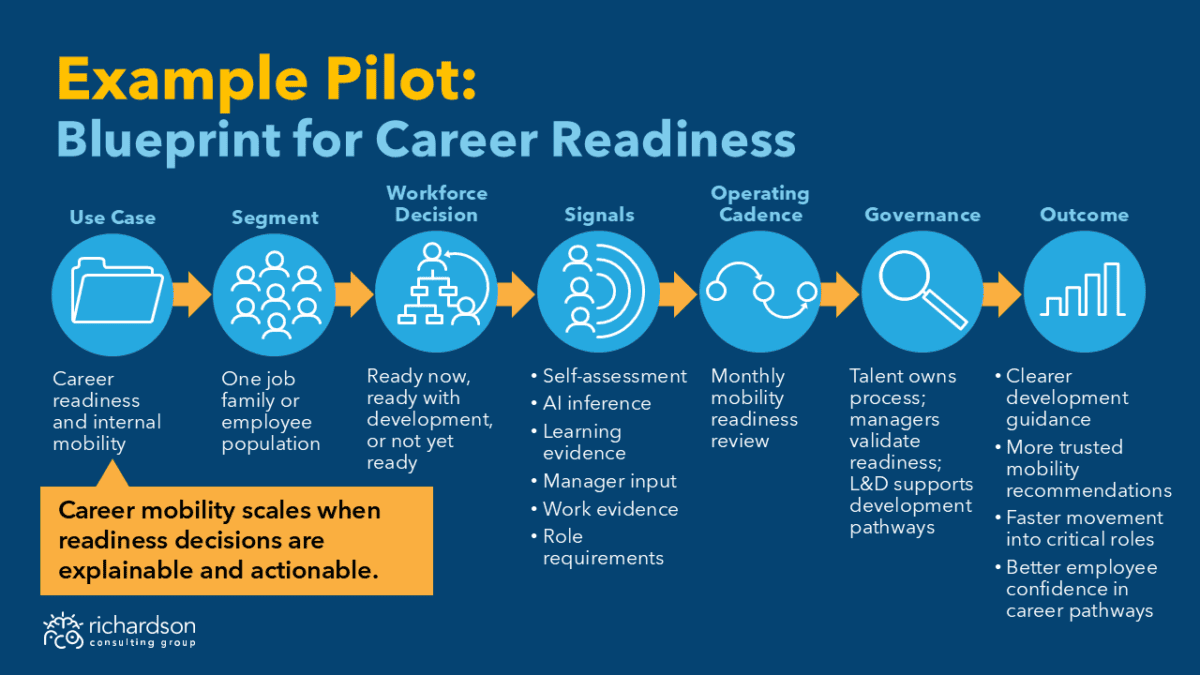
Now consider a mobility-focused pilot.
The broad use case might be:
Improve employee career growth.
That is meaningful but not yet operational.
A stronger pilot might be:
For one critical job family, determine whether employees are ready now, ready with targeted development, or not yet ready for adjacent internal opportunities.
Use Case
Career readiness and internal mobility.
Segment
One job family or employee population.
Decision
Readiness for adjacent roles or opportunities.
Signals
- self-assessed skills,
- inferred skills,
- learning completion,
- experience history,
- manager input,
- work evidence,
- role requirements,
- proficiency expectations.
Cadence
Biweekly or monthly mobility readiness review.
Governance
Talent or HR owns the process. Managers validate readiness. Recruiting or internal mobility teams support opportunity matching. Learning supports targeted development pathways.
Outcomes
- clearer employee development guidance,
- more trusted internal mobility recommendations,
- better manager alignment,
- faster movement into critical roles,
- improved employee confidence in career pathways.
This pilot does not try to launch an enterprise talent marketplace overnight.
It tests whether readiness decisions can operate with enough trust, transparency, and consistency to scale.
That is the right test.
Example: Learning Investment Prioritization Pilot
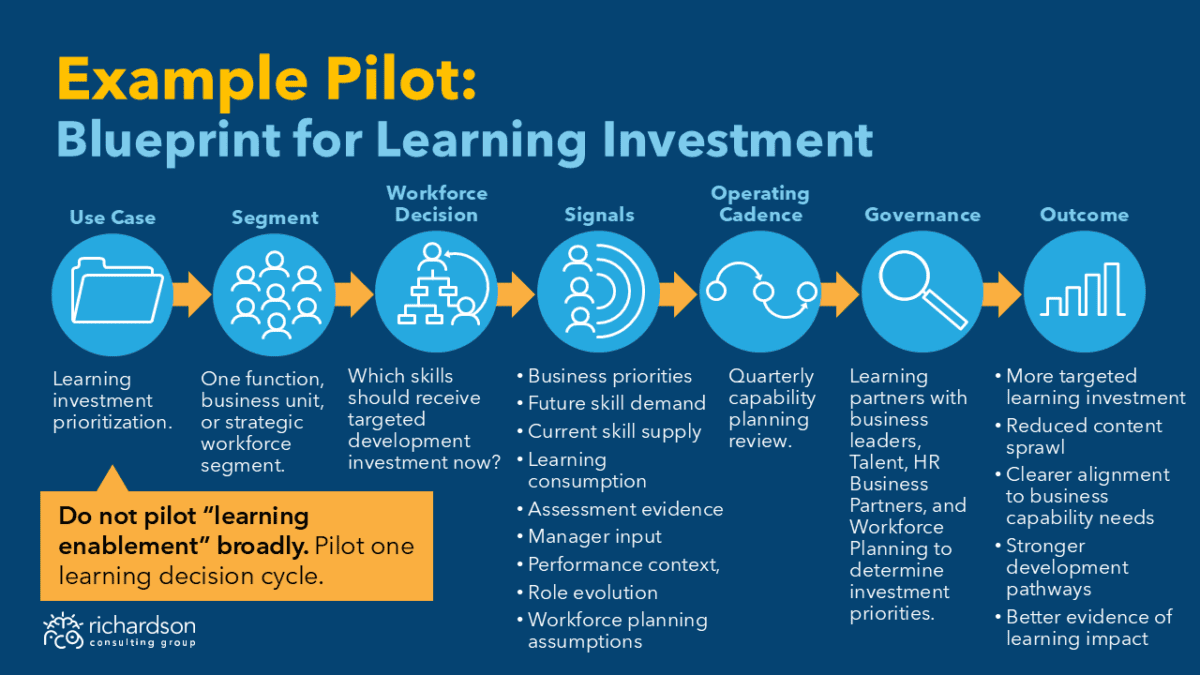
A third example is learning investment.
Many organizations want to personalize learning through skills.
That is useful.
But personalization alone may not prove strategic value.
A stronger pilot might ask:
Which capability gaps should receive prioritized learning investment for this workforce segment based on business strategy, current skill supply, and role trajectory?
Use Case
Learning investment prioritization.
Segment
One function, business unit, or strategic workforce segment.
Decision
Which skills should receive targeted development investment now?
Signals
- business priorities,
- future skill demand,
- current skill supply,
- learning consumption,
- assessment evidence,
- manager input,
- performance context,
- role evolution,
- workforce planning assumptions.
Cadence
Quarterly capability planning review.
Governance
Learning partners with business leaders, Talent, HR Business Partners, and Workforce Planning to determine investment priorities.
Outcomes
- more targeted learning investment,
- reduced content sprawl,
- clearer alignment to business capability needs,
- stronger development pathways,
- better evidence of learning impact.
This is very different from measuring course completions.
It connects learning to workforce decision-making.
That is where skills create strategic value.
What the Pilot Should Produce
A scalable pilot should produce more than a set of results.
It should produce reusable operating assets.
These may include:
Decision Definition
A clear articulation of the workforce decision being enabled.
Signal Model
A defined set of signals used to inform the decision.
Confidence Thresholds
A view of what level of confidence is sufficient for action.
Governance Model
Decision rights, review roles, escalation paths, and exception handling.
Operating Cadence
The recurring rhythm for reviewing signals and making decisions.
Action Pathways
Defined actions that follow from decision outcomes.
Metrics
Measures of decision speed, quality, confidence, consistency, and action.
Lessons Learned
What worked, what failed, what needs adjustment, and what should scale.
These assets matter because they become the blueprint for expansion.
The pilot is not just proving a use case.
It is building organizational capability.
What Not to Scale
One of the most valuable outcomes of a pilot is learning what not to scale.
This is often overlooked.
Organizations tend to view pilots as successful only if the original design works.
But a good pilot should reveal flaws before they become enterprise problems.
For example, the pilot may reveal that:
- a skills signal is not trusted enough for the intended decision,
- managers interpret proficiency inconsistently,
- inferred skills need stronger explanation,
- the governance model is too slow,
- the cadence does not match the decision,
- the action pathway is unclear,
- employees misunderstand what recommendations mean,
- the technology workflow reinforces the wrong behavior,
- or the selected use case is not actionable enough.
That is valuable learning.
The goal is not to avoid problems.
The goal is to surface problems early enough to design around them.
A pilot that reveals the wrong operating assumptions can be more valuable than one that produces a clean but superficial success story.
The purpose of the pilot is learning before scaling.
Scaling the Pattern
If the pilot works, the organization should not simply expand the same activity everywhere.
It should scale the pattern.
That means asking:
What part of this pilot is reusable?
The reusable pattern might include:
- the decision framework,
- the confidence threshold model,
- the governance cadence,
- the signal triangulation approach,
- the stakeholder role clarity,
- the action pathway,
- or the metrics.
Scaling should happen by extending proven operating patterns to adjacent decisions, segments, or use cases.
For example:
An AI build-versus-buy pilot may extend to broader strategic workforce planning.
A career readiness pilot may extend to internal mobility or succession.
A learning investment pilot may extend to enterprise capability planning.
A role transition pilot may extend to redeployment and workforce redesign.
This is how skills transformation scales responsibly.
Not by launching everything everywhere at once.
By proving one decision cycle, then adapting the pattern.
A Practical Pilot Design Checklist
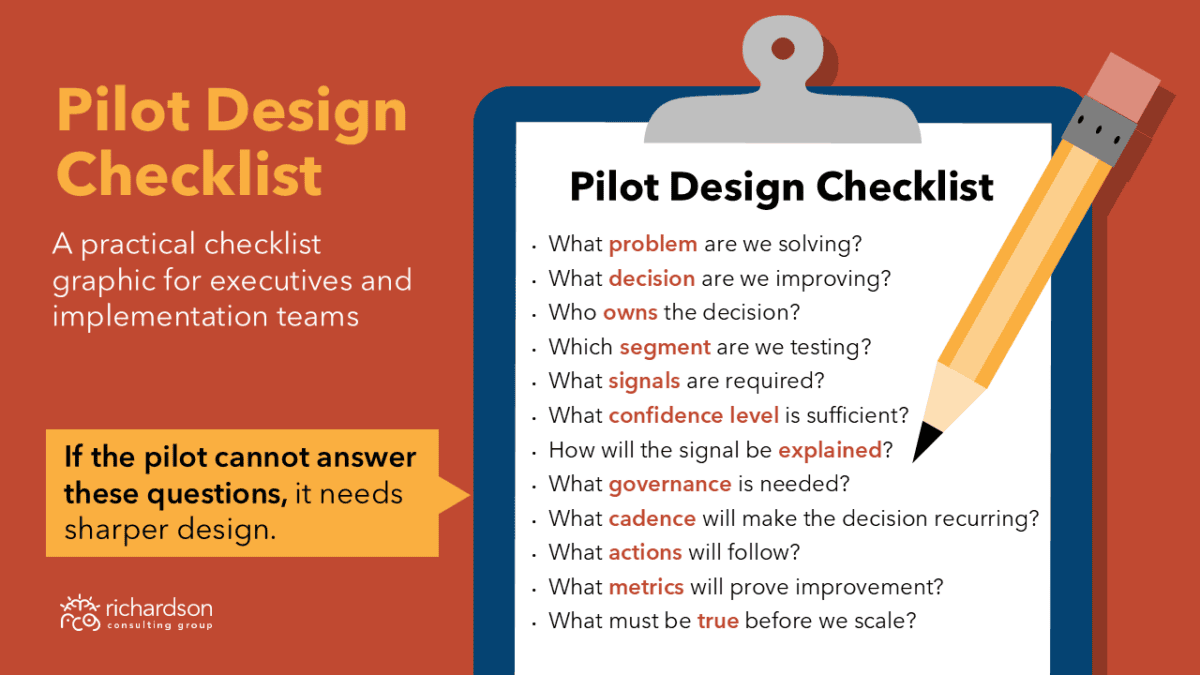
Before launching a skills pilot, leaders should be able to answer the following questions:
- What business or workforce problem are we solving?
- What specific workforce decision are we trying to improve?
- Who owns the decision?
- Which segment will we pilot with?
- What skills signals are required?
- What level of confidence is sufficient to act?
- How will we explain the signal to stakeholders?
- What governance is needed to resolve uncertainty?
- What operating cadence will make the decision recurring?
- What actions will follow from the decision?
- What metrics will show whether the decision improved?
- What feedback loop will improve the model over time?
- What assumptions are we explicitly testing?
- What must be true before this pattern can scale?
If those questions cannot be answered, the pilot is probably not ready.
That does not mean the organization should wait for perfect data.
It means the pilot needs sharper design.
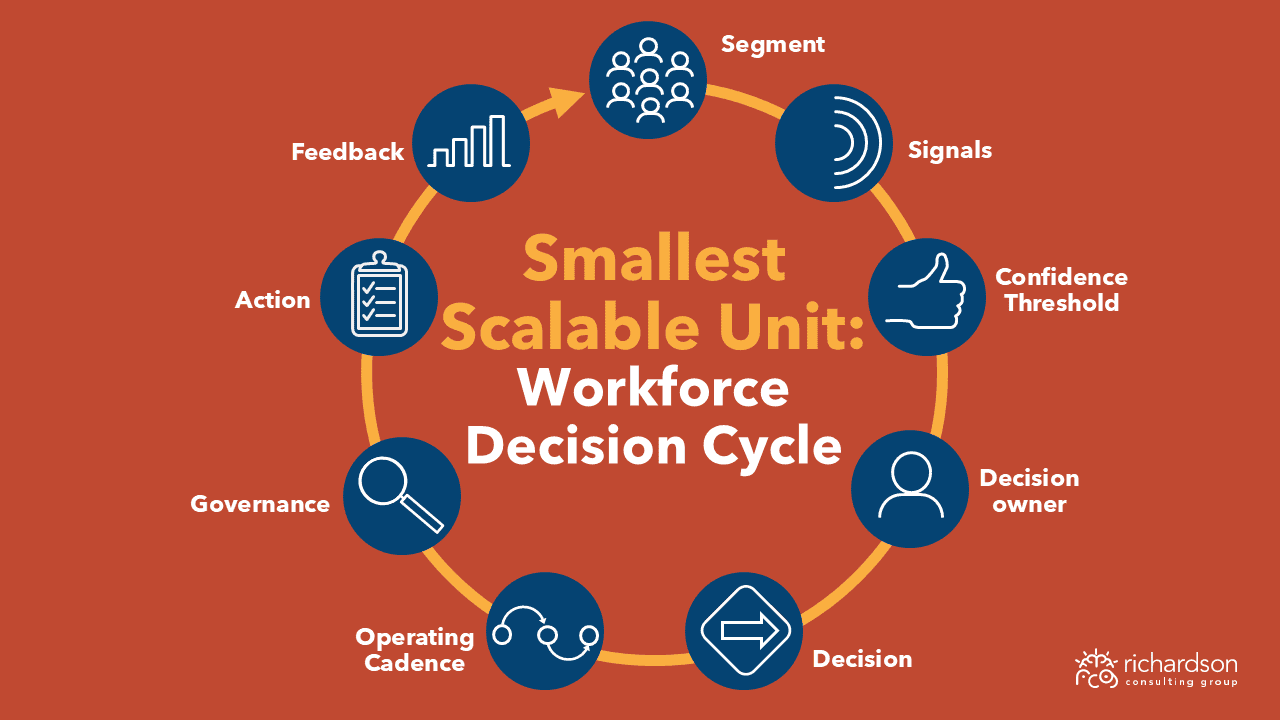
The Smallest Scalable Unit
The best skills pilots are built around the smallest scalable unit.
That unit is not:
- a dashboard,
- a skills profile,
- a taxonomy,
- a platform feature,
- or a learning pathway.
The smallest scalable unit is a workforce decision cycle.
A workforce decision cycle includes:
- a decision,
- a segment,
- a set of signals,
- a confidence threshold,
- a decision owner,
- a governance mechanism,
- a cadence,
- an action pathway,
- and a feedback loop.
If the organization can operate one decision cycle reliably, it has something to scale.
If it cannot, broader deployment will likely create more complexity, not more value.
This is why starting small is not a retreat from strategy.
It is a strategy for scale.
Closing
The future of skills transformation will not be determined by which organization launches the most ambitious pilot.
It will be determined by which organization learns fastest how to operationalize skills intelligence through real workforce decisions.
The most effective pilots are not broad.
They are focused.
They do not try to prove that skills matter everywhere.
They prove that skills can improve one important decision somewhere.
And if that decision cycle works, the organization can scale the pattern.
That is how skills transformation becomes more than a technology implementation.
That is how it becomes workforce intelligence.
And that is how workforce intelligence becomes an operating system.
A successful pilot does not prove that skills matter.
It proves that one workforce decision can reliably operate using skills signals.
That is the smallest scalable unit of enterprise skills transformation.