
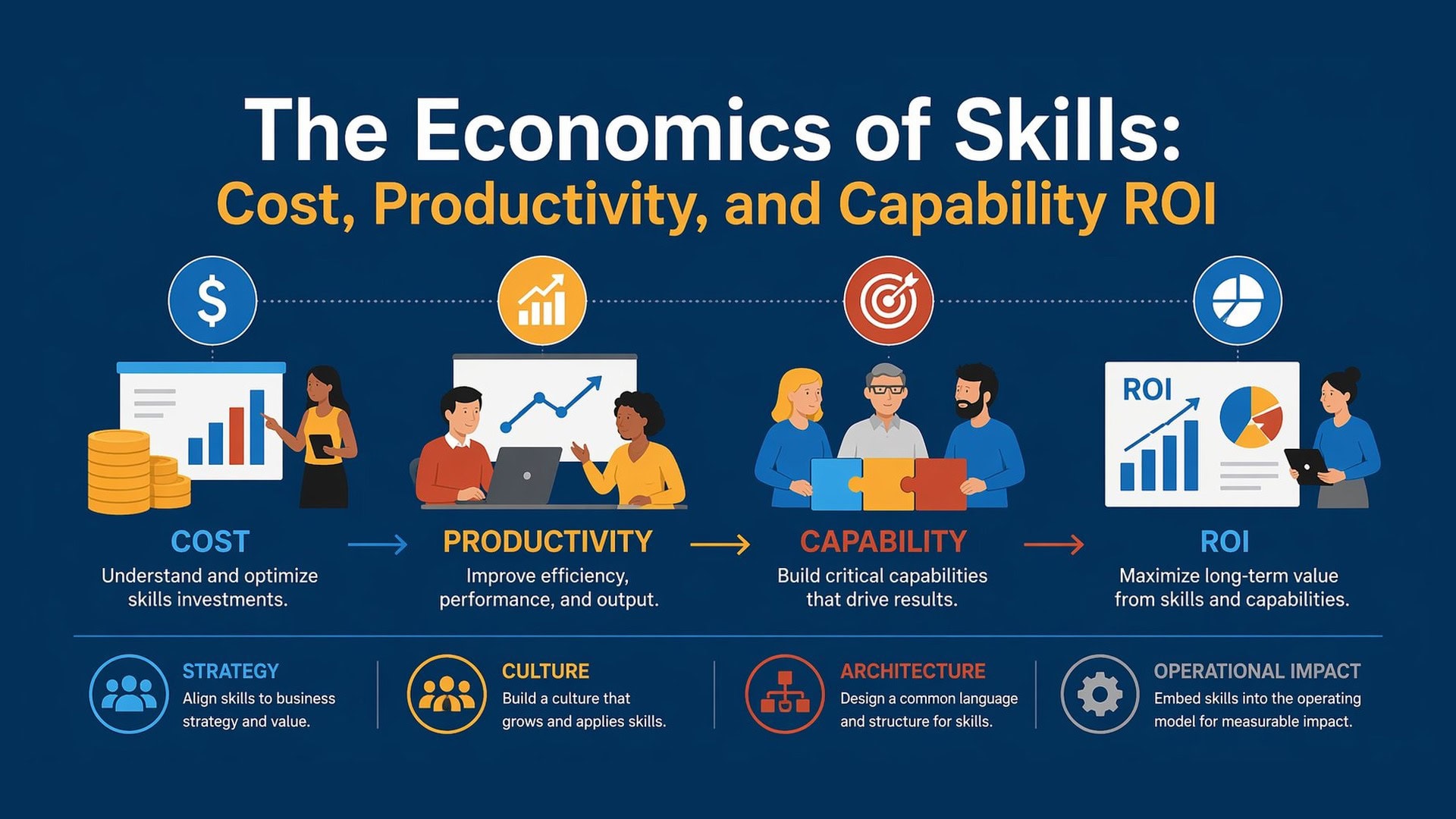
A credible business case for skills explains what the organization will do differently, why that change matters, and what evidence will show that the investment is working.
That was the focus of our September 16 Skills Roundtable, The Economics of Skills, with Priyanku Nandi and leaders working across HR, Talent, Learning, and workforce strategy. We explored how organizations earn support to begin skills work and how they make the case for further investment once the work is underway.
Priyanku shared his experience designing and launching a skills approach at a global toy manufacturer. His case illustrated both the value of better capability information and the work required to make it useful. Learning investment became more focused, adoption remained uneven, and some of the data required closer examination before leaders could rely on it.
The discussion returned to a practical question: which business decision should skills information improve?
The business problem determines the value case
Participants brought different reasons for investing in skills. They described the cost of hiring the wrong people into critical leadership roles, the need for clearer talent matching and development, and the challenge of having people ready when new technology creates an opportunity to move quickly.
Each priority creates a different case for action. Better hiring requires evidence about selection and performance. Faster deployment requires evidence about readiness and the time it takes to get people into the work. More effective development requires evidence that resources are reaching important gaps and helping people close them.
That choice also shapes the infrastructure worth building. A taxonomy, role profiles, and reliable data support the work. The investment case needs to connect them to an outcome the sponsor cares about.
We emphasized that the benefit easiest to monetize may not be the sponsor’s priority. A case for reducing learning expenditure will have limited relevance if the pressing business issue is readiness for a major transformation. The first conversation is about the problem worth solving.
How a learning problem shaped the case study
In the toy manufacturer’s case, internal mobility was already around 44%, which Priyanku described as a strong result. The more urgent concern was employees’ experience of development.
The learning and development survey score stood at 72, below the mid-80s scores employees gave other aspects of the organization on the engagement survey. People struggled to see development opportunities and understand how they could grow. Meanwhile, the organization was spending roughly £15–20 million annually across a fragmented learning ecosystem.
Leadership considered several possible technology responses. The case for skills emerged from the need to understand the capabilities employees had, the capabilities they needed, and where development investment should go.
That starting point gave the initiative a clear purpose for both the organization and its employees. Leaders needed a more coherent basis for learning decisions. Employees needed clearer development and career options.
What the team built
Priyanku described a skills approach supporting 13,780 salaried colleagues, with 774 job profiles mapped to 925 distinct skills. The team developed its own taxonomy and used Workday to support profiles and a common five-point proficiency scale.
The employee proposition connected three activities: understanding current skills, identifying development needs, and exploring career opportunities. Visibility into the requirements of other roles helped people consider horizontal as well as vertical moves.
The build also required substantial human effort. Priyanku described six analysts, a senior manager facilitating business involvement, consulting support, and contributions from HR, rewards, and talent partners. Securing leaders’ time to validate job requirements was part of that work.
The scope mattered. This was a salaried-workforce implementation. Priyanku said extending the approach to the frontline remained work in progress. The scale of the platform therefore should not be read as coverage of the entire workforce.
Where skills information changed investment decisions
The case became more tangible when Priyanku described how the information was influencing learning investment.
The team could identify recurring needs across job families and focus attention on a smaller set of enterprise priorities. Critical thinking, problem solving, accountability, and change agility were among the capabilities he highlighted.
That created a basis for coordinating learning investment across the organization. Priyanku reported that the learning vendor list had fallen from 75 to about 42, while the budget impact was still being realized.
He also described a more specific connection to business demand. An ERP transformation gave the team a concrete set of capability requirements to work toward. Internal talent could then be considered against that demand, with targeted development and deployment decisions following.
These examples show how skills information can inform choices about existing resources. The initial value may come from deciding which learning investments to concentrate, which needs require targeted support, and where internal talent could meet an emerging requirement.
The evidence needs a careful reading
Priyanku was candid about the limits of the evidence. Vendor consolidation was a reported change. He discussed ambitious budget-reduction targets, but the financial impact was still being realized. Those targets should not be presented as achieved savings.
The learning and development survey score had also risen from 72 to 81. That was an encouraging change in employee feedback, although he did not claim that the skills initiative alone caused it.
The distinction matters when making the case for continued investment. Coverage shows what has been built. Participation shows whether people are engaging. Changes in decisions show how the information is being applied. Business outcomes show whether the intended result improved. A financial claim needs a further connection to costs and benefits.
For example, reducing the number of vendors does not by itself establish how much money was saved. Redirecting a budget may improve the value of existing spending without reducing total expenditure. Time released becomes an economic benefit when the organization can use that capacity productively.
A useful extension for any leadership team is to distinguish cash savings, reallocated spending, released capacity, and reduced risk. Each can matter, but each requires different evidence. Baselines, later comparisons, and other changes happening in the business all affect what can reasonably be attributed to skills work.
Three pathways from skills information to business value
The framing for the session outlined three illustrative pathways. These are ways to build a value case, rather than measured outcomes from the toy manufacturer’s case.
Business aim | Decision or action | Evidence to examine | Potential economic value |
|---|---|---|---|
More effective development | Focus learning investment on priority capability gaps | Spend alignment, proficiency, and development experience | Less duplication and better use of existing spend |
Faster access to capability | Identify internal talent and target development | Time to readiness and deployment, plus performance in role | Lower vacancy costs or avoided external spending |
More reliable execution | Address capability gaps in critical work | Quality, rework, cycle time, and delivery | Lower operating costs and more usable capacity |
The business aim determines the measures. A team trying to reduce manufacturing downtime needs evidence connected to operational performance. A team trying to improve development needs to understand whether the right gaps are being addressed and whether proficiency is improving.
Data quality affects the investment case
The implementation produced useful information about the skills approach itself. Priyanku reported adoption ranging from 33% to 72% across job families. An overall participation figure would have concealed that variation.
The team also found differences between how employees interpreted skills and how the business defined them. Some entries reflected interests rather than the development needs the team intended to understand. Apparent gaps therefore needed investigation before they could guide investment.
This is a practical reason to examine how a signal was produced. Interest in a skill, a self-assessment, and demonstrated proficiency answer different questions. A system can contain substantial information while still requiring work to determine which decisions that information can support.
The implication is to match the evidence to the decision. An exploratory development conversation can accommodate uncertainty and help clarify it. A decision to deploy someone into critical work may require additional validation and attention to the context in which that person will perform.
Participants also raised the importance of industry expertise and rapidly changing roles. Transferable skills evidence is useful, but role readiness depends on the requirements of the specific assignment. Keeping that context current is part of the operating cost of a skills approach.
Adoption and workflow are part of the economics
Priyanku repeatedly emphasized the effort needed after launch. Campaigns, communities, clearer examples, system improvements, and ongoing support all contributed to adoption.
The team connected skills updates to existing people processes, including mid-year reviews and development planning. That gave employees a recurring reason to use the information and discuss it with their managers. Integration into other people processes remained ongoing work.
This was also a reminder that benefits and effort can fall on different people. Employees may gain development and career options while doing the work of maintaining profiles. Managers may gain better capability visibility while making time for assessment, development, or releasing people for other opportunities. Leaders weigh the investment against execution risk and competing priorities.
A credible case addresses those requirements. Employees need clarity about how their information will be used. Managers need a workable process and a reason to support it. Leaders need to see how the effort advances a business priority.
Implementation, validation, manager and employee time, data maintenance, and ongoing support belong in the investment discussion. Including them produces a more realistic basis for deciding what to launch, redirect, or expand.
A practical test before the next investment
The discussion suggests a useful way to prepare for a sponsor conversation. Complete this statement:
We are using skills to improve [a specific problem or outcome] by changing [a decision or action]. The next evidence we need is [a measure or comparison].
Then ask:
- Who owns the decision, and what would they do differently with better information?
- What evidence is reliable enough to act on, and what still needs validation?
- What effort and ongoing cost will the change require?
- When will we review the result and decide whether to continue, adjust, or expand?
For a skills pilot, those answers help define what it must demonstrate before it scales. For an established program, they help identify where the next investment could produce value.
The case study showed progress alongside unfinished work. That combination is useful to leaders making real investment decisions. They need to understand what has changed, what remains uncertain, and what the organization will learn next.
Clarify your next skills investment
If your team is deciding whether to launch, redirect, or scale a skills initiative, the Skills Decision Brief™ provides a focused external assessment of your current approach and recommendations on what to prioritize, pause, or avoid for now.
Explore the Skills Decision Brief
To compare experiences with peers, join an upcoming Skills Roundtable. Leaders actively shaping enterprise skills strategy can also request access to our curated Enterprise Skills Advisory Circle.