
How Global Chemical Turned Skills Data Into Strategic Action
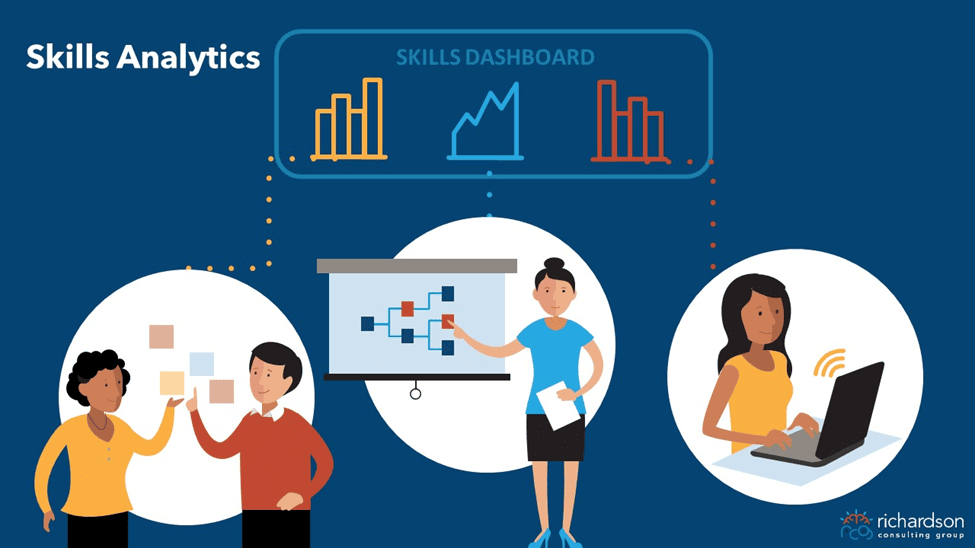
Many organizations now have skill dashboards.
Far fewer are using them to make workforce decisions.
In our February Skills Roundtable, leaders from a global chemical company shared how they moved beyond building a skills framework to applying skills data in talent and workforce strategy decisions.
The conversation surfaced a central insight:
Skills data creates visibility.
Workforce decisions create value.
Here’s what HR, Talent, and L&D leaders can learn from the company’s journey—and what it means if your organization is sitting on skills data that hasn’t yet changed decisions.
Why A Global Chemical Company Invested in Skills Strategy
The Company’s skills initiative began in late 2021 as part of a broader mandate to build a more agile, digitally accelerated workforce.
Skills were positioned as an enabler across the full talent lifecycle:
- Succession planning
- Internal mobility
- Promotion readiness
- Career development
- Workforce planning
- Early career hiring
Crucially, this was not framed as an HR modernization project. It was a workforce capability strategy.
Jason (Skills Program Leader): “Our talent strategy had to support a digitally accelerated future. Skills were how we got there.”
The First Scaling Lesson: Focus on the Vital Few
The Company initially launched seven parallel workstreams—content modernization, governance, skill mapping, and more.
In hindsight:
Jason: “If we did it again, we’d focus on the vital few the business was asking for.”
Like many large enterprises, early ambition outpaced operational focus.
Key takeaway:
Skills initiatives accelerate when anchored to 2–3 business-critical use cases—not broad transformation themes.
For many organizations, those use cases include:
- Strategic workforce planning
- Mobility
- Learning prioritization
- Transformation readiness
Governance Before Dashboards
Before analytics became useful, The Company made several disciplined governance decisions.
1. Guardrails Around Skill Volume
To prevent assessment fatigue and data noise:
- 8–10 skills per role (target)
- 15 maximum per role
- 25 maximum per individual profile
This limited complexity and preserved signal quality.
Jessica (Skills Activation Leader): “Progress over perfection. Otherwise we’d still be mapping skills five years from now.”
2. Human Validation Before AI Extraction
Although AI tools could auto-extract skills from job descriptions, The Company required functional review.
Shirish (Skills Analytics Leader): “We could have gone faster with AI—but we involved leaders to validate. That built trust.”
Jason: “If you present AI-generated skills without human review, credibility erodes quickly.”
Strategic Insight:
Speed matters—but trust matters more. Especially in skills architecture.
Building Trust: Separating Skills From Performance
One of The Company’s most important design decisions:
Skills were positioned strictly as developmental, not evaluative.
- Skills are visible across the organization
- Job profile skills are transparent
- Skills inform interview guides
- Skills are not tied to performance ratings
Jessica: “The minute employees think skills are tied to performance ratings, the model collapses.”
Because skills data drives participation, trust becomes a prerequisite for value.
This is a recurring theme we see across enterprise skills strategy efforts:
If employees perceive skills as an evaluation tool rather than a growth tool, adoption stalls.
What Skills Analytics Are Actually Used For
Once data matured, leaders began asking sharper questions:
- What are the top skills in my function?
- How are we distributed across enterprise competencies?
- Are we building the capabilities our 3–5 year strategy requires?
- Where are we under-indexed?
Rather than static dashboards, analytics became decision prompts.
Shirish: “The concentration of skills versus our five-year strategy created powerful questions.”
Where The Company Has Seen the Most Impact
Development & Mobility Conversations
The most tangible value has shown up in:
- Career hub integration
- Development planning
- Mentoring conversations
- Internal mobility transparency
Shirish: “The most tangible value has been in growth and development.”
Employees better understand:
- What skills their roles require
- What skills adjacent roles require
- Where to focus development effort
Workforce Planning (Still Evolving)
The Company’s long-term aspiration is using skills data to inform:
- Demand vs. supply forecasting
- Transformation readiness
- Succession depth
- Future skill identification
But workforce planning remains complex.
Shirish: “Workforce planning is the aspiration—but orchestrating people like supply chain inventory is complex.”
This mirrors what many roundtable participants acknowledged:
Dashboards are easier than enterprise-level workforce decisions.
Simplicity Wins
The Company structured their model around:
- 6 enterprise competencies
- Job-specific skills nested underneath
They intentionally avoided over-engineered rating frameworks.
Jason: “It has to be simple enough for a site leader in Louisiana or APAC to understand.”
Jessica: “Anything deeper risks confusing the end user.”
For organizations tempted to pursue taxonomy perfection, this serves as a counterpoint:
Operational clarity beats conceptual elegance.
What This Means for Your Skills Strategy
Many organizations now have:
- A skills framework
- A skills inventory
- Dashboards available
But fewer can answer:
- What decisions are we using skills data to improve?
- Are governance and decision rights clear?
- Is our signal strong enough for workforce planning?
- Are we scaling complexity faster than value?
The inflection point isn’t mapping more skills.
It’s moving from visibility to decision capability.
Before expanding further, leaders should ask:
Are we building dashboards — or building the operating discipline to use them?
For organizations navigating that transition, there are two productive next steps.
Apply to Join the Enterprise Skills Advisory Circle
For senior HR, Talent, and L&D leaders actively shaping enterprise skills strategy, we maintain a small, ongoing Advisory Circle connected to the monthly Skills Roundtable.
This is not a marketing list.
It is a curated peer group focused on scaling skills with governance discipline and real business use cases.
Members:
- Receive early access and automatic registration for monthly roundtables
- Participate in discussion-driven, peer-level sessions
- Help shape future topics based on enterprise challenges
- Gain access to select summaries, frameworks, and practical tools
Because discussions are candid and enterprise-focused, we review requests to ensure alignment of role and scope.
If you are:
- Leading or directly influencing enterprise skills strategy
- In HR, Talent, L&D, Workforce Planning, or related functions
- Working at mid-size to large organizations
You can request access here:
👉 [Apply to Join the Advisory Circle]
When to Consider a Skills Decision Brief™
If your organization is at a more immediate inflection point — particularly around:
- Scaling pilots
- Vendor selection or technology configuration
- Workforce planning integration
- Governance clarity
A structured decision reset can prevent costly drift.
Our Skills Decision Brief™ is a fixed-scope diagnostic designed to:
- Benchmark skills culture, architecture, governance, data, and technology
- Assess signal strength and readiness
- Clarify what to prioritize next
- Identify what to pause
- Deliver a 10–12 slide executive-ready brief
- Benchmark skills culture, architecture, governance, data, and technology
- Align leadership in a focused readout
It is not a consulting engagement or a transformation roadmap.
It is executive decision support — before scale locks in cost and constraint.
If this company’s journey surfaced questions about where your organization stands, the Skills Decision Brief is designed to provide clarity before complexity compounds.