
Many organizations have moved past the “should we do skills?” debate. The harder question now is:
How do we scale skills without creating tool sprawl, adoption fatigue, and a framework no one uses?
That’s what we dug into during our January Skills Roundtable with HR, Talent, and L&D leaders. The conversation was intentionally practical—less about polished case studies, more about what actually happens when skills initiatives collide with real operating constraints: regional differences, governance gaps, data trust issues, and managers who are already overloaded.
This article captures the most useful patterns we’re seeing across organizations right now—and the decisions that separate skills pilots that stall from skills strategies that stick.
The Current Reality: Most Orgs Are Still Piloting (and That’s Fine)
In our live poll, most participants described their organizations as either exploring or piloting skills. A smaller group was recalibrating after attempting to scale and discovering friction they didn’t anticipate.
That’s an important signal: skills maturity isn’t linear. The organizations making real progress aren’t the ones with the most elaborate frameworks—they’re the ones that treat early phases as learning cycles, not “phased implementations.”
The goal isn’t to perfect skills architecture first.
The goal is to build a decision system that creates measurable value and can survive real-world complexity.
What Breaks When You Try to Scale Skills
When participants who selected “recalibrating” shared what surprised them, one theme dominated:
1) Cross-Functional Alignment Fails Before Taxonomies Do
The biggest scaling failures weren’t technical. They were operational.
Different regions and functions had different ways of working
Headquarters assumed consistency that didn’t exist
Communication wasn’t tight enough to surface “in-the-weeds” realities early
Cultural norms (especially hierarchy) reduced the flow of detail that implementation depends on
Result: skills strategy became a headquarters initiative rather than a shared operating model.
Authority signal: This is exactly why “governance” is less about committees and more about decision rights, shared standards, and reusable practices.
Why “Skills Powered” Wins Over “Skills Based”
A useful reframing surfaced early in the session:
Skills strategies last when they’re skills-powered, not skills-based
“Skills-based” can imply skills at the exclusion of jobs, behaviors, or established talent practices. That’s not what successful organizations do.
“Skills-powered” is more accurate: skills become a data layer that improves decisions across talent and business priorities.
Jobs don’t go away
Behavioral interviewing still matters
Skills enhance—not replace—existing practices
This framing reduces resistance and makes it easier to secure sponsorship because it positions skills as an enabler of outcomes leaders already care about.
The #1 Driver We’re Seeing: Strategic Workforce Planning
When we asked what triggered organizations’ skills focus, the most common answer was:
Workforce planning / future skills risk
Organizations are using strategic workforce planning (SWP) to answer questions like:
Which roles are truly business-critical?
What skills make those roles resilient over the next 12–36 months?
Where is risk accumulating due to capability gaps—especially with automation and AI?
A practical example shared from Land O’Lakes captured a pattern we see frequently:
Identify business-critical roles (often fewer than expected)
Define what “critical” means in your context
Map the enterprise skills that drive success across those roles
Use those skills as the bridge into mobility, development, and hiring priorities
Why it works: SWP frames skills as risk management + resilience, which is far more fundable than “HR modernization.”
The Two Biggest Bottlenecks: Shared Language and Data Trust
When we asked where organizations feel most stuck, the responses clustered heavily in two areas:
1) Creating a Shared Language for Skills
Leaders repeatedly described the same challenge: the word “skill” means different things to different people.
The conversation gets richer, but also messier:
Skills vs competencies vs knowledge vs abilities (KSA)
“Skill” as a broad capability vs a specific task
Different functions using different levels of granularity
The breakthrough isn’t discussion—it’s decision.
Best practice: define a small set of key terms in plain language, publish them, and treat them as the working standard (not eternal truth).
2) Data Quality & Validation
Nearly every organization eventually hits the validation question:
Start with self-assessment?
Require manager validation?
Use assessments or work artifacts?
Introduce AI inference?
How do we scale credibility without scaling cost?
The pragmatic path many organizations follow:
Begin with self-assessment to get data flowing
Add higher rigor only for high-stakes, business-critical skills
Use inference to enrich other data, based on trusted, transparent signals
Communicate clearly what skills data will and will not be used for
Authority signal: skills data doesn’t need to be perfect to be useful—but it does need to be trusted enough to drive decisions.
What Strong Skills Strategies Do Differently
Across the discussion, several high-leverage practices surfaced—things that reduce complexity while increasing adoption.
Early-stage practices that prevent rework later
Tie a pilot to one clear business problem
Use plain language; avoid “skills jargon” until needed
Secure visible sponsorship early
Start with a manageable skill list (not “the enterprise universe”)
Scaling practices that prevent fragmentation
Establish “Goldilocks governance”: enabling, not bureaucratic
Limit pilots to a few use cases (e.g., SWP, TA, mobility, learning)
Define a single source of truth for skills data
Capture learnings (what confused people, what they resisted), not just outputs
Operating practices that prevent adoption fatigue
Shift from “framework thinking” to an operating model
Embed skills into workflows (IDPs, talent reviews, mobility processes, team routines)
Enable managers—because they control time and priorities
Prune unused skills, practices, and processes as maturity increases
A Common Culture Failure Mode: Skills Become a Promotion Checklist
One of the most practical culture issues raised: when skills matrices show up, employees can interpret them as a checklist:
“If I check the boxes, where’s my promotion?”
That dynamic creates tension and misunderstanding unless you’re explicit about:
The purpose of the skills data
How it does/doesn’t affect performance and promotion
What employees gain (development clarity, mobility visibility, learning personalization)
Some organizations do incorporate skills into promotions—but when they do, they use higher-trust validation methods (e.g., peer review of work portfolios) and very clear governance.
What Must Be True in the Next 6 Months
In our final poll, the top needs to move skills strategy forward were:
Executive alignment and sponsorship
A clear operating model and governance
Stronger manager enablement
This is the pattern we see repeatedly: without those three, skills work stays in pilots—useful locally, hard to scale.
Notable Quotes from the Discussion
Letticia (Heritage Associates): “We underestimated how much cross-functional alignment and ways of working would matter once we tried to scale.”
Letticia (Heritage Associates): “Hierarchy made it harder to get the details we needed—until we went live.”
Jessica (Land O’Lakes): “A skill can mean different things to different people. We need shared definitions—and decisions.”
Amanda (ESL Federal Credit Union): “Transformation and automation are forcing us to understand what skills we have—and what we’ll need.”
Brian (Richardson Consulting Group): “Managers are the make-or-break point—they control time and priorities.”
Ready to Scale Skills Without Scaling Complexity?
If you’re somewhere between exploring, piloting, and early scaling, you’re likely facing one of these tensions:
Too many pilots, not enough reuse
Too much debate, not enough decisions
Skills data exists, but leaders don’t trust it
Tools are being evaluated before operating model clarity
Managers aren’t enabled to make skills “real” in daily work
That’s exactly what our Skills Readiness Snapshot is designed to resolve.
Skills Readiness Snapshot (Complimentary)
In a focused 45-minute working session, we:
Benchmark your current state across 6 critical capabilities:
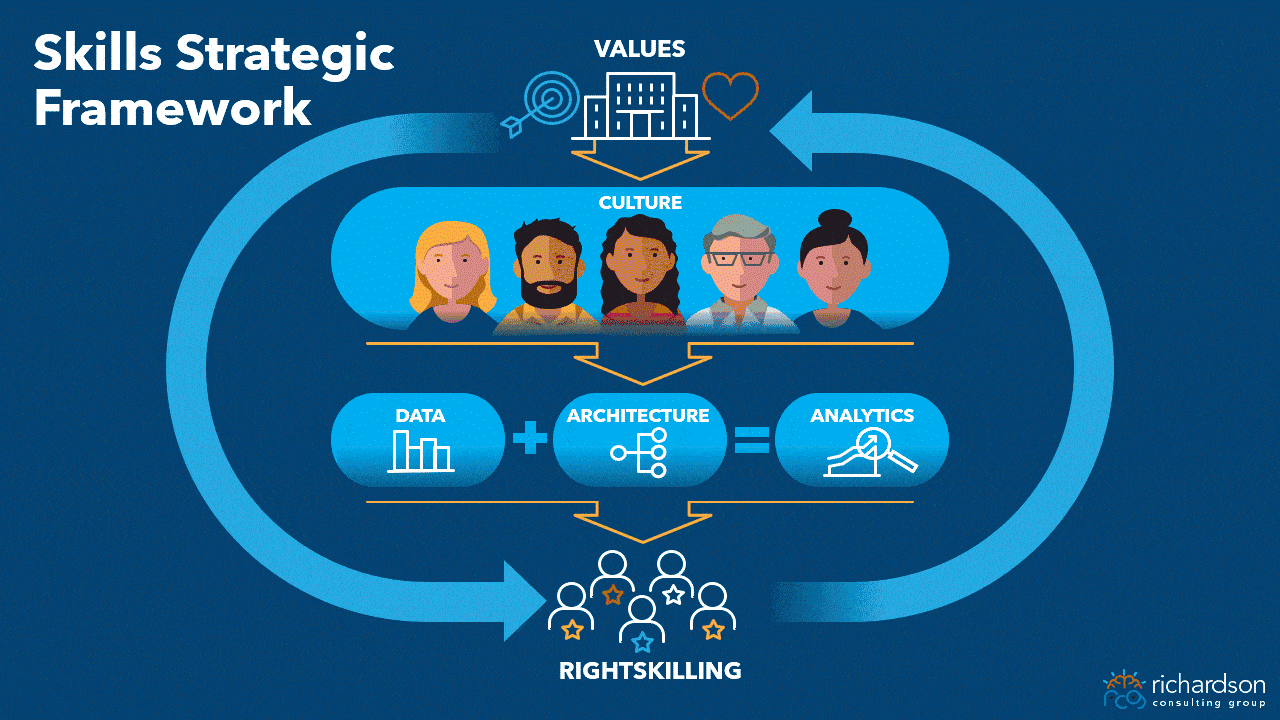
Culture
Skills Architecture
Skills Data
Governance
Partnerships
Technology
Identify immediate next steps to progress each capability
Provide a leader-ready briefing to secure executive buy-in
It’s the same starting point we use with Fortune 500 clients before larger strategy engagements—and it’s complimentary for members of our skills roundtable community.