
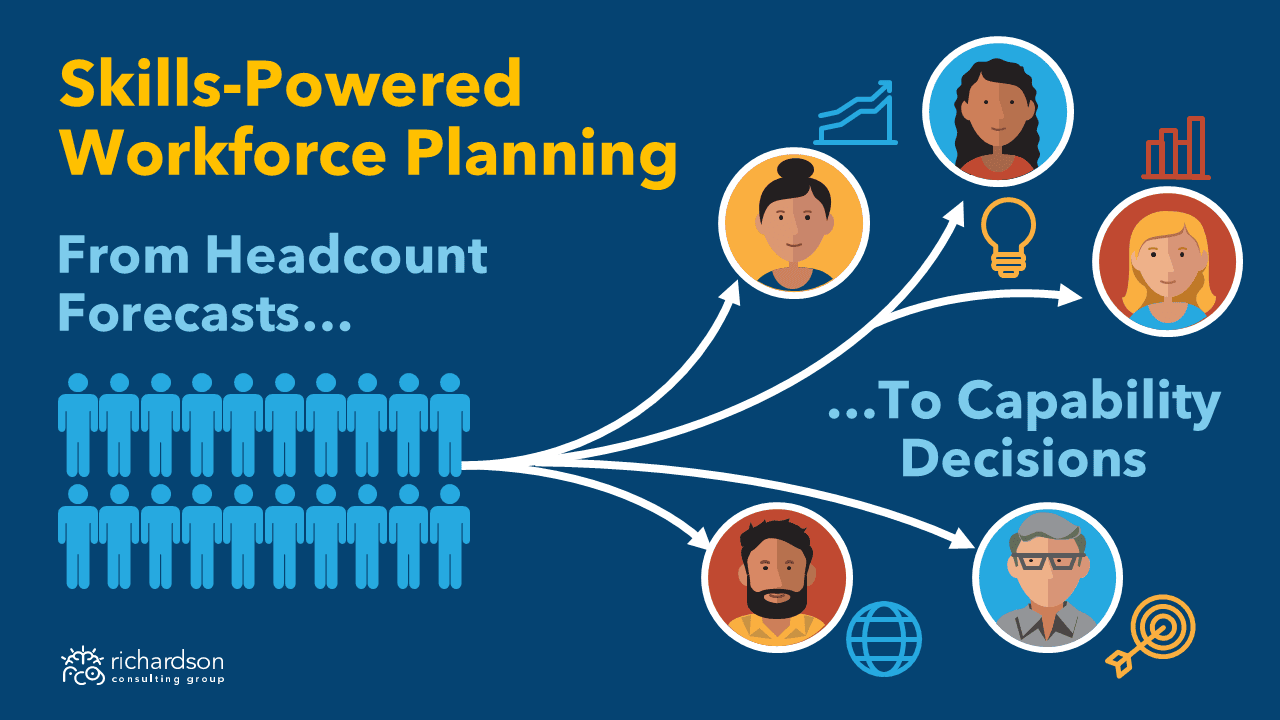
A business growth strategy can depend on expertise that takes years to develop and is difficult to hire. By the time a critical role becomes vacant, the business may have few good options. Strategic workforce planning helps leaders recognize those dependencies early and decide where to develop talent, recruit, or redesign the work. Getting started may require less data than you think: focused conversations with business leaders can reveal where capability gaps threaten the strategy and which actions deserve attention now.
Land O’Lakes began with those leader conversations. At our October 21 Skills Roundtable, Skills-Powered Workforce Planning, Theresa Weimerskirch, Sr. Consultant – Talent & Performance Management, described how interviews with 66 leaders helped the company identify critical roles and enterprise growth skills. She traced what happened next: leaders developed action plans, the team discovered where those plans stalled, and that experience shaped a simpler approach to follow-through.
Two roles illustrated the decisions behind that work. At a Wisconsin cheese plant, certified cheese graders are learning under a Master Cheese Maker to build expertise that takes more than a decade to develop. Elsewhere in the business, leaders are weighing hiring and development options for an Equine Technical Sales Director who must combine scientific expertise with commercial and leadership skills. Both roles support the business strategy, but each requires a different plan to secure the capability the company needs to succeed.
Skills add capability questions to workforce planning
Headcount, roles, cost, and location remain essential planning inputs. Skills bring additional questions into that conversation: What must people be able to do? Who can do it today? Who could develop the capability, and how long would that take?
A skills inventory provides part of the evidence. Readiness also depends on proficiency, relevant experience, availability, and the conditions in which someone will perform. An employee with adjacent skills may be a promising development candidate, but leaders still need to assess the path to readiness and whether it fits the business timeline.
In the opening discussion, we used a hypothetical technical-role example to explore the choice between internal development and external recruitment. The decision required more than a skills match. Employee interest, access to development, manager support, external talent supply, and the time available all affected which response was feasible.
That framing carried into the case study: determine the workforce decision, identify sufficient evidence, name who can commit resources, and establish how progress will be reviewed.
Start with business strategy and a practical question
Land O’Lakes operates across dairy foods, animal nutrition, and crop inputs. Theresa described a workforce of approximately 9,000 employees spanning manufacturing, supply chain, research, sales, technology, and corporate functions. Those businesses face different talent markets and capability requirements.
In 2023, the organization established a common approach to strategic workforce planning. Interviews with 66 senior executives helped answer two questions:
- Which roles were critical to executing the strategy, and
- Which skills would support enterprise growth?
The critical-role assessment focused on the business’s needs over the next three to five years. Two considerations guided the analysis:
- How much the role mattered to achieving business objectives, and
- How difficult it would be to fill.
Skills were already embedded in those questions. Leaders considered specialization, the amount of upskilling or retraining required, and the availability of relevant expertise internally and externally.
The interviews gave the team enough information to identify priorities and begin action planning. Theresa was equally clear about the limits: the organization could not yet systematically identify which employees had the required skills or were ready to move into each role. More detailed capability visibility remained part of the work ahead.
Enterprise growth skills serve a different purpose
The leader interviews also informed shared enterprise development priorities. The five growth skills highlighted in the session were:
- Business Acumen
- Change Mindset
- Generative AI
- Innovative Thinking, and
- Influencing without Authority.
The Learning and Organizational Effectiveness team has connected the growth skills to learning content, learning paths, internal communication campaigns, and individual development planning. That gives employees a common language and accessible opportunities to develop capabilities the business values.
These enterprise priorities complement the specific requirements of critical roles. Business Acumen may matter broadly, while a particular role also requires specialized technical knowledge, experience, or credentials. Evidence that a person is ready for that role is a further question. Keeping these distinctions clear helps leaders use each type of information appropriately.
Two critical roles lead to different workforce responses
Theresa’s examples showed why the action plan has to reflect the work and the available talent supply.
Master Cheese Maker
The Master Cheese Maker at the company’s Kiel, Wisconsin plant oversees cheddar production and grading, helps meet customer quality standards, and works with the production team to improve performance. The expertise also supports product differentiation through the Master’s Mark.
Theresa described a development path of approximately 13–14 years of specific experience and training, together with rigorous certification requirements. That makes this a difficult capability to acquire quickly when a vacancy appears.
The company already has certified cheese graders learning under the Master Cheese Maker and gaining experience across cheesemaking. Developing an internal pipeline is one response to the long lead time and limited external talent pool.
The discussion also drew attention to the roles feeding that pipeline. A role can be important to succession even when it is not itself designated a critical role. Workforce planning needs to account for the development experiences that make a future successor possible.
Equine Technical Sales Director
The Equine Technical Sales Director leads technical experts who work with sales to grow premium horse feed sales. Theresa connected the role to the business’s growth priorities and its effort to reduce dependence on commodity-driven earnings.
The requirements combine advanced equine expertise and a PhD with commercial sales acumen, leadership, and industry relationships. The difficulty lies in finding that combination in the same candidate.
This role had recently been identified as critical, and action planning was underway. Options being considered included external hiring and internal development, potentially with tuition support for advanced degrees.
The distinction between the examples matters. The cheese-maker pipeline was an activity already in place. The equine-role sourcing and development options were still being evaluated. Neither example was presented as a completed demonstration of reduced vacancy risk or financial return.
Simpler action plans need clear ownership
One of Theresa’s most useful lessons concerned follow-through. In the initial approach, some action plans were overbuilt or were not implemented. Identifying the risk had not consistently led to the action needed to address it.
The current refresh is intended to simplify planning for one or two practical actions per critical role. The team is clarifying ownership and strengthening partnership with HR business advisors to support implementation and updates.
Business leaders have also been involved through a group of SWP Champions established during the earlier rollout. Their role included supporting workforce planning within their areas and overseeing action planning.
For other organizations, this raises an immediate design question: who can actually commit the hiring budget, development resources, and employee time the plan requires? The person coordinating workforce planning may not control any of those resources. The plan needs explicit commitments from the people who do.
Theresa also emphasized connecting the work to existing talent reviews and succession planning. That gives leaders a familiar place to consider critical roles, development, and follow-up together.
Assess the future role and include the right perspectives
Questions from the group brought out two further challenges. First, leaders can struggle to separate a role’s importance from the performance of the person currently in it. Theresa said this distinction still requires reinforcement each cycle.
Second, the perspective of one leader may be insufficient when work crosses organizational boundaries. As matrix working has grown, the refresh has sometimes brought business and functional leaders together to assess interdependencies and risk.
The assessment also looks forward. Leaders consider how upskilling needs and headcount requirements may change over three to five years, including possible effects of AI. A profile based only on today’s incumbent and today’s work can miss the capabilities the strategy will require next.
The next stage is still being built
Land O’Lakes is refreshing critical roles across the organization while moving toward updates triggered by changes in strategy, organization, risk, or external markets. The intent is to make planning more responsive than an enterprise refresh every two or three years.
Scenario-planning work is planned for 2027, with a practical framework to be tested in selected areas. Theresa emphasized evaluating it by its usefulness to leaders.
Deeper skills-informed action is a longer-term direction. Work on job architecture and attaching skills to job profiles is intended to support clearer development paths, career mobility, and visibility into capability gaps. Those connections are developing; they are not yet a fully integrated operating model.
Choose one workforce decision to improve
We closed with our 4S approach: Start Somewhere Simple Soon. Applied to workforce planning, that means choosing an important decision and making the next step manageable.
- Identify a role or capability that matters to a business objective.
- State the decision and the time horizon, such as how much capability to develop internally and how much to recruit.
- Determine which evidence is sufficient to act and which assumptions need further validation.
- Name the person who can commit resources, the person responsible for follow-through, and a review date.
At that review, examine whether the action is happening and whether readiness or risk is changing. A completed plan is a useful starting point; the business needs the capability the plan is intended to secure.
Continue the conversation
Our monthly Skills Roundtables bring together HR, Talent, L&D, workforce planning, and business leaders to compare experiences and work through practical questions about enterprise skills strategy.
View upcoming Skills Roundtables
Leaders actively shaping enterprise skills strategy can also request access to the Enterprise Skills Advisory Circle, our curated peer community.