
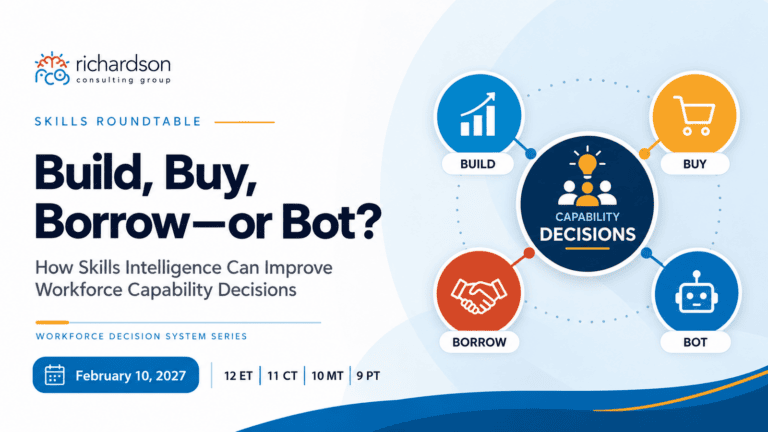
Organizations invest significant resources in understanding their workforce skills, identifying capability gaps, and anticipating future talent needs.
But once a critical gap is identified, what happens next?
Should the organization hire new talent? Develop existing employees? Redeploy people with adjacent skills? Engage external expertise? Or redesign and automate the work using AI?
As AI reshapes jobs and tasks, talent markets evolve, and organizations face pressure to improve productivity, these decisions are becoming increasingly consequential.
Yet many organizations still approach hiring, development, workforce planning, and automation as separate activities—often without a consistent framework for evaluating alternatives.
In our January Skills Roundtable, we explored the shift from collecting skills data to using skills intelligence to improve workforce decisions.
This February, we’ll take that conversation one step further by examining one of the most important decisions organizations face:
The Build, Buy, Borrow, or Bot framework offers a way to evaluate alternatives. But choosing among those options requires more than a framework.
It requires understanding business priorities, current workforce capabilities, skills adjacency, future demand, time constraints, costs, risks, and the potential for AI and automation.
During this interactive roundtable, we’ll discuss:
We’ll introduce a simple workforce capability decision model to frame the discussion, then explore how organizations are making these decisions today, where they encounter challenges, and what approaches are emerging.
We’ll also work through a practical capability-gap scenario to consider the tradeoffs between building, buying, borrowing, and automating talent and work.
The goal isn’t to find a universal answer. It’s to better understand the information, processes, and judgment needed to make better workforce decisions.
This session is designed for HR, Talent Management, Learning & Development, Strategic Workforce Planning, HR Technology, Workforce Analytics, and other business leaders who are actively working to connect skills strategy with workforce and business performance.
As always, the Skills Roundtable is a discussion-driven forum for sharing experiences, challenges, lessons learned, and emerging practices with peers from across organizations and industries.
If your organization is investing in skills intelligence but still working to translate those insights into smarter workforce decisions, this conversation is for you.
Hosted by Richardson Consulting Group as part of the Skills Roundtable series—convening leaders who are shaping the future of enterprise skills strategy and practice.