
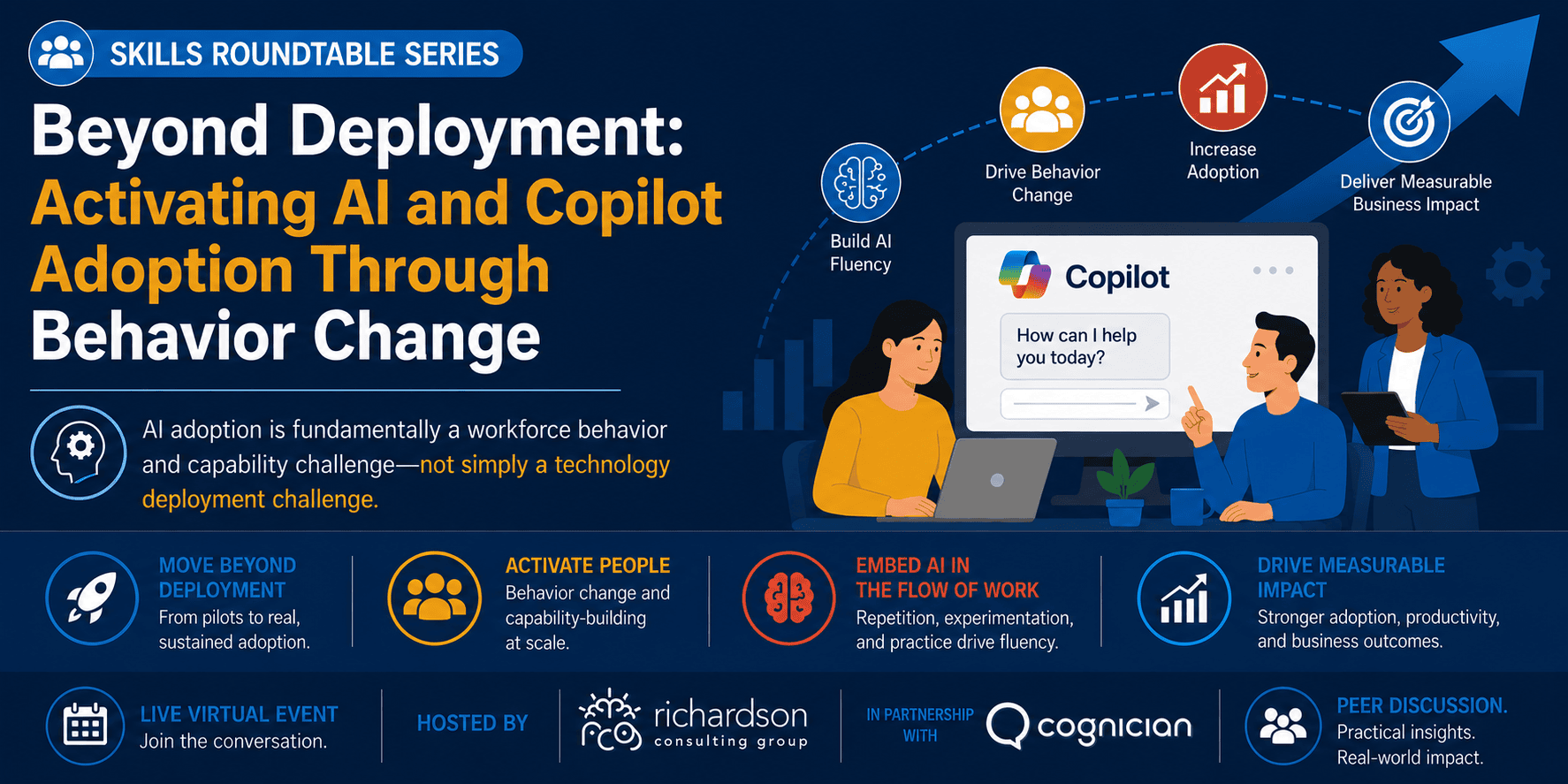
Organizations are moving quickly to deploy AI.
They are buying licenses.
Launching Copilot and other generative AI platforms.
Running training.
Building prompt libraries.
Communicating acceptable-use policies.
And encouraging employees to experiment.
But many are discovering a harder truth:
Deploying AI is much easier than getting people to become confident and consistent using it in their everyday work.
That challenge shaped our recent Skills Roundtable with Barry Kayton of Cognician and leaders from HR, Talent, Learning, technology, and workforce transformation.
The discussion began with an important reframing:
“AI adoption is a workforce architecture and operating model challenge. It’s not a technology challenge.”
— Brian Richardson
The implication is significant.
Between technology deployment and business value sits a series of decisions about work, behavior, ownership, capability, measurement, and reinforcement.
Organizations do not need perfect answers to all of them.
But when those questions remain unresolved, AI adoption tends to become fragmented, episodic, and difficult to scale.
The Seven Enterprise Decisions Behind AI Adoption
We framed the first half of the discussion around seven decisions that increasingly determine whether AI moves from organizational rollout to meaningful workforce adoption:
- Which workflows matter first?
- What defines meaningful adoption?
- Who owns workforce activation?
- What behaviors should managers reinforce?
- How should experimentation happen?
- What capabilities matter most?
- How will adoption become sustainable?
Together, they point toward a broader conclusion:
AI adoption is not simply an enterprise change program. It is a workforce enablement system.
1. Start With the Work, Not the Tool
A common AI rollout starts with a broad goal:
Get everyone familiar with Copilot.
Teach people prompting.
Encourage experimentation.
These steps create awareness.
But awareness does not create value.
The discussion highlighted a more practical starting point: identify high-frequency workflows where AI can reduce friction, save time, or improve outcomes.
Examples included:
- Research
- Meeting preparation
- Meeting summarization
- Knowledge retrieval
- Drafting emails
- Creating documents
- Revising content
These workflows matter because they happen frequently.
Frequency creates opportunities for repetition.
And repetition creates opportunities for employees to experience value firsthand.
The enterprise question is therefore not:
Where can employees use AI?
It is:
Where should we concentrate adoption first?
That distinction moves organizations away from generic AI awareness and toward intentional workflow integration.
2. Stop Confusing Deployment Metrics With Adoption Metrics
AI platforms generate plenty of numbers.
Organizations can measure:
- Licenses assigned
- Logins
- Training completion
- Awareness-session attendance
- Platform access
Those numbers can be useful.
But they mostly tell us whether AI has been deployed and whether employees have been exposed to it.
They do not tell us whether work is changing.
When roundtable participants were asked what would provide stronger evidence of adoption, their answers moved further downstream:
- Repeated usage
- Workflow integration
- Productivity
- Business impact
- Daily and weekly active usage
- Peer-to-peer examples of meaningful application
That creates an important distinction:
Deployment measures access. Adoption measures behavior.
The closer organizations can get to understanding whether AI is becoming integrated into real work, the more useful their measurement strategy becomes.
3. Shared Ownership Needs Clear Decision Rights
When we asked who owns AI workforce adoption, there was no single answer.
Participants described combinations of:
- IT
- HR
- L&D
- AI teams
- Business leaders
- C-suite sponsors
- Managers
- Functional AI ambassadors
That fragmentation is understandable.
IT may own the platform and technical governance.
HR and Learning may own capability-building.
Business leaders own the work.
Managers influence daily behavior.
But shared participation does not automatically create shared accountability.
Brad S. described one practical model: an AI team combining external expertise, internal technology capability, and a network of functional AI ambassadors.
Those ambassadors then work inside functions to identify and activate business-relevant use cases—from procurement and negotiation to data analysis and preparation for important conversations.
The lesson is not that every organization needs the same structure.
It is that organizations need to explicitly answer:
Who owns which decisions?
Technology ownership and workforce adoption ownership are related.
They are not the same thing.
4. Managers Make AI Use Legitimate
Enterprise communication can make employees aware that AI is available.
Managers determine whether using it feels normal.
When participants were asked what observable manager behavior would increase AI use, several themes emerged:
- Share examples of how they personally use AI
- Demonstrate that experimentation is encouraged
- Share prompts, outputs, and lessons learned
- Highlight successful use cases
- Coach employees on how AI fits into their work
Managers do not need to become AI experts.
Their role is different.
They can:
Prompt employees to experiment.
Model effective use.
Coach employees through application and judgment.
Celebrate useful outcomes so good practices become visible.
That matters because daily work takes place much closer to the manager than to the enterprise communication function.
Managers influence priorities, time, psychological safety, and what the team perceives as legitimate work.
As Brian noted during the discussion, managers do not need to become experts in AI. They need to become effective at the behaviors that encourage their teams to use it.
5. “Go Experiment” Is Not an Adoption Strategy
Organizations often encourage employees to explore AI independently.
That sounds empowering.
But completely unstructured experimentation produces predictable results.
Early adopters experiment extensively.
Others wait.
Useful discoveries stay local.
Lessons are not captured.
And different teams repeatedly solve the same problems.
Participants described a better balance as a form of freedom within a framework.
The goal is not heavy governance.
It is enough structure to create repeatable learning loops.
That might mean:
- Starting with a real work challenge
- Trying AI against that challenge
- Reflecting on the result
- Sharing what worked
- Capturing useful prompts or approaches
- Applying the lesson again
Some governance can remain decentralized.
But organizations benefit when there is a mechanism for successful experimentation to spread beyond the individual or team that discovered it.
6. AI Capability Is More Than Prompting
Much of the early AI learning market has focused on prompting.
Prompting matters.
But it is only part of effective AI-enabled performance.
The session highlighted four capabilities in particular:
Prompting
Knowing how to communicate effectively with AI systems.
Judgment
Evaluating whether an AI-generated answer is accurate, useful, appropriate, and trustworthy.
Workflow Integration
Understanding where AI should enter a process, where humans should remain responsible, and how handoffs should work.
Human + AI Collaboration
Knowing what to delegate, what to retain, what to verify, and how to combine machine capability with human expertise.
These requirements vary by role and workflow.
That is why the better enterprise question is not:
What AI training should everyone take?
It is:
What capabilities enable people to perform specific work differently and better?
That moves the conversation from tool training toward workforce capability-building.
From Training to Activation
The second half of the session shifted from enterprise design to the behavior-change mechanisms that actually produce adoption.
Barry Kayton introduced Cognician’s activation approach around eight catalysts:
- Meaning
- Guidance
- Contribution
- Action
- Commitment
- Collaboration
- Reflection
- Support
The premise is that people are more likely to change behavior when they are doing meaningful work—not passively consuming information.
Barry summarized the distinction this way:
“Action is the next catalyst—far more than information. Simple actions drive change.”
And:
“The best predictor of future action is past action.”
In other words, if the goal is for employees to use Copilot regularly, the intervention needs to create repeated opportunities for employees to actually use Copilot across different contexts.
Why Contribution Matters
One of the most interesting parts of the activation model is contribution.
Traditional training often presents the trainer’s examples.
Participants watch someone else demonstrate what AI can do.
Activation asks employees to bring:
- Their own project
- Their own document
- Their own challenge
- Their own client
- Their own workflow
- Their own question
That changes the learning experience.
The AI interaction becomes personally relevant.
As Barry explained:
“Getting people to contribute their own ideas in practice, in real time, is where the magic happens.”
This is a critical distinction between understanding AI conceptually and experiencing its value directly.
What Structured Activation Looks Like
Barry demonstrated activation journeys for several platforms, including:
- Microsoft Copilot
- Gemini
- ChatGPT
- Claude
The programs range from introductory experiences to more advanced agent-focused and function-specific journeys.
A typical journey might run for 10–16 days.
Employees receive small, specific challenges.
They apply AI to real work.
They receive the amount of guidance they need.
They share insights with peers.
They reflect on the experience.
And they make commitments about where they will use the approach again.
Some programs incorporate:
- Badges
- Leaderboards
- Certificates
- Daily Teams or email prompts
- Virtual coaches
- Peer insight sharing
- Personalized prompt guidance
The exact tactics can vary based on organizational culture.
The architecture is more important than any single feature:
Repeated meaningful action + feedback + social reinforcement + reflection.
The Difference Shows Up in Usage
Barry shared results from a Copilot activation program involving more than 4,000 employees at an oil and gas organization.
Microsoft usage data from the period after the 16-day activation journey showed dramatic increases in activities such as:
- Summarizing meetings
- Summarizing Teams conversations
- Summarizing email
- Drafting email
- Drafting documents
- Revising documents
Microsoft’s estimated time-savings calculation showed an approximately 475% increase in estimated time saved following the activation program.
Barry noted that training had already taken place before the intervention and usage had remained relatively stable.
The significant increase occurred after structured activation.
A separate controlled study conducted with Microsoft showed approximately a 200% sustained increase in AI-agent usage after the intervention.
Those results reinforce an important point:
Training can create knowledge. Activation is designed to create behavior.
Sustainability Comes From Experiencing Value
Perhaps the most important question came near the end of the session:
What happens when the activation program ends?
Does usage fall back?
Barry said Cognician has not observed that usage fades.
The explanation was straightforward.
Once employees personally experience meaningful value, they have a reason to continue.
In one program with more than 4,000 participants, Cognician collected more than a million words of feedback. Approximately 80% was positive.
Barry described repeated comments from employees who discovered that a single interaction could save 20 or 25 minutes of work.
That is different from being told AI will make you more productive.
The employee has experienced the productivity improvement firsthand.
Barry captured the distinction particularly well:
“The biggest problem with training is that you’re watching somebody else do something. You’re not doing it for yourself.”
Sustainable adoption is more likely when employees repeatedly experience useful outcomes in their own work.
The Bigger Lesson: AI Adoption Is a Skills Conversation
For regular Skills Roundtable participants, this session may have looked different from discussions about taxonomies, skills data, governance, validation, culture, or workforce planning.
But the underlying questions were remarkably similar.
AI adoption requires organizations to determine:
- Which capabilities matter?
- What work should change?
- Who owns the decisions?
- What behaviors need reinforcement?
- What evidence should leaders trust?
- How will people practice?
- How will new ways of working become integrated into existing processes?
- How will the organization sustain capability over time?
Those are not simply technology questions.
They are skills, workforce, governance, culture, and operating-model questions.
AI just makes the need to answer them more urgent.
Final Takeaway
Enterprise AI adoption will not be determined by which organization distributes the most licenses or delivers the most training.
The organizations that move further are likely to be the ones that intentionally connect:
Technology → Workflows → Behavior → Capability → Business Value
That means targeting meaningful work.
Measuring actual adoption.
Clarifying ownership.
Activating managers.
Structuring experimentation.
Building role-relevant capabilities.
And creating enough repeated, meaningful interaction for new behaviors to become part of how work gets done.
Because ultimately:
Deployment gives people AI access.
Activation turns access into workforce capability.
Explore the AI Workforce Activation Resources
We’ve brought together the recording and supporting resources from the session, including:
- The 7 Enterprise Decisions That Determine AI Adoption Success
- The Laws of AI Adoption
- The Microsoft Agent Activation Case Study
- Information on Microsoft 365 Copilot adoption programs
- The full session recording
Continue the Conversation
Turn AI deployment into workforce adoption.
If your organization is navigating Copilot adoption, AI workforce readiness, manager enablement, measurement, governance, or activation strategy, Richardson Consulting Group can help you pressure-test your approach and identify the decisions that matter most.