
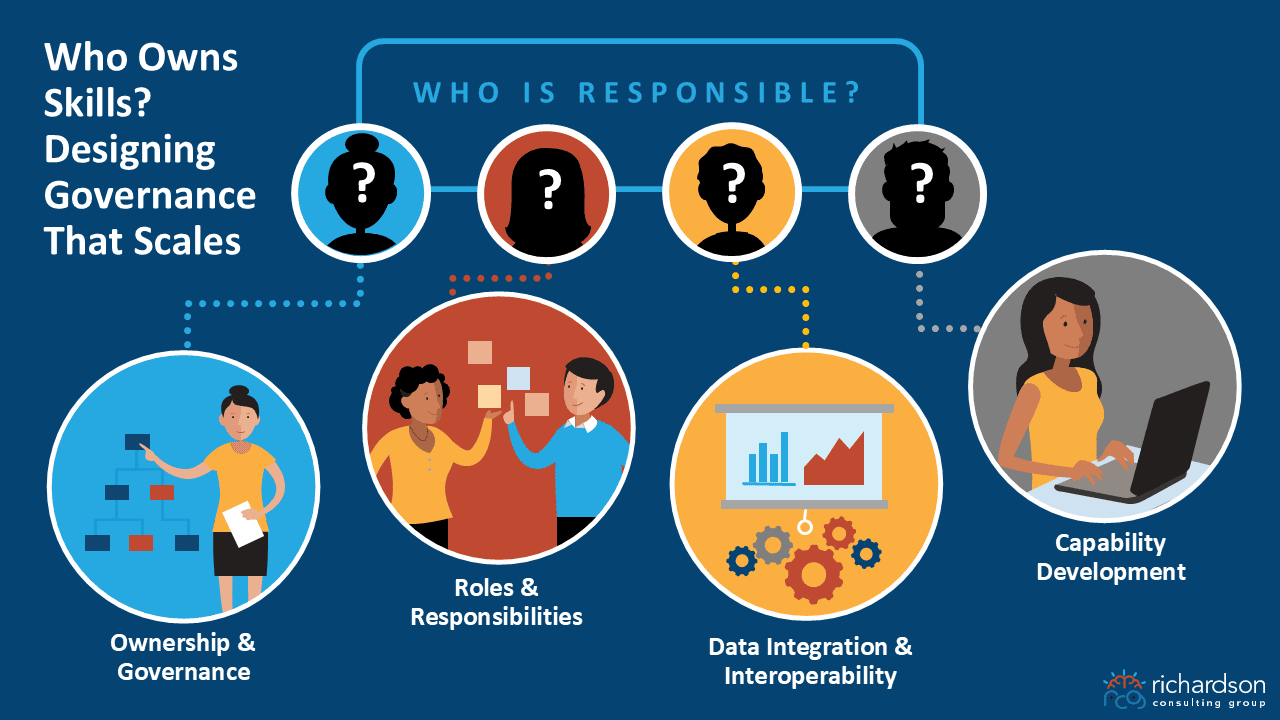
Who Owns Skills? Designing Governance That Actually Scales
As skills-based initiatives expand across hiring, learning, mobility, and workforce planning, one question becomes unavoidable:
Who owns skills?
In a recent Skills Roundtable with HR, Talent, and L&D leaders, the answer was clear:
Ownership is rarely defined—and that’s exactly why skills strategies stall.
Why “ownership” is the wrong starting point
Most organizations approach skills ownership as a structural question:
- Should HR own it?
- Should the business own it?
- Should it sit in Talent or L&D?
But this framing creates more confusion than clarity.
The more effective question is:
How are decisions about skills actually made?
The real issue: unclear decision rights
Across organizations, we consistently see:
- Multiple definitions of “skills” across functions
- Inconsistent validation methods
- Competing sources of truth
- Disconnected use cases
The result:
Skills mean different things depending on where you sit.
This leads to low trust in data—and limited adoption.
A scalable model for skills governance
Organizations making progress are converging on a shared model:
- Enterprise ownership (HR / COE)
- Defines standards, taxonomy, and architecture
- Maintains consistency across the organization
- Business ownership
- Determines which skills matter most
- Applies skills to real workforce decisions
- Execution layer (HR tech / IT)
- Manages systems and data flows
- Enables integration across platforms
This model creates:
- Consistency (enterprise standards)
- Relevance (business ownership)
- Scalability (aligned systems)
Common barriers to scaling
Even with a model in place, organizations face recurring challenges:
Fragmented ownership
Shared “ownership” without clarity leads to stalled decisions.
Late-stage governance
Governance is often introduced after technology and pilots are already in motion.
Conflicting definitions
Different functions define and use skills differently.
Low data trust
Unclear validation methods reduce confidence in skills data.
What leading organizations are doing differently
Participants shared several practical approaches:
Establish cross-functional governance
Skills councils with HR, Talent, HR Tech, and business leaders
Define decision rights early
Clarify who owns:
- Definition
- Validation
- Updates
- Usage
Create a single source of truth
Align systems and data flows to reduce fragmentation
Balance standardization and flexibility
Adopt a “freedom within a framework” model
The inflection point
Most organizations are not blocked by:
- Skills frameworks
- Technology platforms
- Data availability
They are blocked by:
Governance clarity and decision alignment
Where to focus next
If your organization is scaling skills, prioritize:
- Clear ownership of decisions—not just roles
- Defined governance before expanding use cases
- Alignment across HR, Talent, and the business
- Trust in skills data through validation
From insight to action: Skills Decision Brief™
If you’re navigating questions like:
- Who should own skills across the enterprise?
- How should decision rights be structured?
- How do we align governance with our technology stack?
This is exactly where we support clients.
The Skills Decision Brief™ provides:
- A structured assessment across six critical capabilities
- Clear ownership and governance recommendations
- Prioritized next steps
- An executive-ready briefing to align leadership
This is the same starting point we use with enterprise clients before larger skills investments.
[Apply to Join the Advisory Circle]
Continue the conversation
You can also join the discussion and see how others are approaching this topic here: